
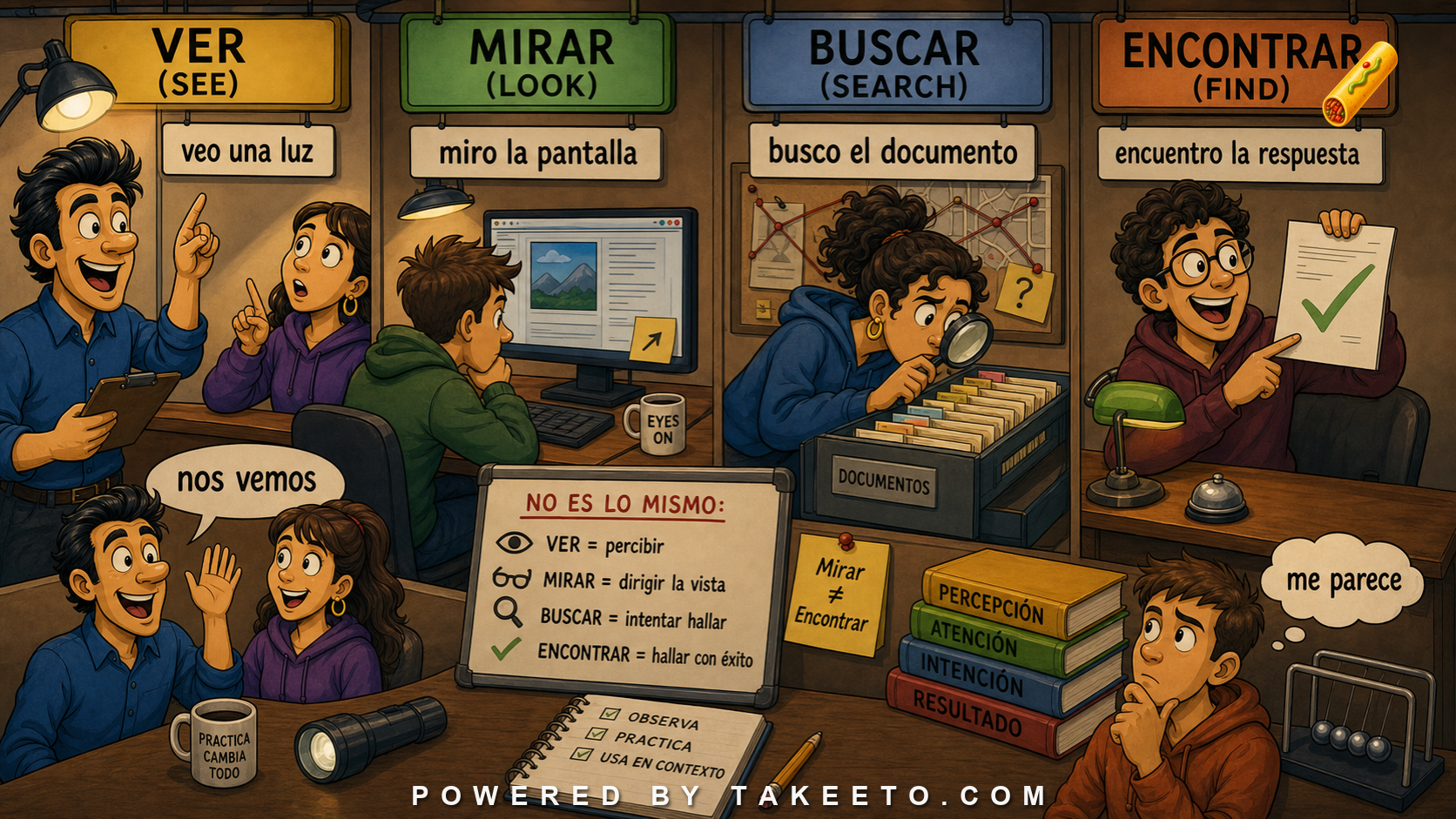
Perception and search are separate events
English learners often confuse ver, mirar, buscar, and encontrar because English phrases like “look for,” “see,” “look at,” and “find” overlap in everyday thought. Spanish keeps several distinctions clear.
Compare:
Veo una luz.
I see a light.
Miro la pantalla.
I look at the screen.
Busco el documento.
I’m looking for the document.
Encuentro la respuesta.
I find the answer.
The key principle is:
Ver is perception, mirar is directed attention, buscar is search, and encontrar is successful discovery or encounter.
The verbs form a sequence, but they are not interchangeable. You can mirar without ver clearly. You can buscar without encontrar. You can ver something without trying to mirar at it.
Ver: perception and understanding
Ver means to see, perceive visually, watch in some contexts, or understand.
Veo una casa al final de la calle.
I see a house at the end of the street.
¿Viste la película?
Did you see/watch the movie?
No veo el problema.
I don’t see the problem.
Ya veo.
I see / I understand.
The basic sense is perception. The subject receives visual information. But ver extends naturally to comprehension and evaluation.
Vamos a ver qué pasa.
Let’s see what happens.
A ver.
Let’s see / well / hold on.
Spanish uses ver in many discourse phrases. Do not reduce it to literal eyesight.
Mirar: directed attention
Mirar means to look at, watch, observe, or direct one’s gaze.
Mira la pantalla.
Look at the screen.
Miré por la ventana.
I looked out the window.
No me mires así.
Don’t look at me like that.
Mirar requires attention or intention more strongly than ver. You can mirar but not ver if the object is hidden, dark, or unclear.
Miré, pero no vi nada.
I looked, but I didn’t see anything.
That sentence captures the contrast perfectly. Looking is the attempt; seeing is the perception.
Buscar: searching, not finding
Buscar means to look for, search for, seek, or try to find.
Busco las llaves.
I’m looking for the keys.
Estamos buscando una solución.
We are looking for a solution.
Buscaron información en internet.
They searched for information online.
The crucial point: buscar does not imply success. It describes the search process.
A common learner error is adding a preposition because English uses “look for.” Standard Spanish uses a direct object:
Busco el documento.
not: Busco por el documento in ordinary Spanish.
There are constructions like buscar por todas partes (“search everywhere”), but the thing sought is normally direct object.
Encontrar: finding and encountering
Encontrar means to find, come across, or encounter.
Encontré las llaves.
I found the keys.
Encontramos una solución.
We found a solution.
Me encontré con Ana en la calle.
I ran into Ana on the street.
Encontrar marks success or occurrence. The search may be deliberate or accidental. With encontrarse con, the meaning often becomes “run into” or “meet unexpectedly.”
The pronominal encontrarse can also describe state or location in more formal registers:
El edificio se encuentra en el centro.
The building is located downtown.
Me encuentro bien.
I feel well.
This is not beginner-only vocabulary. Encontrar is a major verb in narrative, formal description, and everyday speech.
Nos vemos and social seeing
Ver appears in social formulas:
Nos vemos mañana.
See you tomorrow.
¿Cuándo nos vemos?
When are we meeting / seeing each other?
Me veo con Laura los viernes.
I meet up with Laura on Fridays.
The reflexive/reciprocal verse can mean to see oneself, look, appear, or meet/see one another.
Me veo cansado.
I look tired.
Se ven felices.
They look happy.
Nos vimos en Madrid.
We saw/met each other in Madrid.
Article 131 handles reflexive and reciprocal readings, but learners should already notice that ver can build social interaction.
Me parece and perception of judgment
The outline includes me parece because Spanish connects perception, appearance, and opinion. Strictly speaking, parecer is the main verb here, but it belongs in the perception family.
Me parece bien.
It seems fine to me.
Parece difícil.
It seems difficult.
The cognitive path is visible: perception becomes judgment. Ver also participates:
Lo veo difícil.
I see it as difficult.
¿Cómo lo ves?
How do you see it? / What do you think?
Perception verbs often become stance verbs.
Search sequence: from attention to result
A useful sequence:
Miro la mesa.
I look at the table.
Busco las llaves.
I look for the keys.
Veo algo debajo de un papel.
I see something under a paper.
Encuentro las llaves.
I find the keys.
This sequence shows why translation shortcuts fail. Mirar is not buscar. Buscar is not encontrar. Ver may happen during either.
Common learner errors
The first error is using mirar por to mean “look for.” In standard Spanish, use buscar.
Busco mi teléfono.
not: Miro por mi teléfono for ordinary “I’m looking for my phone.”
The second error is treating buscar as successful.
Busqué las llaves, pero no las encontré.
I looked for the keys, but I didn’t find them.
The third error is using ver where Spanish wants active attention:
Mira este ejemplo.
Look at this example.
The fourth error is forgetting that ver can mean “watch” with movies, shows, and games:
Vi el partido.
I watched the game.
Remediation notes: attention, result, and prepositions
The most common repair here is to stop translating English “look” directly. Look at, look for, look like, look into, and look over are different events. Spanish usually does not use one verb for all of them.
With visual attention, use mirar:
Mira la pantalla.
Look at the screen.
With perception or watching a film/program, ver is often natural:
Vi una película anoche.
I watched/saw a movie last night.
No veo bien desde aquí.
I can’t see well from here.
With search, use buscar without copying English “for”:
Busco el documento.
I’m looking for the document.
Not:
Busco por el documento.
Spanish can use prepositions with buscar in other meanings or frames, such as buscar en la carpeta (“search in the folder”) or buscar por internet (“search online”), but the object searched for is normally direct: buscar algo, buscar a alguien.
With people, the personal a matters:
Busco a Laura.
I’m looking for Laura.
Vi a Laura.
I saw Laura.
Encontré a Laura en la estación.
I found/ran into Laura at the station.
For encounters, distinguish encontrar and encontrarse con:
Encontré la respuesta.
I found the answer.
Me encontré con Ana.
I ran into Ana / I met up with Ana.
Encontrarse con often presents an encounter, sometimes accidental. Encontrar by itself can present finding, discovering, or locating.
Finally, parecer is not the normal translation of “look at.” It belongs to appearance and judgment:
Parece cansado.
He looks/seems tired.
Me parece bien.
It seems fine to me.
The production sequence is: direct your gaze with mirar, receive visual information with ver, search with buscar, obtain the result with encontrar, and judge appearance with parecer. Keeping these stages separate prevents most errors.
Example bank walkthrough
veo una luz
Perception. The light enters your field of awareness.
Learner action: use ver for seeing, noticing, and often watching.
miro la pantalla
Directed gaze or attention.
Learner action: use mirar when the subject intentionally looks.
busco el documento
Search process. No success implied.
Learner action: do not add por after buscar for the object sought.
encuentro la respuesta
Successful finding.
Learner action: use encontrar when the result is obtained.
nos vemos
Social formula: “see you” or “we’ll see each other.”
Learner action: recognize reciprocal nos.
me parece
Opinion through appearance: “it seems to me.”
Learner action: connect perception and stance.
Suggested interactive module: perception-search sequence diagram
A useful tool would show the event chain.
Suggested functions:
- Event classifier: perception, attention, search, result, encounter, opinion.
- Verb selector: ver, mirar, buscar, encontrar, parecer.
- Search logic: searching can fail; finding implies result.
- Preposition warning: buscar algo, not English-style buscar por algo.
- Social mode: nos vemos, verse con, encontrarse con.
- Metaphor mode: ver un problema, encontrar una solución, me parece.
Final rule
Keep the sequence clear: mirar directs attention, ver perceives, buscar searches, and encontrar finds.
Spanish becomes easier when you separate the action of looking from the success of seeing or finding.