
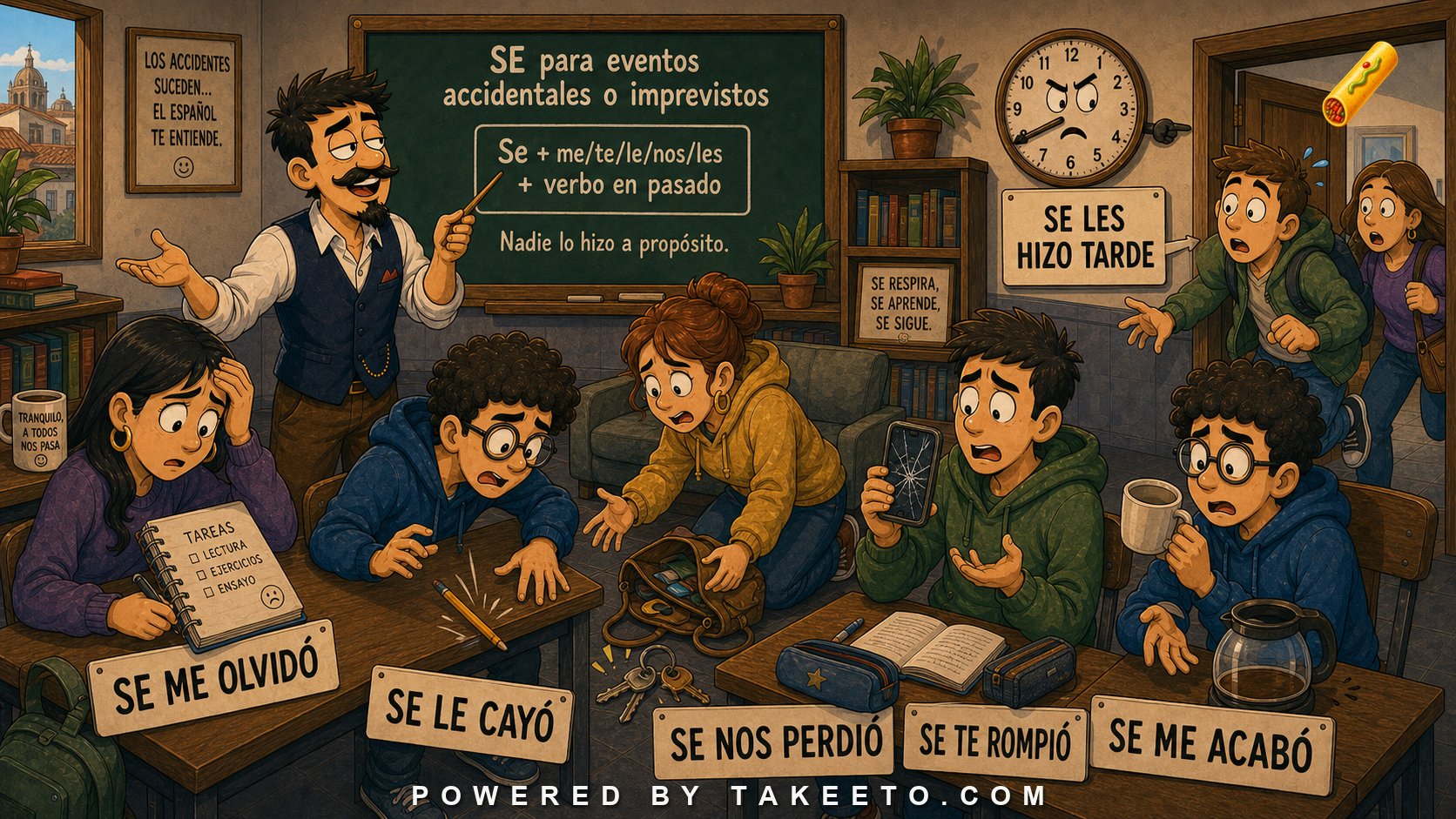
Spanish can frame an event as happening to someone
English often forces a speaker to choose between direct responsibility and passive accident:
I broke the glass.
The glass broke.
Spanish has a third common option:
Se me rompió el vaso.
The glass broke on me. / I accidentally broke the glass.
This construction does not simply deny responsibility. It frames the event as unplanned, uncontrolled, or experienced by someone rather than intentionally performed by that person.
The basic shape is:
se + indirect object pronoun + verb + affected thing
Examples:
Se me olvidó la llave.
I forgot the key. / The key slipped my mind.
Se le cayó el teléfono.
He/she dropped the phone. / The phone fell on him/her.
Se nos perdió el recibo.
We lost the receipt.
Se te rompió la mochila.
Your backpack broke on you.
The learner trap is to translate word by word. The grammar is not English-shaped. Spanish is assigning roles differently.
The affected thing is usually the subject
In se me olvidó la llave, the verb agrees with la llave, not with me.
Se me olvidó la llave.
The key slipped my mind.
Se me olvidaron las llaves.
The keys slipped my mind.
The same pattern appears with many verbs:
| Singular thing | Plural thing |
|---|---|
| Se me cayó el vaso. | Se me cayeron los vasos. |
| Se le rompió el zapato. | Se le rompieron los zapatos. |
| Se nos perdió el documento. | Se nos perdieron los documentos. |
| Se te olvidó la fecha. | Se te olvidaron las fechas. |
The indirect object pronoun marks the affected participant:
| Pronoun | Affected participant |
|---|---|
| me | to/for/on me |
| te | to/for/on you |
| le | to/for/on him, her, you formal |
| nos | to/for/on us |
| os | to/for/on you plural familiar |
| les | to/for/on them, you plural |
That participant is not grammatically the subject. The thing that falls, breaks, gets lost, runs out, or is forgotten is usually the subject.
Responsibility is backgrounded, not erased
Compare three ways to describe a broken glass.
| Spanish | Literal role framing | Likely English |
|---|---|---|
| Rompí el vaso. | I broke the glass. | I broke the glass. |
| El vaso se rompió. | The glass broke. | The glass broke. |
| Se me rompió el vaso. | The glass broke on me. | I accidentally broke the glass / The glass broke on me. |
The third sentence does not prove innocence. It simply frames the event as uncontrolled or unintended. Context decides whether it sounds neutral, apologetic, evasive, polite, or entirely ordinary.
A child might use it to soften responsibility:
Se me rompió.
It broke on me.
An adult might use it because it is the natural description of an unplanned mishap:
Se me apagó el ordenador.
My computer shut off on me.
Spanish gives the speaker a grammatical way to put the event first and the human participant in an affected role.
Common verbs in accidental se constructions
Not every verb works equally naturally in this pattern. It is especially common with events that can happen without deliberate control.
| Verb | Example | Meaning |
|---|---|---|
| olvidar | Se me olvidó la cita. | I forgot the appointment. |
| caer | Se le cayó el vaso. | He/she dropped the glass. |
| romper | Se nos rompió el coche. | Our car broke down. |
| perder | Se te perdió la tarjeta. | You lost your card. |
| acabar | Se me acabó el dinero. | I ran out of money. |
| quedar | Se nos quedó la maleta en el taxi. | We left the suitcase in the taxi. |
| hacer tarde | Se les hizo tarde. | They got delayed / it got late for them. |
| apagar | Se me apagó el teléfono. | My phone turned off on me. |
Some of these have English translations with “I” as subject. Spanish may not.
Se me acabó el café.
I ran out of coffee.
The coffee is what ran out. Me marks the person affected.
Olvidar vs olvidarse vs se me olvidó
Forgetting is especially useful because Spanish offers several patterns.
Olvidé la llave.
I forgot the key.
This is straightforward: yo is the subject, la llave is the direct object.
Me olvidé de la llave.
I forgot about the key.
This uses the pronominal verb olvidarse de.
Se me olvidó la llave.
The key slipped my mind.
This is the accidental se pattern.
These are close in meaning, but not identical in framing. Olvidé la llave is direct. Me olvidé de la llave is pronominal and often focuses on failing to remember. Se me olvidó la llave frames the forgetting as something that happened to the speaker’s memory.
A learner does not need to rank them as “correct” and “incorrect.” The key is to recognize the participant structure.
Caer and the difference between falling and dropping
English distinguishes fall and drop partly through subject choice:
The phone fell.
I dropped the phone.
Spanish can use caerse and accidental se:
El teléfono se cayó.
The phone fell.
Se me cayó el teléfono.
I dropped the phone. / The phone fell from me.
Again, el teléfono controls verb agreement:
Se me cayó el teléfono.
Se me cayeron las llaves.
The construction says that the object’s falling event affected or involved me. It does not present me as a deliberate agent.
The role of le and les
Because le and les can refer to many people, Spanish often adds an a phrase for clarity.
Se le perdió el pasaporte a Marta.
Marta lost her passport.
Se les rompió el coche a mis padres.
My parents’ car broke down.
The a phrase clarifies the affected participant. It is not the subject. The subject remains el pasaporte or el coche.
This is the same redundancy pattern seen with indirect object pronouns more generally:
A Marta se le perdió el pasaporte.
The pronoun le and the phrase a Marta work together.
Word order and emphasis
The default order often places the affected thing after the verb:
Se me olvidó la contraseña.
Se nos perdió el recibo.
But Spanish can move elements for topic or emphasis:
La contraseña se me olvidó.
The password slipped my mind.
A mí se me olvidó, pero a Ana no.
I forgot, but Ana did not.
The pattern remains the same: se + indirect object + verb, with agreement controlled by the thing affected.
Common learner errors
Error 1: Making the verb agree with the person
Se me olvidé la llave.
Better:
Se me olvidó la llave.
The subject is la llave, not yo.
Error 2: Forgetting plural agreement
Se me olvidó las llaves.
Better:
Se me olvidaron las llaves.
Error 3: Treating the construction as a lie about agency
Se me rompió el vaso does not necessarily mean “I had nothing to do with it.” It means the event is framed as unplanned or uncontrolled.
Error 4: Translating too literally
It forgot itself to me.
That is useless. Translate the role structure naturally: “I forgot it,” “it slipped my mind,” “it broke on me,” “I dropped it,” depending on the verb.
Error 5: Confusing accidental se with passive se
Se vendieron las entradas.
The tickets were sold.
Se me perdieron las entradas.
I lost the tickets.
Both use se, but the second includes an affected-person pronoun.
Agency, politeness, and the “accident” frame
The so-called accidental se is sometimes taught as a way to avoid blame. That can be true in context, but it is too cynical as a general explanation. The construction is broader: it presents an event as occurring outside the affected person’s full control.
Compare these three sentences:
Perdí las llaves.
I lost the keys.
Las llaves se perdieron.
The keys got lost.
Se me perdieron las llaves.
The keys got lost on me / I lost the keys.
The first sentence gives the speaker full subject position. The second removes the person entirely. The third includes the person, but as affected participant rather than deliberate agent.
This middle option is extremely useful because many everyday mishaps are neither intentional actions nor ownerless events. Phones die, receipts disappear, computers shut down, names slip the mind, backpacks tear, appointments are forgotten. Spanish can mark the person whose life is affected without presenting that person as the agent who made the event happen.
The construction can soften, but it does not absolve
A child saying se me rompió el vaso may be avoiding blame. An adult saying se me cayó el teléfono may simply be describing an accident. A colleague saying se me olvidó adjuntar el archivo may be apologizing while explaining the kind of failure.
The social meaning depends on context, tone, relationship, and consequence.
Agreement keeps the roles honest
Because the thing is usually the subject, plural agreement matters:
Se me perdió el documento.
Se me perdieron los documentos.
If you make the verb agree with the person, you destroy the construction:
Se me perdí los documentos is not the pattern.
Use direct forms when agency matters
The accidental frame is not a universal replacement for direct responsibility.
Rompí la ventana.
I broke the window.
If you intentionally broke it, se me rompió sounds evasive or false. The construction is strongest when lack of control, unintended result, or affected experience is relevant.
The best learners do not use accidental se to dodge every action. They use it to mark the event frame Spanish actually wants: something happened, and it happened to me, on me, or in my sphere of responsibility without being fully planned.
Diagnostic refinement: accidental se is not an apology formula
The construction in se me olvidó is often taught as the “oops” form, as if Spanish simply gives speakers a way to dodge responsibility. That is too shallow. The construction backgrounds agency, but it does not automatically deny responsibility.
Its structure is:
se + indirect object + verb + subject
The subject is usually the thing that undergoes the event:
Se me olvidó el pasaporte.
My passport got forgotten / I forgot my passport.
Se me olvidaron las llaves.
I forgot my keys.
The agreement is with the thing forgotten, lost, broken, dropped, or finished:
| Subject | Verb | Sentence |
|---|---|---|
| el pasaporte | olvidó | Se me olvidó el pasaporte. |
| las llaves | olvidaron | Se me olvidaron las llaves. |
| el vaso | cayó | Se le cayó el vaso. |
| los papeles | cayeron | Se le cayeron los papeles. |
The indirect object marks the affected person: me, te, le, nos, os, les. It does not control the verb. This is the same diagnostic learners need for gustar-type predicates: the person affected is not necessarily the subject.
The construction is common with events that feel unplanned, uncontrolled, or unfortunate:
- se me olvidó — I forgot it / it slipped my mind
- se le cayó — he/she dropped it / it fell from him/her
- se nos perdió — we lost it / it got lost on us
- se te rompió — you broke it / it broke on you
- se me acabó — I ran out of it / it ran out on me
- se nos hizo tarde — it got late on us
But it can still coexist with accountability:
Se me olvidó enviar el archivo. Lo siento; lo mando ahora.
I forgot to send the file. Sorry; I’ll send it now.
That sentence does not evade responsibility. It frames the forgetting as an event that happened in the speaker’s sphere, then accepts the consequence.
The practical editing rule is: use accidental se when the Spanish sentence should foreground the affected person and the event, not the deliberate agent. Do not use it as a universal replacement for olvidé, perdí, rompí, or dejé caer when you need to emphasize agency.
Suggested interactive module: accidental se argument diagram
A useful tool for this article would show the hidden argument structure behind sentences such as se me olvidó.
Suggested functions:
- Role labeling: se marker, affected participant, verb, subject thing.
- Agreement checker: flags se me olvidó las llaves and suggests se me olvidaron las llaves.
- Framing contrast: compares rompí el vaso, el vaso se rompió, and se me rompió el vaso.
- Clarification builder: adds a Marta, a mis padres, a nosotros for le/les ambiguity.
- Natural translation options: “I forgot,” “I dropped,” “it broke on me,” “we ran out,” not just literal glosses.
Example input:
Se nos perdieron los documentos.
Possible output:
- los documentos = subject; controls plural perdieron.
- nos = affected participant.
- Natural translation: “We lost the documents.”
- Framing: unplanned event, agency backgrounded.
Final rule
Accidental se is a way to frame an event as unplanned, uncontrolled, or experienced by someone. The affected person appears as an indirect object pronoun: me, te, le, nos, os, les. The thing that falls, breaks, gets lost, runs out, or is forgotten usually controls verb agreement.
Do not translate the construction word by word. Track the roles. In se me olvidaron las llaves, the keys are the grammatical subject, me is the affected participant, and the whole sentence means that I forgot the keys in a way Spanish presents as “the keys slipped from my control.”