
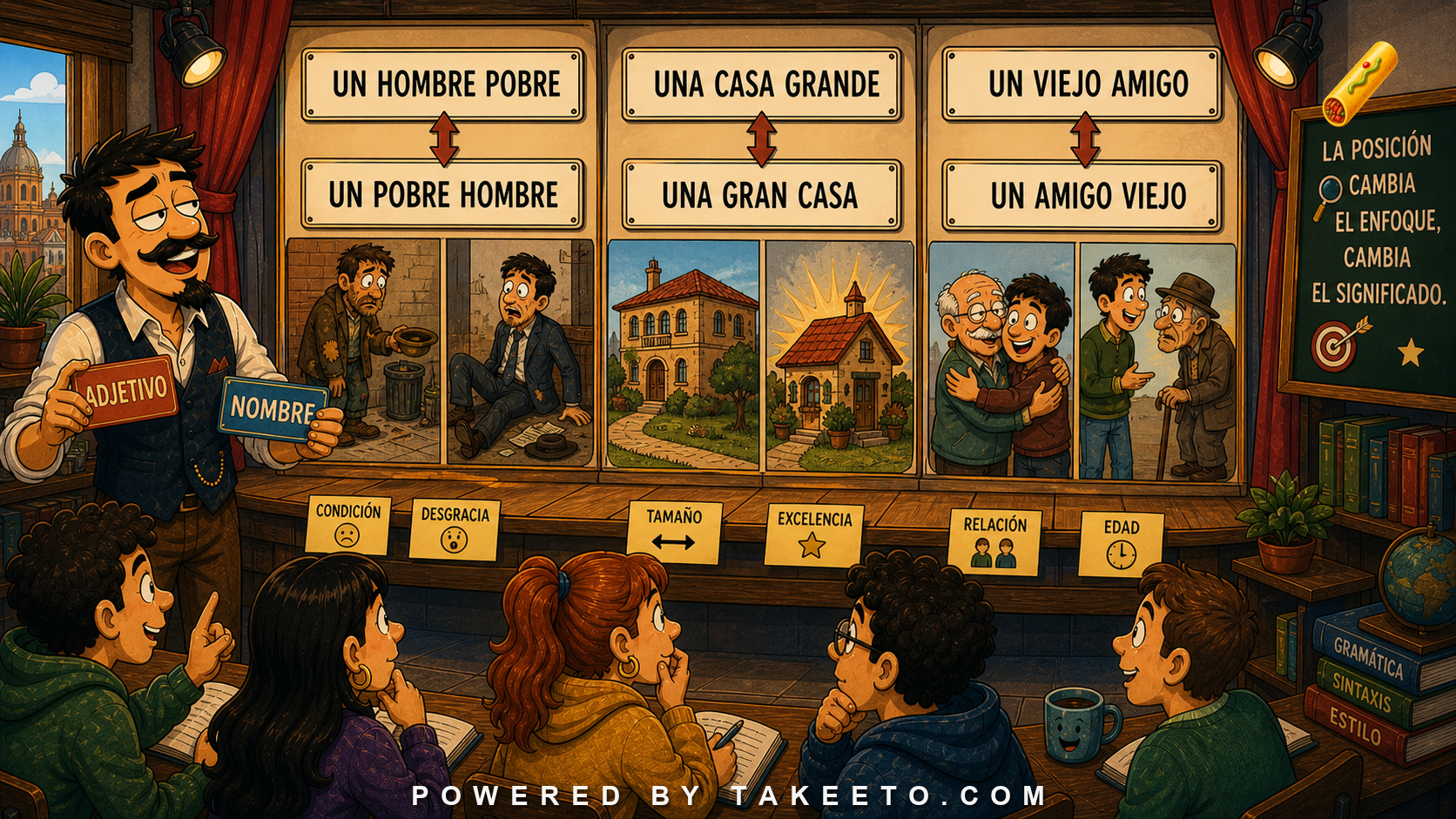
Spanish adjectives do not simply go after nouns
A beginner learns that Spanish adjectives usually follow the noun:
- una casa blanca
- un libro interesante
- una ciudad grande
- un problema difícil
That is a good default. But it quickly fails as a full explanation.
Spanish also says:
- un buen día
- una gran ciudad
- un viejo amigo
- un pobre hombre
- la alta montaña in certain styles
- la famosa escritora
Sometimes adjective position changes tone. Sometimes it changes meaning. Sometimes it signals whether the adjective is classifying, evaluating, expected, inherent, poetic, or already known in the discourse.
The better rule is:
Postnominal adjectives often classify or restrict; prenominal adjectives often evaluate, frame, or present known/inherent qualities.
This is not absolute, but it is a powerful starting point.
The default: adjectives after nouns
Spanish commonly places adjectives after nouns when they classify, distinguish, or provide identifying information.
Examples:
una casa blanca
a white house, not another colored house
un libro interesante
an interesting book
una ciudad grande
a large city
estudiantes inteligentes
intelligent students
problemas difíciles
difficult problems
Postnominal adjectives often answer: which kind? which one? what property distinguishes it?
This is why nationality, color, shape, religion, political affiliation, and classifying adjectives often follow the noun:
- una idea española
- una camisa roja
- una mesa redonda
- una tradición católica
- un partido liberal
- una novela histórica
Before the noun: evaluation and framing
Adjectives before the noun often express the speaker’s evaluation or frame the noun as already having that quality.
Compare:
una ciudad grande
a large city
una gran ciudad
a great city
The first is size. The second is evaluation or importance.
Compare:
un hombre pobre
a poor man, economically poor
un pobre hombre
a poor man in the sense of pitiable, unfortunate, pathetic depending on context
The adjective’s position changes interpretation.
Meaning-shift adjectives
Some adjectives have especially clear position-based meaning contrasts.
| After noun | Meaning | Before noun | Meaning |
|---|---|---|---|
| un hombre pobre | economically poor | un pobre hombre | pitiable/unfortunate man |
| una casa grande | large house | una gran casa | great/impressive house |
| un amigo viejo | elderly/old friend by age | un viejo amigo | longtime friend |
| una familia antigua | ancient/old family in historical sense | una antigua familia noble | former/old-established depending on context |
| una noticia cierta | certain/true news, less common phrasing | cierta noticia | a certain piece of news |
| una oportunidad única | unique opportunity | la única oportunidad | the only opportunity |
| una computadora nueva | new computer, recently made/acquired | una nueva computadora | another/newly introduced computer depending on context |
These are not random idioms. Position changes whether the adjective classifies the noun or frames it subjectively/discourse-wise.
Grande and gran
Grande before a singular noun often shortens to gran.
- un gran problema
- una gran idea
- un gran escritor
- una gran ciudad
After the noun, it remains grande:
- una casa grande
- un problema grande
The meaning often shifts:
| Phrase | Likely meaning |
|---|---|
| una casa grande | physically large house |
| una gran casa | impressive/great house, sometimes not only size |
| un problema grande | large problem, perhaps size/scope |
| un gran problema | serious/major problem |
| un hombre grande | large/tall man |
| un gran hombre | great man |
Position and apocope work together.
Bueno and malo before nouns
Bueno and malo shorten before masculine singular nouns:
- un buen día
- un buen libro
- un mal momento
- un mal ejemplo
After the noun:
- un día bueno, possible but less neutral in many contexts
- un libro bueno, contrastive or evaluative in a different way
- un momento malo
With feminine nouns, no masculine apocope:
- una buena idea
- una mala decisión
The short forms are part of a broader apocope system, but their meaning also interacts with position.
Inherent and expected qualities
Prenominal adjectives can present a quality as inherent, expected, or already associated with the noun.
la blanca nieve
the white snow
Snow is expected to be white, so the adjective feels literary, descriptive, or evocative rather than distinguishing white snow from blue snow.
la oscura noche
the dark night
The darkness is expected; the adjective creates atmosphere.
Postnominal placement would feel more classifying:
la nieve blanca
the white snow, perhaps in contrast to dirty snow
la noche oscura
the dark night, perhaps as a distinguishing property
This is common in literary and elevated style.
Known information and discourse
An adjective before the noun can signal that the quality is already known or not the main distinguishing information.
El famoso escritor llegó tarde.
The famous writer arrived late.
The fame is presented as known or framing information.
El escritor famoso llegó tarde.
The famous writer arrived late, possibly distinguishing him from another writer.
The difference is subtle and context-dependent, but real.
Adjective position and register
Prenominal adjectives can sound literary, journalistic, formal, or evaluative depending on the adjective and noun.
- la difícil situación
- el grave problema
- la creciente preocupación
- el mencionado artículo
- la citada ley
Formal writing often uses prenominal adjectives to frame nouns within an argument.
Everyday speech uses many prenominal adjectives too, especially common ones:
- buen día
- mala idea
- gran problema
- viejo amigo
- pobre mujer
The point is not “before = poetic.” The point is that before-noun position is semantically motivated.
Common learner mistakes
Mistake 1: Putting every adjective after the noun
This is safe for many adjectives but not all. Un hombre pobre and un pobre hombre differ.
Mistake 2: Putting every adjective before the noun because English does
Una blanca casa is not the neutral way to say “a white house.” Use una casa blanca unless you want a marked/literary effect.
Mistake 3: Missing apocope
Use un buen amigo, not un bueno amigo. Use una buena amiga, not una buen amiga.
Mistake 4: Treating meaning-shift pairs as interchangeable
Un viejo amigo is not the same as un amigo viejo.
Mistake 5: Ignoring discourse context
Adjective position often depends on what the speaker assumes is known, contrastive, or evaluative.
Practice contrasts
| Phrase | Interpretation |
|---|---|
| un hombre pobre | a man without much money |
| un pobre hombre | a pitiable/unfortunate man |
| una casa grande | a large house |
| una gran casa | a great/impressive house |
| un amigo viejo | an old/elderly friend |
| un viejo amigo | a longtime friend |
| una noticia cierta | a true/certain piece of news |
| cierta noticia | a certain piece of news |
| una computadora nueva | a new computer |
| una nueva computadora | another/newly introduced computer, depending on context |
Suggested interactive module: meaning-pair explorer
A useful tool for this article would let users move adjectives before and after nouns and see meaning changes.
Suggested functions:
- Before/after toggle: hombre pobre / pobre hombre.
- Meaning labels: classifying, evaluative, inherent, discourse-known, literary.
- Apocope checker: bueno → buen, malo → mal, grande → gran.
- Register note: neutral, formal, literary, colloquial.
- Context examples: show each phrase in a sentence.
Example input:
viejo amigo
Possible output:
- un viejo amigo: a longtime friend
- un amigo viejo: an elderly/old friend
- Position changes meaning from relationship duration to age/classification
Final rule
Spanish adjective position is meaningful.
After the noun is the strong default for classification and distinction. Before the noun often adds evaluation, framing, known information, inherent description, or a specific meaning shift.
Do not memorize “adjectives go after nouns” as if it were the whole truth. Spanish gives you two positions because it uses them to say different things.