
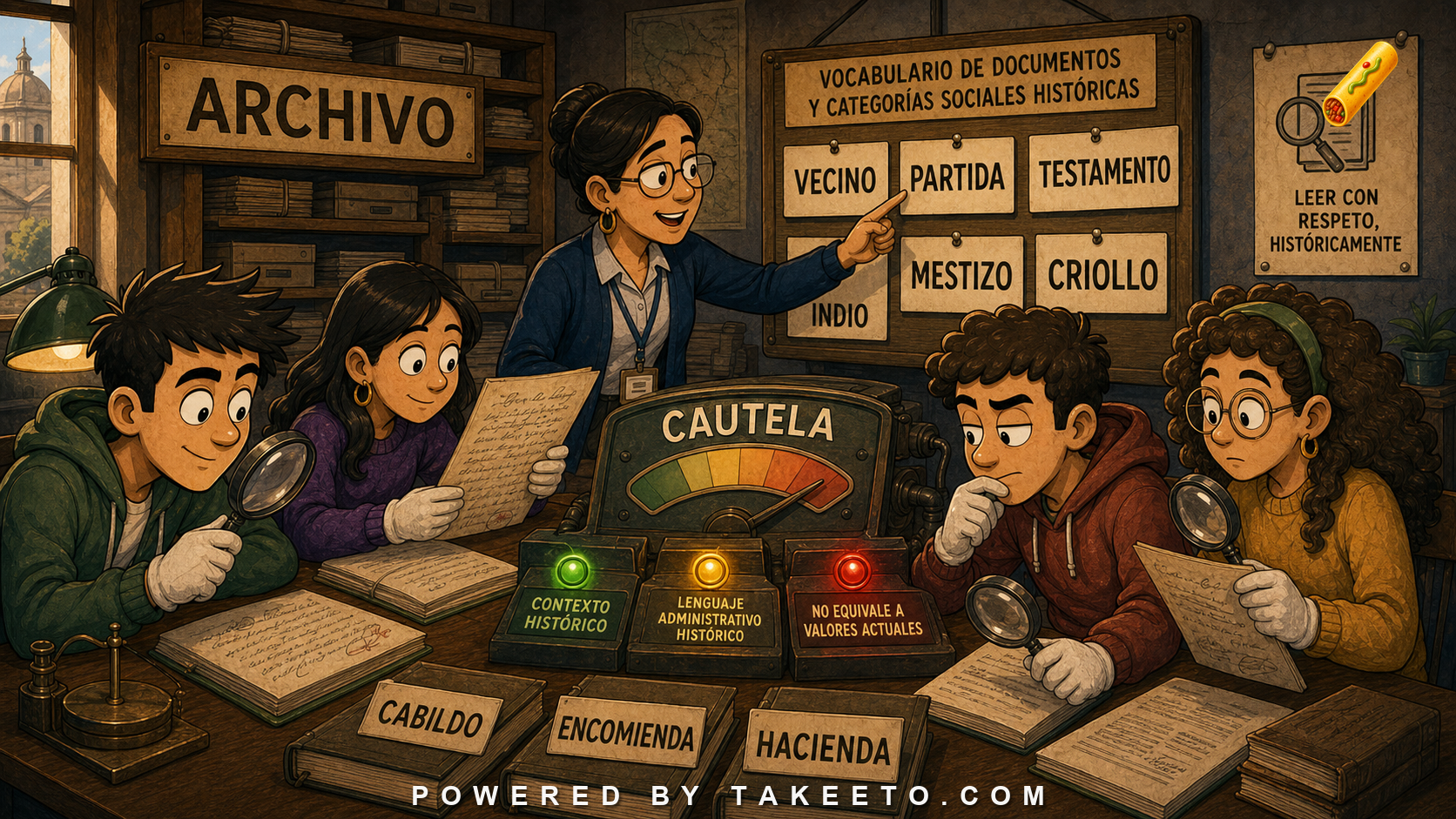
Colonial documents are not neutral windows
Spanish colonial documents can be valuable for history, genealogy, land research, legal history, linguistics, and cultural memory. They are also dangerous if read naïvely. They were often produced by colonial institutions: courts, churches, notaries, councils, tax authorities, land offices, military authorities, and administrators. Their language may classify people according to categories that were hierarchical, coercive, racialized, religious, and legally consequential.
The key principle is:
Colonial Spanish documents preserve institutional language, not neutral social truth.
A learner must recognize terms without adopting the worldview that produced them.
Administrative vocabulary
Colonial documents use many terms tied to governance and local administration.
cabildo — municipal council/local governing body
alcalde — local magistrate/mayor, depending on context
corregidor — royal/local official in some colonial systems
gobernador — governor
virreinato — viceroyalty
audiencia — high court/administrative tribunal
escribano — scribe/notary-like official
expediente — file/case record
merced — grant/favor, often land or privilege context
Example:
El cabildo acordó remitir la solicitud al gobernador.
The council agreed to send the request to the governor.
Do not assume modern meanings. Audiencia in this context is not merely an audience or hearing; it may refer to an institution.
Legal and notarial vocabulary
Many colonial records are legal or notarial.
escritura — deed/instrument
testamento — will
poder — power of attorney
venta — sale
dote — dowry
inventario — inventory
declaración — statement/declaration
testigo — witness
otorgar — execute/grant
fiador — guarantor/surety
Example:
Otorgó testamento ante el escribano y dos testigos.
He/she executed a will before the scribe and two witnesses.
This language is formulaic. It often gives names, status, residence, property, kinship, obligations, and witnesses.
Religious and church-record vocabulary
The church produced many colonial records.
partida — register entry
bautismo — baptism
matrimonio — marriage
defunción — death record/burial record depending on context
feligrés — parishioner
parroquia — parish
cura — priest
padrino / madrina — godfather/godmother
legítimo / natural — legitimacy categories in records
Example:
En la partida de bautismo constan los nombres de los padres y padrinos.
The baptism entry records the names of the parents and godparents.
Partida is not a game here. It is an entry in a register.
Land and labor vocabulary
Colonial records often involve land, tribute, labor, and property.
encomienda — colonial labor/tribute institution, context-specific and historically loaded
repartimiento — distribution/allocation system, labor or goods depending on context
hacienda — estate
estancia — ranch/estate, depending on region
solar — town lot/plot
tierras — lands
linderos — boundaries
tributo — tribute/tax
obraje — workshop/manufacturing establishment in some colonial contexts
Example:
La escritura describe los linderos de la hacienda.
The deed describes the boundaries of the estate.
Terms like encomienda are not simple economic vocabulary. They name institutions embedded in coercion and colonial power.
Social classification terms require caution
Colonial documents may use labels such as:
indio
mestizo
criollo
español
mulato
negro
pardo
castizo
These labels are historical artifacts. They may reflect legal status, social perception, taxation, church classification, local practice, or official ideology. They do not map cleanly onto modern identity categories.
A serious reader must not treat them as timeless biological or cultural facts. They were unstable, strategic, imposed, contested, and regionally variable.
Better approach:
The document labels X as Y in this institutional context.
Not:
X was objectively Y in a modern sense.
Indio, indígena, pueblo originario
The word indio appears frequently in colonial documents. It carries colonial history and can be offensive or inappropriate in modern contexts, depending on region and usage. Contemporary respectful language may use indígena, pueblo indígena, pueblo originario, or a specific nation/community name where appropriate.
When quoting or describing colonial documents, distinguish document language from your own voice.
Example:
El documento emplea la categoría colonial “indio” para clasificar a los tributarios.
The document uses the colonial category “indio” to classify tribute payers.
This signals historical distance.
Criollo, mestizo, and regional variation
Criollo may refer to a person of Spanish descent born in the Americas, but usage varies by time, place, and context. Mestizo generally refers to mixed ancestry categories under colonial classification, but its social meaning is historically complex.
Do not flatten these words into simple dictionary equivalents. Ask:
What century?
Which colony or region?
Which institution produced the document?
Is the label self-identified, imposed, or recorded by an official?
Does the label affect tribute, marriage, office, land, or legal standing?
Archive caution
Archival documents often survive because institutions preserved their own paperwork. That means the archive may overrepresent property holders, litigants, officials, church records, and people who entered bureaucratic systems under pressure.
The absence of a voice in a document is not absence from history.
When reading colonial Spanish, combine linguistic analysis with archival caution:
Who had the power to write?
Who had to speak through an interpreter, scribe, priest, or official?
What was formulaic?
What was contested?
What did the document need to prove?
Example bank walkthrough
cabildo
Local council/governing body.
Learner action: identify its institutional role in the specific place.
encomienda
Colonial institution involving labor/tribute rights and obligations.
Learner action: treat as historically loaded, not a neutral job term.
vecino
Resident/local member/status term.
Learner action: do not translate as casual neighbor automatically.
partida
Register entry, often church record.
Learner action: identify baptism, marriage, or burial context.
testamento
Will.
Learner action: watch for property, kinship, debts, pious requests, witnesses.
hacienda
Estate.
Learner action: distinguish from modern “finance department” meanings.
indio
Colonial social/legal category.
Learner action: mention as document language and use caution in your own voice.
mestizo
Colonial classification term.
Learner action: avoid treating as stable modern identity across contexts.
criollo
Historically variable category, often related to American-born Spanish descent.
Learner action: check period and region.
Colonial-document reading workflow
- Identify document type: will, register, land deed, court file, council record.
- Identify institution: church, notary, court, cabildo, royal official.
- Map participants and roles.
- Separate formula from event.
- Mark social labels as document categories.
- Do not modernize identity terms casually.
- Track land, labor, tribute, and kinship terms.
- Note interpreters, scribes, witnesses, and officials.
- Preserve uncertainty in transcription.
- Consult historical specialists for serious claims.
Remediation: colonial vocabulary is not neutral description
Colonial Spanish documents require a double reading. First, the reader must understand what the words meant inside the administrative, legal, religious, and economic systems that produced them. Second, the reader must avoid treating those words as neutral categories of human identity.
Terms such as indio, mestizo, mulato, criollo, español, casta, natural, vecino, encomienda, and tributo were embedded in systems of power. They may record how an institution classified a person, not how that person understood themselves. They may also shift by region, century, scribe, legal context, and social strategy.
The remediation rule is:
Translate the document’s category, but do not naturalize the document’s worldview.
A glossary should therefore include caution notes, not just definitions.
Administrative actors and institutions
Colonial documents often name institutions and offices that structure the record:
cabildo, audiencia, corregidor, alcalde, escribano, cura, parroquia, encomendero, hacienda, doctrina, virreinato.
A learner should build an actor map before reading details. For example:
cabildo = local council or municipal body in many colonial contexts.
escribano = notary/scribe recording legal acts.
cura = priest, often central in parish records.
audiencia = high court/administrative body depending on context.
encomendero = holder of an encomienda, with historically specific obligations and exploitative power structures.
Do not flatten all officials into “government.” Colonial administration was layered, uneven, and locally negotiated.
Mini-workshop: annotate a colonial record sentence
Consider this simplified sentence:
Compareció ante el escribano un vecino de la ciudad, quien declaró poseer tierras en la hacienda de San Miguel y tener en servicio a varios indios tributarios.
A responsible annotation:
compareció ante el escribano = formal legal appearance.
vecino de la ciudad = status/residence category, not merely “neighbor.”
declaró poseer tierras = claim of property.
hacienda de San Miguel = estate/place.
tener en servicio = labor/social relation needing historical scrutiny.
indios tributarios = colonial category tied to tribute obligations; not a neutral identity label.
A plain modern paraphrase might help comprehension, but the original terms should be preserved in notes when they carry historical weight.
Document types and reading expectations
Different colonial records do different things:
testamento — distributes property, names kin, expresses religious obligations, records status.
partida — church record of baptism, marriage, or burial.
merced — grant, often of land or privilege.
pleito — lawsuit or dispute.
padrón — census/list/register.
expediente — file/dossier.
carta — letter, but often formal and institutional.
A will is not read like a census. A baptismal record is not read like a land grant. A lawsuit may preserve competing narratives rather than stable facts. A register may compress people into categories designed for taxation, control, or religious administration.
Ethics of quotation and translation
When writing about colonial categories, quote carefully and frame clearly. Avoid casually reproducing harmful labels without explaining that they are historical classifications. In educational material, it is often best to preserve the original term in italics or quotation marks the first time, provide a contextual explanation, and avoid turning it into a modern identity label.
Weak:
The document says the person was an Indian.
Stronger:
The document classifies the person as indio, a colonial legal and social category tied in many contexts to tribute, labor, and institutional control.
This is longer because it is more honest.
Research workflow
For colonial documents, the reader should proceed in layers:
- Identify document type.
- Identify institution and place.
- Identify date and jurisdiction.
- Extract names and roles.
- Mark legal or social classifications.
- Separate formulaic language from event-specific information.
- Consult specialist references for terms of status, land, labor, and race.
- Preserve uncertainty.
The learner does not need to solve every historical question. The goal is to avoid confident misreadings.
Remediation drill: separate document voice from your voice
When writing about colonial documents, mark whether you are using the document's terminology or your own analytic language.
Risky:
El mestizo pidió tierras.
Better:
El documento identifica al solicitante como mestizo y registra su petición de tierras.
Risky:
Los indios del pueblo se quejaron.
Better:
La fuente se refiere a los habitantes del pueblo con la categoría colonial indios; en el expediente, estos presentan una queja contra...
This distinction protects accuracy and ethics. It tells the reader that the term belongs to the source and that you understand it as a historical category.
For article drafting, use quotation marks or typographic emphasis when the historical label itself is under discussion. When the modern community or scholarly category is intended, use present-day terms carefully and consistently.
A good research note might say:
Terminology note: this article preserves selected colonial labels when analyzing the documents, but does not use them as neutral descriptions of present-day identity.
That one sentence prevents a lot of irresponsible writing.
Suggested interactive module: colonial-document glossary with caution notes
A strong tool for this article would combine vocabulary and ethics.
Suggested functions:
- Institution glossary: cabildo, audiencia, escribano, virreinato.
- Document-type tags: partida, testamento, escritura, expediente.
- Social-label caution cards: historical use, modern caution, region notes.
- Role map: official, witness, scribe, petitioner, subject.
- Formula detector: otorgo, ante mí, compareció.
- Archive-question prompts: who wrote, why, for whom, under what power.
Final rule
Colonial Spanish documents must be read with linguistic skill and ethical caution.
Learn the vocabulary of administration, law, church records, land, and labor. But treat social classification terms as historical categories produced by colonial systems. Do not let the document’s language become your unexamined language.