
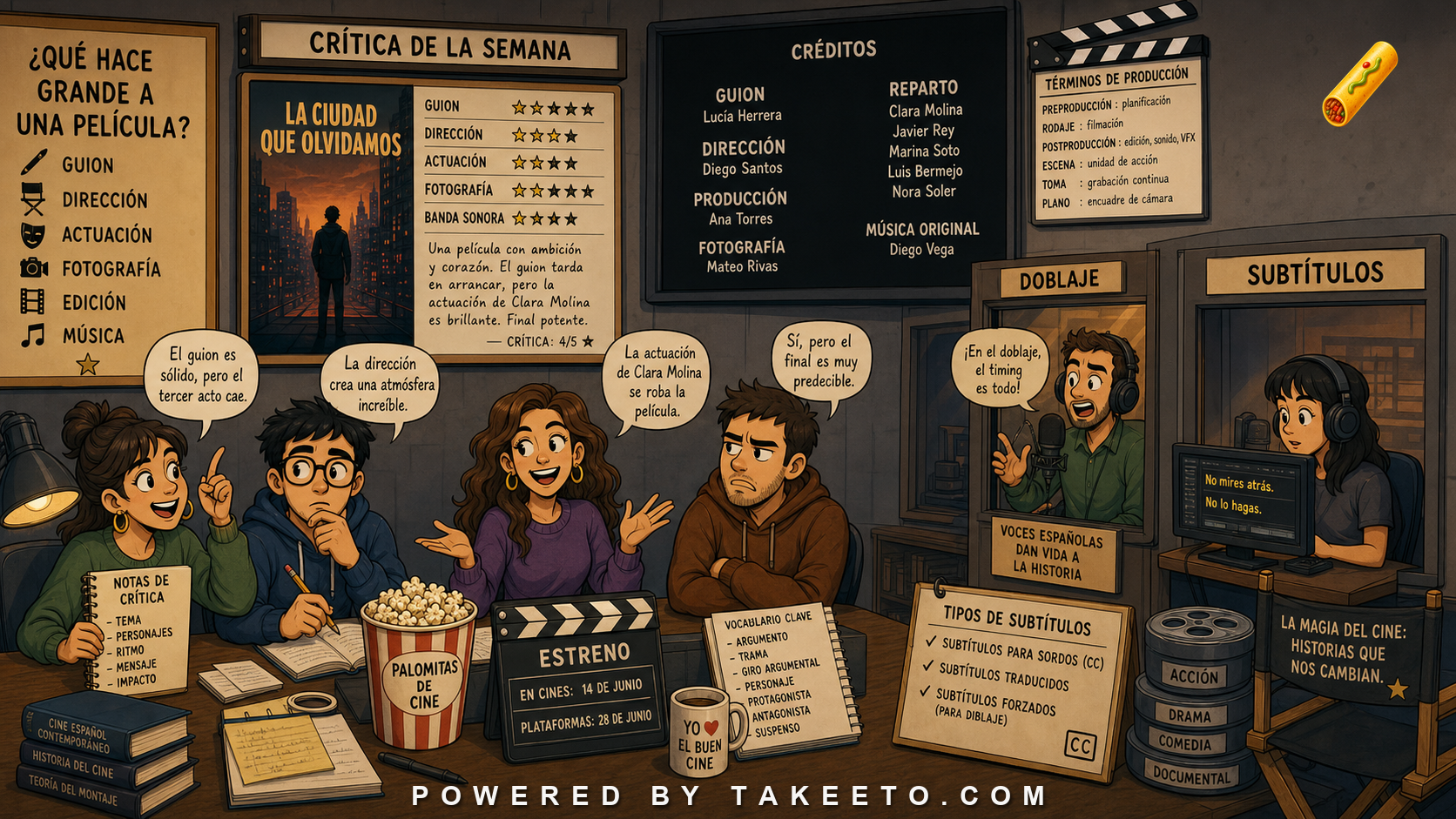
Film Spanish is a vocabulary of making and judging
A learner can watch a Spanish-language film and understand the plot, but still struggle to read a review, browse a streaming page, understand credits, or discuss production choices. Film and television Spanish uses ordinary words in specialized ways: dirección is not just “direction,” papel may be a role, reparto is a cast, guion is a script, and crítica may mean criticism, a review, or critical reception.
The key principle is:
Film Spanish moves between story, production, release, translation, and evaluation.
You need to know which layer the text is talking about.
Película, filme, cinta, serie, episodio
Película is the ordinary word for film/movie.
La película se estrenó en 2024.
The film premiered in 2024.
Filme is more formal, journalistic, or critical.
El filme recibió varios premios.
The film received several awards.
Cinta can also mean film, especially in journalism.
La cinta fue dirigida por una cineasta mexicana.
The film was directed by a Mexican filmmaker.
For television and streaming:
serie — series/show
temporada — season
episodio / capítulo — episode
entrega — installment
miniserie — miniseries
Capítulo can mean a chapter in a book or an episode of a series. Streaming pages may use episodio for clarity.
Plot vocabulary: trama, argumento, sinopsis
A review often distinguishes between the story itself and how the text summarizes it.
trama — plot, storyline
argumento — plot/argument/storyline, depending on context
sinopsis — synopsis
desenlace — ending/resolution
giro — twist/turn
personaje — character
Example:
La sinopsis revela demasiado del desenlace.
The synopsis reveals too much of the ending.
Learners often translate argumento as “argument” in the debate sense. In film contexts, it frequently means plot or storyline.
El argumento es sencillo, pero la puesta en escena es notable.
The plot is simple, but the staging/visual execution is remarkable.
Guion and dialogue
Guion means script or screenplay. The accent guión is still seen, but guion is the current standard spelling in many editorial contexts. Learners should recognize both.
Related terms:
guionista — screenwriter
diálogo — dialogue
adaptación — adaptation
basado en — based on
versión libre — loose adaptation
narración — narration
Example:
El guion evita explicar demasiado y confía en las imágenes.
The script avoids overexplaining and trusts the images.
A review may praise acting while criticizing the script:
Las actuaciones son sólidas, aunque el guion pierde fuerza en el último tramo.
The performances are strong, although the script loses force in the final stretch.
Dirección, realización, montaje, fotografía
Production terms often look deceptively ordinary.
dirección — direction
realización — production/directing/execution, especially in TV contexts
montaje — editing
fotografía — cinematography
banda sonora — soundtrack/score
sonido — sound
iluminación — lighting
puesta en escena — staging/mise-en-scène
Fotografía does not simply mean still photography in film criticism. It often refers to cinematography.
La fotografía crea una atmósfera fría y contenida.
The cinematography creates a cold, restrained atmosphere.
Montaje is editing, but can also imply the construction of rhythm and sequence.
El montaje alterna escenas íntimas con imágenes documentales.
The editing alternates intimate scenes with documentary images.
Reparto, elenco, actuación
Actor-related vocabulary varies regionally and by register.
reparto — cast
elenco — cast, common in Latin America and formal contexts
actor / actriz — actor/actress
protagonista — lead/protagonist
papel / rol — role
actuación — performance/acting
interpretar — to play/perform a role
Example:
La actriz interpreta a una periodista retirada.
The actress plays a retired journalist.
El reparto sostiene una historia irregular.
The cast carries an uneven story.
Interpretar again means perform, not merely explain meaning.
Estreno, taquilla, distribución
Release vocabulary matters in entertainment news.
estreno — premiere/release
estrenarse — to premiere/be released
taquilla — box office
distribución — distribution
plataforma — platform
salas — theaters/cinemas
cartelera — listings / what is currently showing
lanzamiento — release/launch
Example:
La película se estrena en salas el viernes y llegará a plataformas en junio.
The film opens in theaters on Friday and will arrive on platforms in June.
Sala can mean room, hall, or movie theater screen/theater depending on context.
Subtitles and dubbing
Film and television Spanish often discusses translation modes.
subtítulos — subtitles
doblaje — dubbing
versión original — original version
versión doblada — dubbed version
versión subtitulada — subtitled version
voces — voice actors/voices
sincronización — synchronization
Example:
La plataforma ofrece la serie en versión original con subtítulos en español.
The platform offers the series in the original version with Spanish subtitles.
Do not assume subtitles are literal transcripts. They may compress, adapt, omit, or neutralize regional language.
Review language: evaluative but not random
Reviews use evaluative vocabulary that can sound vague until you learn the patterns.
Positive:
sólida — solid
contenida — restrained
intensa — intense
arriesgada — bold/risky
conmovedora — moving
lograda — successful/well-realized
notable — noteworthy/strong
Negative:
irregular — uneven
previsible — predictable
forzada — forced
lenta — slow
superficial — shallow
excesiva — excessive
fallida — unsuccessful
Example:
Una propuesta visualmente ambiciosa, pero narrativamente irregular.
A visually ambitious but narratively uneven work.
This sentence is not just opinion. It separates visual execution from narrative structure.
Metaphor in criticism
Film criticism often uses metaphor:
La película respira.
The film breathes.
El relato se desinfla.
The story deflates.
La cámara acompaña al personaje.
The camera accompanies the character.
Learners should not translate these mechanically. Criticism often personifies film elements. La cámara “does” things; el guion “allows” or “fails”; la narración “advances,” “stalls,” or “opens.”
Example bank walkthrough
película
The ordinary word for film/movie.
Learner action: recognize filme and cinta as alternatives.
guion
Script/screenplay.
Learner action: do not confuse plot summary with script quality.
dirección
Direction/directing.
Learner action: distinguish film direction from physical direction.
reparto
Cast.
Learner action: link to actors and roles.
estreno
Premiere/release.
Learner action: check whether it is in theaters, festivals, TV, or streaming.
doblaje
Dubbing.
Learner action: understand it as adaptation under timing and voice constraints.
subtítulos
Subtitles.
Learner action: use critically; they are not always full dialogue.
crítica
Review, criticism, or critical response.
Learner action: determine whether la crítica means one review or critics collectively.
actuación
Acting/performance.
Learner action: connect with interpretar un papel.
Film-review reading workflow
When reading Spanish film or television writing:
- Identify the text type: review, listing, interview, credits, platform description, press release.
- Separate layers: plot, script, direction, acting, editing, sound, release.
- Mark evaluative adjectives. Ask what feature they evaluate.
- Watch for metaphor. Translate critical function, not word-for-word image.
- Identify regional terms: reparto/elenco, película/filme/cinta.
- Separate translation mode: original, dubbed, subtitled.
- Do not confuse synopsis with criticism.
- Look for concessions: aunque, si bien, pese a, sin embargo.
Remediation: do not confuse story, production, release, and reception
Film and television Spanish becomes much clearer when the reader separates four layers:
historia — what happens in the fictional world
producción — how the work was made
distribución/estreno — how and when it reaches the public
recepción/crítica — how viewers and critics respond
A review may move through all four in one paragraph:
Aunque la trama es previsible, la dirección sostiene el ritmo y el reparto logra que el conflicto resulte creíble. La serie se estrenó en una plataforma internacional y recibió críticas favorables por su tratamiento visual.
The weak reader translates sentence by sentence and misses the movement. The strong reader labels the layers:
trama = story level
dirección = production/creative control
reparto = cast/performance level
se estrenó = release/distribution
recibió críticas favorables = reception
This is important because the same adjective may evaluate different things. Lenta can criticize pacing, plot development, editing, or even a performance style. Oscura can describe lighting, tone, subject matter, or moral atmosphere. Ambiciosa can praise scope or imply that the work fails to control its own ambitions.
False friends and register traps
Several film terms look easy and are not.
Crítica may mean criticism, a review, the body of critics, or critical reception.
La crítica elogió la película.
Critics praised the film.
Leí una crítica de la película.
I read a review of the film.
Argumento is not always “argument.” In narrative contexts it often means plot or storyline. Guion is the script or screenplay, not a “guide.” Reparto is the cast, not a department or distribution in the ordinary business sense. Estreno can mean premiere, release, or opening depending on context. Temporada means season of a show, not only weather season.
Learners also over-translate realizador and director. In many contexts director means director. Realizador may be used in film/television production, sometimes with meanings around filmmaker or production director depending on country and medium. Do not assume a one-to-one English credit without context.
Mini-workshop: unpack a short review paragraph
Read this paragraph:
La película parte de una premisa sencilla, pero el guion evita el melodrama y construye a sus personajes mediante gestos mínimos. La fotografía, de tonos fríos, refuerza la sensación de aislamiento. Sin embargo, el desenlace resulta apresurado.
Mark the function of each clause:
parte de una premisa sencilla = story setup
el guion evita el melodrama = writing evaluation
construye a sus personajes mediante gestos mínimos = characterization technique
la fotografía, de tonos fríos = visual style
refuerza la sensación de aislamiento = effect of visual style
sin embargo = contrast
el desenlace resulta apresurado = criticism of ending/pacing
Now turn the paragraph into a review skeleton:
- Basic premise.
- Strength in writing.
- Visual technique.
- Emotional effect.
- Limitation.
This is how serious reviews work: they do not only say whether the film is good. They explain which formal choices create which effects.
Writing remediation: avoid plot summary disguised as criticism
Learners writing film reviews often produce this:
La película trata de una familia que vive en una ciudad. El padre pierde su trabajo. Después la hija conoce a un amigo. Al final todos cambian.
That is summary, not criticism. A better review uses story details as evidence for a claim:
La película presenta la crisis económica a través de una familia, pero evita convertir a los personajes en símbolos. Las escenas domésticas muestran cómo la pérdida de empleo altera el lenguaje cotidiano: las conversaciones se vuelven más breves, más indirectas y más tensas.
The upgrade is not fancier vocabulary. It is argument. A good Spanish film review often uses verbs such as:
presentar, construir, explorar, retratar, cuestionar, sostener, romper, intensificar, sugerir, evitar, convertir, recuperar.
The reader should learn these as criticism verbs, not just dictionary entries.
Television-specific notes
Series add their own vocabulary:
episodio, capítulo, temporada, arco narrativo, reparto coral, final de temporada, piloto, renovación, cancelación.
Capítulo and episodio often overlap, but capítulo can also refer to book chapters and telenovela-style episodes. Temporada can be platform season, broadcast season, or production season. Piloto is a pilot episode, not only an airplane pilot. Context decides.
A future Takeeto exercise could ask the learner to tag every term in a review as story, production, release, or reception. That one habit makes film and television Spanish far less blurry.
Remediation drill: three review claims, three levels of strength
Film criticism often fails when every opinion is written at the same level of certainty. Spanish gives you ways to grade strength.
Strong claim:
La película fracasa en su intento de combinar comedia y thriller.
Moderate claim:
La película no siempre logra equilibrar la comedia y el thriller.
Soft claim:
La combinación de comedia y thriller resulta irregular en algunos momentos.
These are not just style variants. They change the critic's responsibility. Fracasa is a hard judgment. No siempre logra is balanced. Resulta irregular is evaluative but less aggressive.
Practice by rewriting one reaction three ways:
El final es malo.
Hard:
El final debilita la película porque resuelve el conflicto de manera apresurada.
Moderate:
El final resulta menos convincente que el desarrollo inicial.
Soft:
El final puede sentirse algo apresurado en comparación con la primera mitad.
A serious review does not need to sound brutal. It needs to be precise. The best Spanish criticism often earns authority by matching certainty to evidence.
Suggested interactive module: film review phrase map
A strong tool for this article would let learners tag review sentences by domain.
Suggested functions:
- Phrase classifier: plot, acting, direction, editing, sound, release.
- Evaluation scale: positive, mixed, negative, descriptive.
- Metaphor explainer: el relato se desinfla, la cámara observa.
- Credits decoder: reparto, guion, dirección, montaje, fotografía.
- Version labels: VO, doblada, subtitulada.
- Review rewrite mode: turn promotional copy into neutral summary.
Final rule
Film Spanish is layered. A text may talk about story, script, acting, direction, release, translation, or industry context.
Do not stop at película. Learn guion, reparto, montaje, fotografía, estreno, doblaje, and crítica as domain words. A good reader can tell not only whether a reviewer liked the film, but what part of the film the reviewer is judging.