
Food Spanish is practical, regional, and sensory
Food vocabulary seems concrete. You can point at food. You can see a menu. You can taste the result. But Spanish food language varies enormously by region. A word that means one ingredient in one country may mean something else elsewhere. Restaurant etiquette and menu structure also vary. Recipes use commands, infinitives, and specialized verbs. Allergy language can be high-stakes.
The key principle is:
Food Spanish combines menu categories, ingredients, preparation, dietary needs, and regional vocabulary.
A learner who only memorizes “food words” will miss how restaurants and recipes actually work.
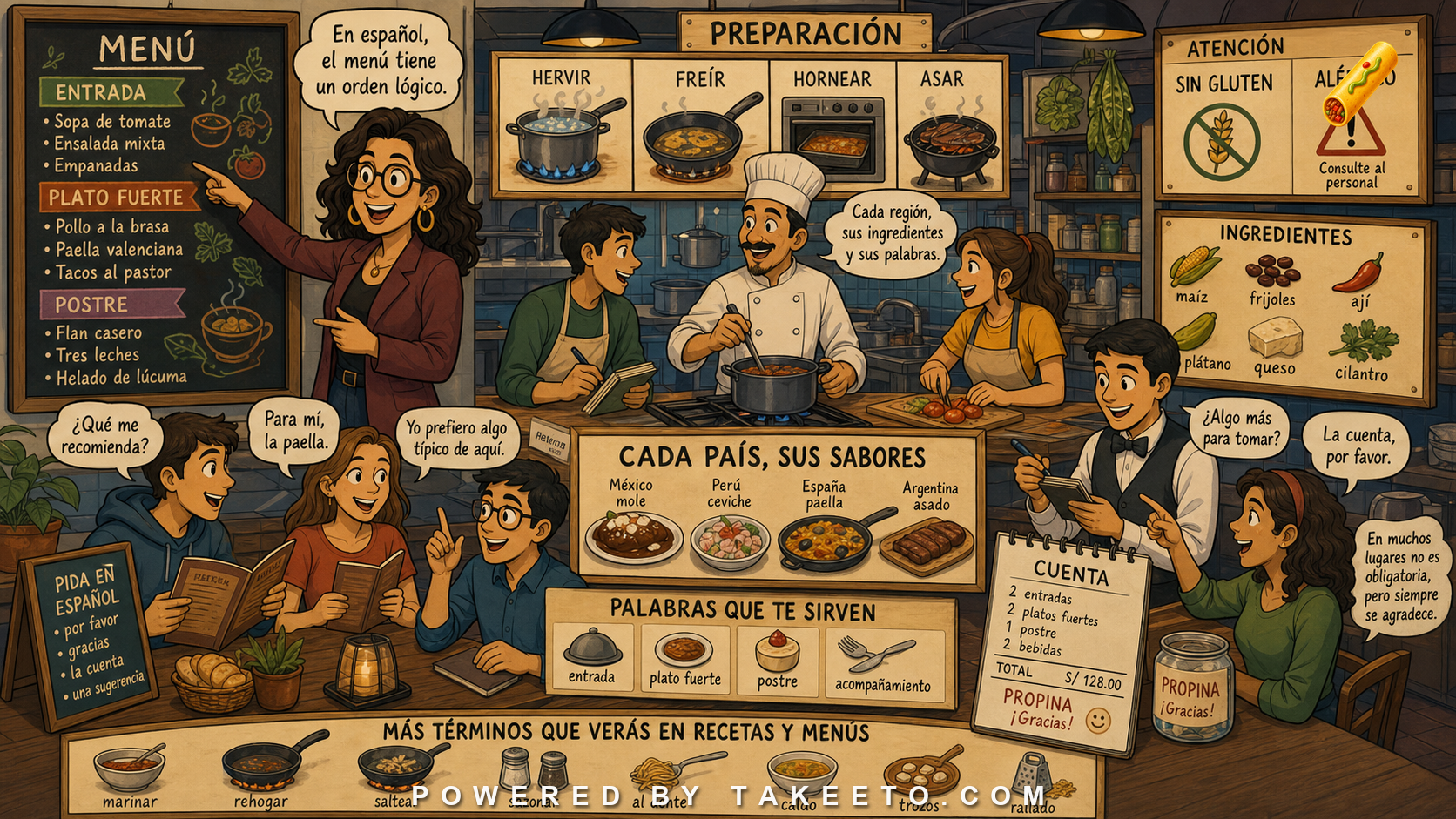
Menu structure: entrada, plato fuerte, postre
Common menu categories include entrada / entrante, plato fuerte / plato principal, acompañamiento / guarnición, postre, bebida, menú del día, and carta. In some regions, entrada is common; in Spain, entrante may be frequent. Plato fuerte is common in many Latin American contexts; plato principal is widely understood.
Learner action: do not assume menu category words are identical everywhere.
Ordering politely
Restaurant requests vary by setting. Useful neutral phrases include quisiera, ¿me puede traer...?, ¿qué recomienda?, la cuenta, por favor, and ¿está incluido el servicio?
Cuenta here means bill/check, not bank account. Propina is tip. Tipping norms differ by country and setting, so read the bill and local expectations.
Ingredients and dietary restrictions
Common ingredient and restriction language includes ingredientes, contiene, puede contener trazas de, sin gluten, sin lactosa, vegetariano, vegano, alérgico/a a, intolerante a, frutos secos, and mariscos.
Allergy language should be precise. Soy alérgico al maní/cacahuate/cacahuete may need regional adjustment. In some places, peanut is maní; in others, cacahuate or cacahuete.
Learner action: for serious allergies, use written local wording and confirm with staff.
Cooking verbs in recipes
Recipes use a compact technical vocabulary: hervir, freír, hornear, asar, saltear, cocer / cocinar, pelar, picar, cortar, mezclar, batir, añadir / agregar, sazonar / condimentar.
Cocer and cocinar differ by region and construction. In Spain, cocer is common for boiling/cooking food in water; in many Latin American contexts, cocinar is broader and more common.
Recipe grammar: infinitives, commands, and se
Recipes may use infinitives, formal commands, second-person commands, or impersonal se.
Examples:
Pelar las papas y cortarlas en cubos.
Peel the potatoes and cut them into cubes.
Agregue sal al gusto.
Add salt to taste.
Se hornea durante 30 minutos.
It is baked for 30 minutes.
Learner action: learn recipe grammar as procedural instruction, not as full conversation.
Regional ingredient traps
Some food words vary sharply: maíz / elote / choclo, papa / patata, frijoles / judías / porotos / alubias, aguacate / palta, durazno / melocotón, fresa / frutilla, banana / plátano / guineo.
Plátano is especially risky because it can refer to banana or plantain depending on country and context. The menu may clarify by preparation: plátano frito, plátano maduro, banana, guineo.
Learner action: when food matters, localize your vocabulary.
Example bank walkthrough
entrada
Starter/appetizer in many contexts.
Learner action: compare with entrante.
plato fuerte
Main dish, common in many Latin American contexts.
Learner action: also recognize plato principal.
postre
Dessert.
Learner action: stable and widely useful.
hervir
Boil.
Learner action: often appears in recipes.
freír
Fry.
Learner action: notice accent in freír.
hornear
Bake.
Learner action: common in written recipes.
sin gluten
Gluten-free.
Learner action: for medical need, confirm contamination risk.
alérgico
Allergic.
Learner action: match gender: alérgico/alérgica.
cuenta
Restaurant bill/check.
Learner action: domain changes meaning.
propina
Tip.
Learner action: local norms vary.
Remediation notes: menu Spanish is regional and risk-sensitive
Food Spanish looks friendly, but it can become high-stakes when allergies, medical restrictions, religious diets, or unfamiliar ingredients are involved. The remediation pass should make this explicit: do not rely on a generic translation of a menu item when the consequence matters. Ask about ingredients, preparation, and cross-contact.
The key distinction is between dish names and ingredient facts. A menu item may have a poetic or regional name that does not list everything in the dish. Salsa, adobo, mole, sofrito, guiso, relleno, caldo, and crema can hide multiple ingredients. Sin gluten, sin lactosa, sin azúcar, vegetariano, vegano, apto para celíacos, and contiene frutos secos require exact interpretation, not vibes.
A useful allergen sentence pattern:
Soy alérgico/a a los frutos secos. ¿Este plato los contiene o puede haber contaminación cruzada?
Another:
No puedo comer mariscos. ¿La salsa lleva caldo de camarón o algún producto del mar?
Learners also need a regional-food warning. Tortilla is not the same object everywhere. Frijoles, porotos, habichuelas, judías, and alubias vary regionally. Jugo and zumo differ by region. Palta and aguacate refer to the same fruit in different areas. Elote, choclo, and maíz overlap but are not always interchangeable in menus.
Recipe grammar deserves stronger treatment. Recipes often use infinitives:
Añadir la harina. Mezclar bien. Hornear durante 20 minutos.
They may use imperatives:
Añada la harina. Mezcle bien.
Or impersonal/reflexive-looking se:
Se añade la harina y se mezcla hasta obtener una masa homogénea.
These styles differ in tone, not basic cooking logic. The learner should understand all three.
Restaurant politeness also varies. La cuenta, por favor is widely understood. ¿Me trae la cuenta, por favor? is polite. ¿Me regala la cuenta? occurs in some regions but should not be treated as universal. Propina practices vary by country and setting; language can tell you whether a service charge is included, suggested, optional, or expected.
Repair rule:
In food Spanish, dish names are not enough. Read ingredients, preparation, dietary labels, regional terms, and service context.
Suggested interactive module: menu/recipe glossary with regional tags
A strong tool for this article would make food Spanish local and practical.
Suggested functions:
- Menu category parser: entrada, plato principal, postre, bebida.
- Ingredient regional map: papa/patata, frijol/judía/poroto, aguacate/palta.
- Allergy card builder: local wording for serious restrictions.
- Recipe verb trainer: hervir, freír, hornear, saltear, picar.
- Grammar mode: infinitive, command, impersonal se.
- Flavor/texture tags: crujiente, tierno, picante, ahumado.
- Bill decoder: cuenta, servicio, propina, impuesto.
- Restaurant phrase selector: casual, polite, formal, allergy-sensitive.
Final rule
Food Spanish is not one vocabulary list.
Menus, recipes, allergies, and restaurant interactions each have their own grammar and regional vocabulary. When food affects health, guesswork is not acceptable.