
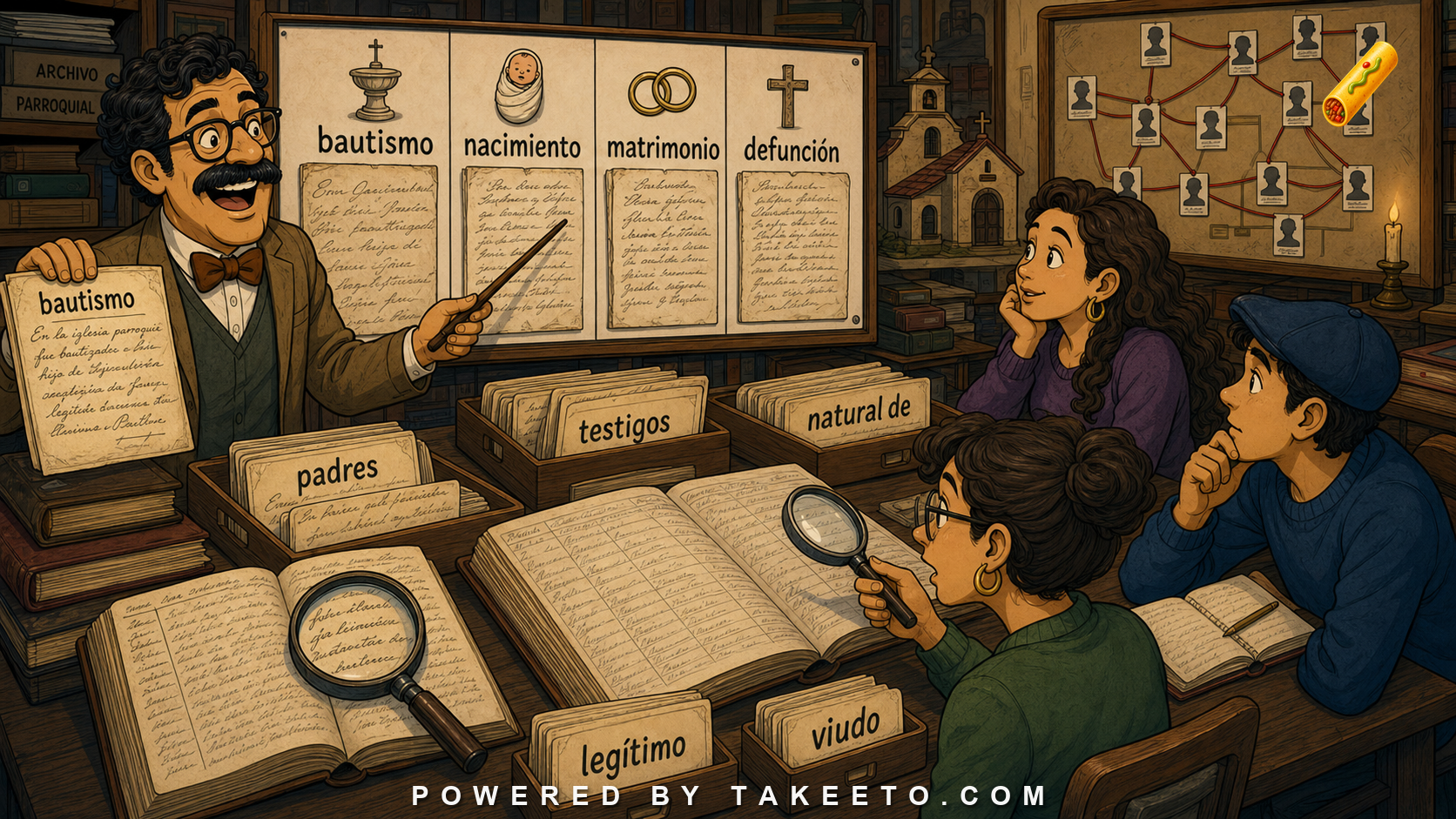
Genealogy records are formula-driven
Spanish genealogical records are often easier than they first appear because they use repeated formulas. A baptism entry, marriage record, or death record may look dense, but the same fields recur: date, place, person, parents, witnesses, residence, legitimacy status, spouse, age, and official.
The key principle is:
Genealogy Spanish is field reading: identify the record type, then extract names, dates, places, relationships, and status terms.
Do not translate every word from the beginning. Build the record grid first.
Church and civil records
Spanish-speaking countries and communities have both church and civil records, depending on period and place.
Church terms:
bautismo — baptism
matrimonio — marriage
entierro / sepultura — burial
defunción — death/death record, depending on context
parroquia — parish
cura / presbítero — priest
padrino / madrina — godparent
Civil terms:
nacimiento — birth
matrimonio civil — civil marriage
defunción — death
registro civil — civil registry
acta — record/certificate entry
certificado — certificate
juez / oficial — official/judge, depending on system
A baptism record is not identical to a birth certificate. It may include birth date, but sometimes only baptism date is explicit.
Bautismo and nacimiento
A baptism record often begins with a date and parish formula.
Common phrases:
En la parroquia de...
bauticé solemnemente a...
nació el día...
hijo legítimo de...
fueron padrinos...
Fields to extract:
- Date of baptism.
- Name of child.
- Birth date if provided.
- Parents.
- Legitimacy/status phrase.
- Godparents.
- Parish/place.
- Priest/official.
Example-style sentence:
Bauticé a María, nacida el día anterior, hija legítima de José Ramírez y Ana López.
Translation function:
The priest baptized María, born the previous day, legitimate daughter of José Ramírez and Ana López.
Matrimonio
Marriage records identify spouses and often parents, residence, marital status, witnesses, dispensations, and banns.
Terms:
contrayentes — contracting parties/spouses
esposo / esposa — husband/wife
novio / novia — groom/bride, depending on record style
soltero / soltera — unmarried/single
viudo / viuda — widower/widow
natural de — native of / born in
vecino de — resident of
hijo de — son of
testigos — witnesses
impedimento — impediment
dispensación — dispensation
Example:
Juan Pérez, natural de Córdoba y vecino de esta ciudad, hijo de Pedro Pérez y María Ruiz, contrajo matrimonio con...
Natural de is a major genealogical phrase. It usually points to origin or birthplace, not personality.
Defunción and burial records
Death records vary widely. They may include age, spouse, parents, cause of death, burial place, sacraments, residence, and social status.
Terms:
falleció — died
murió — died
defunción — death
entierro — burial
sepultura — burial/grave
edad — age
viudo / viuda — widower/widow
cónyuge — spouse
causa de muerte — cause of death
testó — made a will
no testó — did not make a will
Example:
Falleció a la edad de setenta años, viuda de Manuel García.
She died at the age of seventy, widow of Manuel García.
Ages in older records can be approximate. Treat them as clues, not always exact facts.
Parents, grandparents, and kinship
Core kinship terms:
padre — father
madre — mother
padres — parents
abuelo / abuela — grandfather/grandmother
abuelos paternos — paternal grandparents
abuelos maternos — maternal grandparents
hijo / hija — son/daughter
hermano / hermana — brother/sister
cónyuge — spouse
consorte — spouse, often formal/older
Padres in Spanish means parents, not fathers only, though context can vary historically. If the document lists padres, expect mother and father.
Legitimacy and sensitive labels
Genealogical records may include status terms:
legítimo / legítima
natural
ilegítimo / ilegítima
expósito / expósita
de padres no conocidos
hijo de padre no declarado
These terms reflect legal, religious, and social categories of the time. They can be painful or stigmatizing. Treat them as record terms, not moral judgments.
Example:
hija legítima de...
legitimate daughter of...
hijo natural de...
natural child of...
The exact legal meaning can vary by period and place. Do not overinterpret without context.
Handwriting and abbreviations
Genealogy research often requires reading handwriting. Common difficulties:
abbreviated names
inconsistent spelling
old letterforms
Latin phrases
damaged pages
repeated formulas
marginal notes
Names may vary:
Ximénez / Jiménez
Ysabel / Isabel
Joseph / José
Antonia / Ant.ª
Do not assume spelling was fixed. A person’s surname may appear in several forms.
Field-by-field extraction beats full translation
A beginner may try to translate the whole record and get stuck. Better:
| Field | Question |
|---|---|
| Record type | baptism, marriage, death? |
| Date | when was the event recorded? |
| Event date | birth, marriage, death date if different? |
| Person | who is the record about? |
| Parents | who are named? |
| Spouse | if marriage/death record? |
| Origin | natural de? |
| Residence | vecino de? |
| Witnesses | testigos? |
| Status | legítimo, viudo, soltero? |
| Official | priest, judge, registrar? |
Once the grid is filled, translation becomes easier.
Example bank walkthrough
bautismo
Baptism.
Learner action: distinguish baptism date from birth date.
nacimiento
Birth.
Learner action: look for civil record or birth date inside baptism record.
matrimonio
Marriage.
Learner action: extract spouses, parents, witnesses, origin, residence.
defunción
Death/death record.
Learner action: look for age, spouse, burial, and will information.
padres
Parents.
Learner action: do not read as only fathers.
testigos
Witnesses.
Learner action: record names; they may be relatives or community members.
natural de
Native of/born in.
Learner action: treat as origin clue.
legítimo
Legitimate, in historical legal/religious status terms.
Learner action: record carefully without moralizing.
viudo
Widower.
Learner action: use to identify prior spouse and distinguish individuals.
Genealogy-record reading workflow
- Identify record type.
- Transcribe names as written.
- Extract dates separately from event dates.
- List all named people and roles.
- Mark kinship terms.
- Record origin and residence phrases.
- Note witnesses and godparents.
- Preserve spelling variants.
- Flag uncertain readings instead of guessing.
- Cross-check across multiple records.
Remediation: genealogy records are evidence, not ready-made family stories
Spanish genealogical records are tempting because they appear to offer direct answers: birth, marriage, death, parents, place, and date. But they are still institutional documents. A baptism record is not identical to a birth certificate. A marriage record may encode legitimacy, residence, social status, witnesses, dispensations, and church procedure. A death record may report approximate age or incomplete family information.
The remediation rule is:
Extract fields first; build narrative later.
Do not begin with “this proves the family story.” Begin with:
What kind of record is this?
Who produced it?
What event does it record?
What information is firsthand, and what may be reported by someone else?
What is missing?
Names are unstable
Names in Spanish records may vary across time and documents. You may see:
given name variants, multiple surnames, maternal/paternal surname order, spelling variation, saints’ names, abbreviations, omitted second surnames, married women identified through spouses, children identified through parents.
A person called María Josefa in one record may appear as Josefa, María J., or with a spelling variation in another. Surnames can shift in spelling: Giménez/Jiménez, Vázquez/Básquez, de la Cruz/De la Cruz. Historical handwriting adds another layer.
Do not reject a possible match only because spelling differs. Do not accept a match only because a name is similar. Use date, place, relatives, witnesses, occupation, and residence together.
Mini-workshop: field-by-field annotation
Simplified baptism record:
En esta parroquia fue bautizado José, hijo legítimo de Manuel García y Ana Ruiz, naturales de Puebla y vecinos de esta feligresía. Fueron padrinos Pedro López y María Santos.
Fields:
record type = baptism.
child = José.
parents = Manuel García and Ana Ruiz.
legitimacy phrase = hijo legítimo.
origin = naturales de Puebla.
residence/parish connection = vecinos de esta feligresía.
godparents/witnesses = Pedro López and María Santos.
The record does not necessarily give José’s birth date unless another phrase states it. It records baptism. Some baptism records include birth date; some do not. That distinction matters.
Common genealogical terms that carry extra weight
natural de — native of/from; often place of origin.
vecino de — resident or recognized member of a locality, not simply “neighbor.”
feligresía — parish community.
hijo legítimo / natural — legitimacy categories with historical and legal/religious significance.
viudo/a — widowed.
difunto/a — deceased.
padrino/madrina — godparent, not only sponsor in a casual sense.
testigo — witness.
Treat legitimacy terms carefully. They reflect institutional categories and social norms of the record’s time. Do not import them into modern moral judgment.
Date and place traps
Spanish records may use written dates, feast days, regnal years, local calendar conventions, or abbreviated month names. Place names may change, merge, split, or refer to parishes rather than modern municipalities.
A record may say en esta parroquia, which only makes sense if you know the parish named elsewhere in the page or book. A margin note may contain the key place. A later civil copy may normalize old spelling.
Good practice:
Record the date exactly as written.
Record a normalized date separately.
Record the place exactly as written.
Add modern place identification only with evidence.
Corroboration workflow
Genealogical Spanish should be read across records, not in isolation. A baptism record can be compared with marriage, death, census, military, notarial, immigration, or land records. Witnesses and godparents may reveal kin networks. Repeated occupations or addresses can distinguish two people with the same name.
A Takeeto module could show a cluster of three records and ask the learner to decide whether they refer to the same person, requiring evidence rather than intuition. That is the real skill: Spanish reading plus historical inference discipline.
Remediation drill: kinship terms need record logic
Genealogy learners often confuse biological, spiritual, legal, and marital relationships. Spanish records may name all of them close together.
Key terms:
padre / madre — parent
abuelos paternos / maternos — paternal/maternal grandparents
padrino / madrina — godparent/sponsor
cónyuge / esposo / esposa — spouse
viudo / viuda — widower/widow
testigo — witness
declarante — person making the declaration
compareciente — person appearing before the authority
A baptism record may list parents and godparents. A marriage record may list parents, witnesses, previous spouses, and dispensations. A death record may list spouse, parents, informant, and burial details. Do not convert every named adult into a parent.
Practice sentence:
Fueron padrinos Antonio Silva y Rosa Medina, vecinos de esta parroquia.
Correct reading:
Antonio Silva and Rosa Medina were godparents/sponsors, not necessarily relatives.
Another:
Declaró la defunción su yerno, Manuel Ortiz.
Correct reading:
The death was reported by the person's son-in-law, Manuel Ortiz.
Cross-checking principle
Never build a family tree from one label alone when the record type is ambiguous. Cross-check dates, places, spouses, witnesses, and repeated names. A witness can be a relative, but the word testigo alone does not prove kinship. A godparent can be a relative, patron, neighbor, or community sponsor.
Learner rule:
In genealogical Spanish, relationship words are evidence; they are not the whole proof.
Suggested interactive module: genealogy record annotation template
A strong tool for this article would turn records into structured fields.
Suggested functions:
- Record-type selector: baptism, birth, marriage, death, burial.
- Field extraction grid: date, person, parents, spouse, witnesses.
- Kinship highlighter: hijo de, viuda de, padres, abuelos.
- Origin/residence tagger: natural de, vecino de.
- Status caution labels: legítimo, natural, expósito.
- Name-variant tracker: spelling alternatives across records.
- Uncertainty marker: unclear letters or damaged text.
Final rule
Genealogy Spanish is best read as structured evidence.
Identify the record type, extract fields, preserve uncertainty, and treat historical status terms with care. Baptism, marriage, and death records can be rich, but they are formulaic, institutional, and sometimes approximate. A good genealogical reader is patient, literal where necessary, and cautious where the document is unclear.