
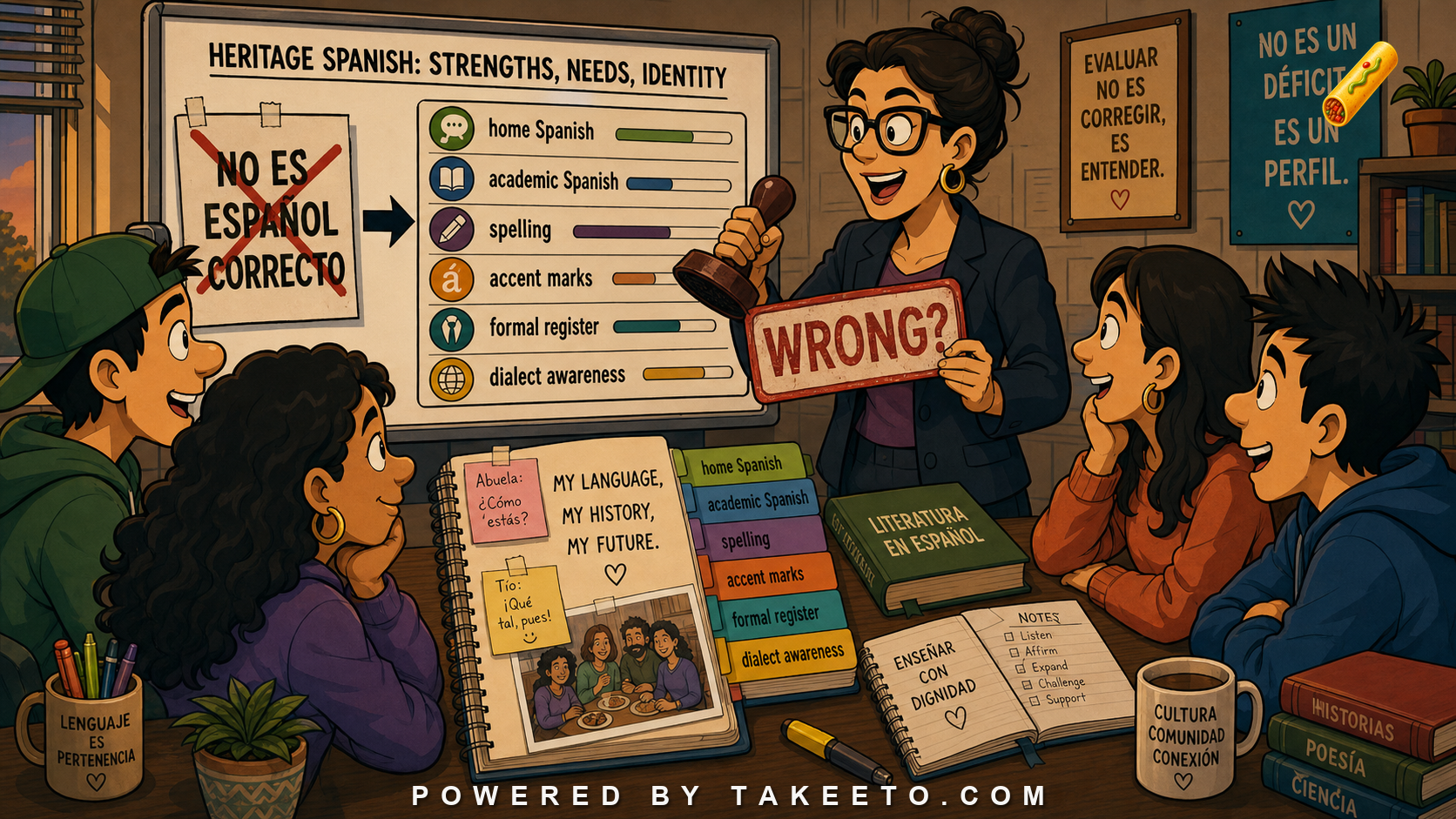
Heritage Spanish is not failed classroom Spanish
A heritage speaker is not simply a learner who started early. A heritage Spanish speaker usually grows up with Spanish in the family, neighborhood, religious community, workplace, media world, or local bilingual ecology, while also being educated partly or mainly in another dominant language. In the United States, that dominant language is usually English, but the same broad profile can appear wherever Spanish is maintained across generations outside a Spanish-dominant school system.
The mistake is to measure heritage speakers with the same ruler used for beginning second-language students. A heritage speaker may understand rapid family speech, recognize regional idioms, switch registers with relatives, and carry emotional knowledge of Spanish that an advanced classroom learner does not have. The same person may struggle with accent marks, formal writing, academic vocabulary, gender agreement in edited prose, or terminology for institutions. That combination is not a contradiction. It is the natural shape of a language learned across unequal domains.
The key principle is:
Heritage Spanish is a linguistic resource with uneven domain development, not broken Spanish waiting to be replaced.
The educational task is expansion: more registers, more literacy, more dialect awareness, more metalinguistic control. Replacement is the wrong model.
Oral strength and literacy gaps can coexist
Many heritage speakers have strong listening comprehension and informal speaking ability. They may understand jokes, family conflict, childcare instructions, food vocabulary, religious formulas, insults, affectionate diminutives, and everyday narrative. But literacy is a separate layer. Reading a legal notice, writing an academic paragraph, placing accent marks, using punctuation in formal email, or choosing between por consiguiente and entonces may require explicit instruction.
A learner who grew up saying mi abuela vive con nosotros may still ask whether abuela takes an accent mark. That is not evidence of weak Spanish. It is evidence that speech and writing are different systems.
Heritage instruction should make this difference explicit. A student who speaks Spanish at home does not automatically know how to write a literature analysis, a professional email, or a résumé bullet in Spanish. A child who has heard pa for para in fast family speech may need to learn when reduced forms are normal in conversation and when full forms are expected in formal writing.
Learner action: separate “Can I say this naturally at home?” from “Can I write this in a school, professional, or institutional register?” Both questions matter.
Dialect stigma does real damage
Heritage speakers are often told that their family Spanish is “incorrect,” “slang,” “mixed,” “not real,” or “too regional.” This is lazy teaching. Every Spanish speaker speaks some variety. Mexican, Caribbean, Central American, Andean, Colombian, Chilean, Rioplatense, U.S. Latino, Peninsular, and local family varieties are not deviations from an imaginary neutral Spanish. They are Spanish.
That does not mean every form belongs in every context. A serious speaker learns range. Haiga, fuistes, ansina, parquear, lonche, vos, ustedes, usté, la calor, or regional object-pronoun patterns can have different distributions, histories, social meanings, and register values. The teacher’s job is not to shame the speaker. The teacher’s job is to explain where forms circulate, how they are perceived, and what alternatives are expected in formal settings.
A better classroom sentence is not “Don’t say that; it’s wrong.” It is: “That form exists in your community. In formal written Spanish, this other form is expected. Let’s learn both the community form and the standard-register form.”
Common grammatical profiles
Heritage Spanish often shows strengths and vulnerabilities shaped by input, schooling, and language dominance. Some speakers handle complex narrative tense beautifully but hesitate in academic subjunctive clauses. Some have native-like pronunciation but limited formal vocabulary. Some understand regional pronouns but have never seen vosotros. Some use family vocabulary for food and kinship but lack terms for civics, science, banking, or medical forms.
Common areas for expansion include:
- accent marks and spelling conventions,
- formal object-pronoun choice,
- subjunctive in written registers,
- academic connectors,
- nominalization,
- professional email formulas,
- standard punctuation,
- dialect comparison,
- reading stamina,
- heritage-to-standard translation skills.
None of these areas proves deficiency. They are normal instructional targets.
Identity is part of the grammar classroom
For many heritage speakers, Spanish is not only a subject. It is family memory, embarrassment, pride, grief, regional belonging, immigration history, racialization, humor, music, religion, food, and responsibility. A classroom that ignores identity will misread hesitation as laziness or pride as resistance.
A heritage speaker may avoid Spanish because they were mocked by relatives. Another may overclaim fluency because admitting gaps feels like betraying family. Another may understand everything but speak little because they were always answered in English. Another may be pushed into interpreting adult medical or legal situations before they have the language to do it safely.
Good instruction respects these realities without turning the classroom into therapy. It gives learners tools: name the variety, describe the register, expand the repertoire, and separate personal worth from formal accuracy.
Expansion, not replacement
A strong heritage curriculum should do four things.
First, it should validate the speaker’s existing Spanish. This means using real family and community language as data, not as a punching bag.
Second, it should build literacy: accentuation, paragraph structure, punctuation, reading strategies, editing, and genre awareness.
Third, it should teach register. The same speaker needs tools for texting a cousin, speaking to a patient, writing to a professor, reading a lease, and understanding a government form.
Fourth, it should teach dialect awareness. Students should learn that vos, ustedes, coger, platicar, guagua, chamba, ordenador, and computadora have geography and social meaning.
Example bank walkthrough
home Spanish
The Spanish of family, neighborhood, religious life, local media, and community interaction.
Learner action: treat it as real data, then learn what registers it does and does not cover.
academic Spanish
The Spanish of essays, lectures, evidence, formal argument, and school assessment.
Learner action: build connectors, nominalizations, paragraph patterns, and source language.
spelling
Heritage speakers may know a word by sound but not by written convention.
Learner action: study spelling as literacy, not as proof of authenticity.
accent marks
Accent marks encode stress, distinctions, and grammatical contrasts.
Learner action: learn accentuation rules systematically rather than word by word only.
formal register
The style used in institutional, professional, academic, and public settings.
Learner action: add formal options without erasing informal fluency.
dialect awareness
Understanding where forms come from and how they are perceived.
Learner action: learn to say “This is common in my community; this is expected in formal writing.”
Remediation notes: expansion without erasure
The main repair for a heritage-Spanish article is to make the instructional target sharper. Heritage learners do not need a teacher to “clean up” family Spanish. They need more range. Range means being able to recognize a home form, name its social meaning, and produce another form when school, publishing, work, or official writing calls for it.
A useful classroom contrast is not wrong/right. It is community form / formal written form / regional alternative / high-stakes safest form. For example, a speaker may hear pa for para in fast family speech and still need para in an academic essay. A speaker may use lonche or troca locally and still need to recognize almuerzo, comida, camión, camioneta, or furgoneta elsewhere. A speaker may understand family usté or reduced endings while needing full spellings in writing. The mature lesson is not shame. It is control.
The article also needs a receptive-profile warning. Some heritage speakers are strong receptive bilinguals: they understand Spanish well but produce little. Others speak comfortably but read slowly. Others use Spanish fluently in family topics but lack civic, medical, legal, academic, or professional vocabulary. A single placement test can misread all of these profiles. The better diagnostic asks by domain: home conversation, storytelling, reading, spelling, accent marks, formal email, argument writing, grammar vocabulary, regional awareness, and translation under pressure.
Teachers should also avoid treating “standard Spanish” as a replacement identity. Standard written forms are useful tools because they travel through institutions. They are not a moral upgrade over family speech. A heritage learner who learns haya alongside a community haiga, or fuiste alongside fuistes, is not abandoning family. They are adding a register.
Production target: give learners sentence frames that expand rather than erase. En mi familia se dice X; en escritura formal se espera Y. Esta palabra es común en mi comunidad, pero para un público internacional usaría Z. That habit turns dialect awareness into literacy instead of insecurity.
Suggested interactive module: heritage learner profile map
A strong tool for this article would map competence by domain rather than giving one crude fluency score.
Suggested functions:
- Domain profile: home, school, work, public services, media, literature, formal writing.
- Skill split: listening, speaking, reading, writing, editing, interpreting.
- Register slider: intimate, informal, neutral, professional, academic, legal/medical caution.
- Dialect inventory: family-region vocabulary and grammar labels.
- Expansion goals: spelling, accent marks, formal email, academic argument, terminology.
- Confidence notes: areas of pride, shame, avoidance, and practical need.
- Portfolio mode: collect samples of speech, texts, emails, and rewritten versions.
Final rule
Heritage Spanish is not failed Spanish. It is Spanish distributed unevenly across family, community, school, literacy, and public life.
Do not replace it. Expand it. Teach standard registers without humiliating local speech. Teach grammar without attacking identity. Build range.