
Music Spanish is not only the names of genres
Learners often approach Spanish music through genres first:
salsa
reguetón
flamenco
rock en español
corrido
bachata
Genre names are useful, but they are only the surface. If you want to read interviews, reviews, album notes, streaming metadata, copyright notices, concert announcements, or serious criticism, you need a wider vocabulary. Music Spanish talks about composition, performance, voice, instruments, arrangement, rights, recording, audience, tradition, and interpretation.
The key principle is:
Music Spanish separates the song as a work, the recording as an object, and the performance as an event.
English often collapses these in casual speech. Spanish can too, but formal and specialist contexts distinguish them carefully.
Canción, tema, pista, sencillo, álbum
A canción is a song. It may be a composition, a recorded track, or something performed live, depending on context.
La canción fue compuesta en 1982.
The song was composed in 1982.
La canción abre el álbum.
The song opens the album.
Tema is common in reviews, radio, and music journalism. It can mean track, tune, song, or musical piece.
El disco incluye diez temas.
The record includes ten tracks.
Pista is more technical or release-oriented: track.
La tercera pista tiene una mezcla distinta.
The third track has a different mix.
Sencillo means single. In many Latin American contexts, single also appears, especially in music industry and streaming contexts.
El sencillo se lanzó antes del álbum.
The single was released before the album.
Álbum, disco, and larga duración overlap but carry different register and era associations. Disco may mean album, record, or disc; álbum is common in streaming and criticism; LP appears in collector and industry writing.
A useful learner habit is to ask:
Is the text talking about the musical work, the recording, the release, or the physical/digital product?
Letra is not just “letter”
In music Spanish, letra usually means lyrics.
La letra habla de la migración.
The lyrics are about migration.
La letra combina humor y crítica social.
The lyrics combine humor and social criticism.
The word lyrics can be translated as la letra, las letras, or la lírica, depending on context. La lírica may refer to lyric poetry, the expressive quality of a song, or the words of the song in a more literary register.
Do not confuse:
letra — lyrics / letter / handwriting, depending on context
letra de cambio — bill of exchange
letra pequeña — fine print
In music, context usually resolves it.
A major caution: lyrics are creative texts. They may be poetic, regional, compressed, intentionally ungrammatical, archaic, vulgar, playful, or code-switched. Do not treat every lyric line as a model for ordinary formal Spanish.
Verse, chorus, bridge, and structure
Song-structure vocabulary is essential for talking about form.
Common terms:
verso — verse
estrofa — stanza/verse section
coro / estribillo — chorus/refrain
puente — bridge
introducción — intro
cierre / final — ending
repetición — repetition
Coro and estribillo often overlap. Estribillo is the more traditional term for the repeated refrain; coro is extremely common in popular music discussion and may also refer to a choir or background vocal group. Context matters.
Examples:
El estribillo es más pegadizo que las estrofas.
The chorus is catchier than the verses.
El coro entra después del segundo verso.
The chorus comes in after the second verse.
Los coros acompañan la voz principal.
The backing vocals accompany the lead voice.
Here coros means backing vocals, not chorus section. The same word can name a formal section or a vocal function.
Interpretar, tocar, cantar, ejecutar
Performance Spanish distinguishes several actions.
cantar — to sing
tocar — to play an instrument
interpretar — to perform / interpret
ejecutar — to perform, usually more formal or technical
versionar — to cover / make a version of
grabar — to record
Interpretar is especially important because it does not merely mean “translate” or “interpret meaning.” In music, it means to perform a work.
La cantante interpretó tres canciones inéditas.
The singer performed three unreleased songs.
La orquesta interpretará obras de Falla.
The orchestra will perform works by Falla.
Ejecutar appears in formal classical, institutional, or technical writing.
La pieza fue ejecutada con gran precisión.
The piece was performed with great precision.
In ordinary conversation, ejecutar may sound stiff unless the register supports it.
Composer, performer, arranger, producer
Music credits contain many roles.
compositor / compositora — composer/songwriter
letrista — lyricist
autor / autora — author, often of words/music depending on rights context
intérprete — performer
cantante — singer
músico / música — musician
arreglista — arranger
productor / productora — producer
director / directora — conductor/director, depending on context
The word autor deserves care. In everyday English, “author” is usually literary. In Spanish rights language, autor can refer to the creator of a musical work. A song may have authors of lyrics and music; a recording may have performers and producers.
A reader of credits should ask:
Who wrote the work? Who performed it? Who arranged it? Who produced the recording? Who owns or administers rights?
Rights language: derechos, autoría, licencia
Music appears in legal and platform contexts as well as cultural ones.
Core terms:
derechos de autor — copyright / authors’ rights
regalías — royalties
licencia — license
titular de derechos — rights holder
dominio público — public domain
reproducción — reproduction
distribución — distribution
comunicación pública — public communication/performance, depending on jurisdiction
autorización — authorization
Example:
La reproducción de la obra requiere autorización del titular de los derechos.
Reproduction of the work requires authorization from the rights holder.
This is not vocabulary to improvise casually in high-stakes settings. Copyright terms vary by jurisdiction. A platform notice, licensing agreement, or contract deserves professional review when money or legal exposure is involved.
For learners, the first step is not legal judgment. It is structural reading: who has rights, what use is allowed, what use is restricted, and what permission is required.
Lyric language is not normal prose
Lyrics compress Spanish differently from essays, news, and conversation. They may omit subjects, bend word order, rhyme across dialects, use archaic forms, mix registers, invent metaphors, or rely on regional speech.
A lyric line may use:
tú, vos, usted, or no pronoun at all
Caribbean elision
Andalusian or Mexican vocabulary
English borrowings
colloquial spelling
poetic inversion
double meaning
Learner mistake:
“I heard this in a song, so I should say it in a normal email.”
Better:
“I heard this in a song. I need to identify its register, dialect, poetic function, and whether ordinary speakers use it outside music.”
Music is a powerful listening tool, but not every lyric is a safe production model.
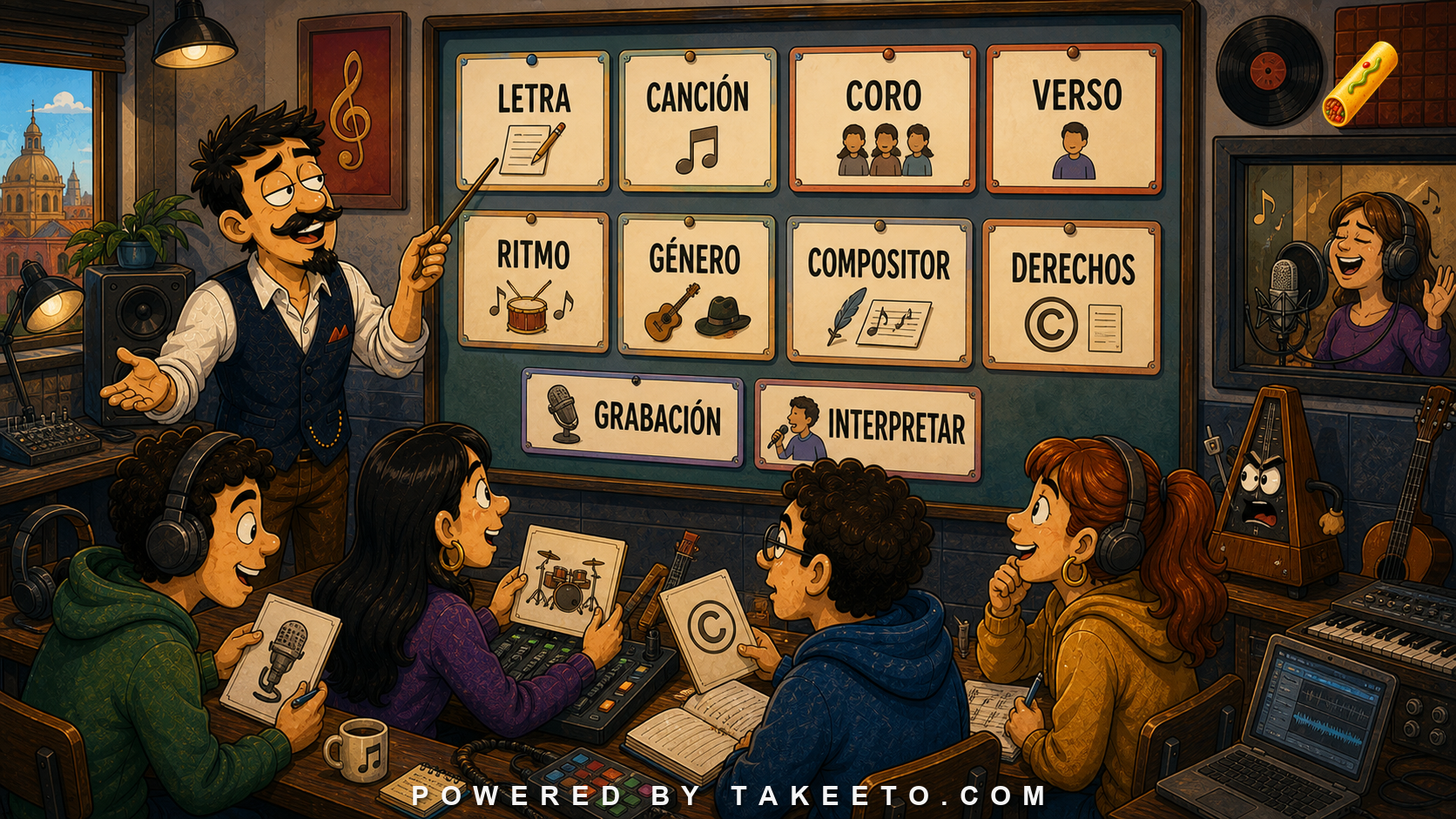
Example bank walkthrough
letra
In music, lyrics.
Learner action: identify whether the text discusses words, handwriting, or fine print.
canción
Song as a broad term.
Learner action: check whether the context means composition, recording, or performance item.
coro
Chorus section, choir, or backing vocals.
Learner action: use surrounding verbs to classify the meaning.
verso
Verse or line-like poetic unit.
Learner action: distinguish verso from estrofa when reading criticism.
ritmo
Rhythm, beat, rhythmic feel.
Learner action: notice collocations such as ritmo bailable, ritmo lento, cambio de ritmo.
género
Genre.
Learner action: do not reduce a song to genre alone; add performance, lyric, and production vocabulary.
compositor
Composer/songwriter.
Learner action: distinguish composer from singer and producer.
derechos
Rights.
Learner action: in legal contexts, map permissions and restrictions carefully.
grabación
Recording.
Learner action: distinguish live performance from recorded version.
interpretar
To perform a piece.
Learner action: do not translate automatically as “interpret meaning.”
Music-reading workflow
When reading Spanish about music:
- Identify the object: song, track, album, performance, video, score, or rights notice.
- Separate roles: composer, lyricist, performer, producer, arranger, label.
- Mark structure words: verso, estribillo, coro, puente.
- Mark evaluation words: pegadizo, íntimo, potente, repetitivo, irregular.
- Check register: review, interview, fan comment, academic article, legal notice.
- Treat lyrics as artistic language, not default prose.
- Map rights language cautiously.
- Look for regional vocabulary and genre-specific terms.
- Translate function before translating individual words.
Remediation: separate work, recording, event, and rights
The most common learner error in music Spanish is collapsing everything into la canción. That is fine for casual conversation, but it becomes weak when reading reviews, credits, industry notes, and rights language. A song can exist as a composition before anyone records it. A recording can become famous even when the composition is older. A live performance can change the meaning of a familiar song. A license can authorize one use of the recording but not another use of the underlying composition.
A stronger reading grid has four columns:
| Question | Spanish clues | What you are identifying |
|---|---|---|
| What was written? | canción, obra, composición, letra, música | the underlying work |
| What was recorded? | grabación, pista, sencillo, álbum, versión | the recorded object |
| What was performed? | interpretar, tocar, cantar, concierto, directo | the live or performed event |
| What is legally controlled? | derechos, licencia, titular, autorización | the permitted use |
This grid prevents several bad translations. Interpretar una canción is usually to perform it, not to explain it. Autor in a rights note may mean songwriter or rights-relevant creator, not “book author.” Versión may mean a cover, an arrangement, a recording take, or a particular release. Derechos does not simply mean “rights” in the abstract; it points to who can authorize reproduction, performance, distribution, synchronization, quotation, or platform use.
A learner who reads music Spanish only through genre labels will miss the institutional language around music. A learner who reads only through legal terms will miss performance and aesthetic language. The point is to hold both together.
Mini-workshop: annotate a music blurb
Take this sentence:
La cantautora interpretó una versión acústica del tema principal, cuya letra fue escrita por su padre y cuyos derechos administra una editorial independiente.
A weak translation grabs isolated words: singer-songwriter, acoustic version, main theme, lyrics, father, rights. A stronger reading marks roles and relationships.
La cantautora = performer and likely authorial figure, but not automatically sole rights holder.
interpretó = performed.
una versión acústica = a particular arrangement/performance format.
del tema principal = of the main song/track/theme.
cuya letra fue escrita por su padre = lyrics written by her father.
cuyos derechos administra una editorial independiente = rights are administered by an independent publisher.
The sentence separates performance from authorship and authorship from rights administration. That is exactly the kind of separation music Spanish often requires.
Now rewrite the sentence in plain Spanish:
La artista cantó una versión acústica de la canción principal. La letra la escribió su padre. Los derechos de la obra los gestiona una editorial independiente.
The rewrite is less elegant but easier to parse. This is a good remediation exercise: first preserve the formal sentence, then unpack it into actor-action units.
Production practice: criticism without empty adjectives
Learners often describe music with vague praise:
La canción es muy bonita.
El ritmo es bueno.
La letra es interesante.
Those sentences are grammatical but thin. A more serious review identifies a feature and an effect:
El estribillo se apoya en una melodía sencilla, pero la repetición lo vuelve memorable.
La letra alterna imágenes religiosas con lenguaje cotidiano, lo que crea un tono íntimo.
La producción deja la voz casi al frente de la mezcla y reduce el peso de la percusión.
The pattern is:
feature + technique + effect
Useful verbs for this work:
combinar, alternar, construir, sostener, contrastar, reforzar, suavizar, intensificar, recuperar, transformar.
Do not overuse transmitir and expresar. They are useful, but they become lazy when every song “transmits feelings.” Name the concrete musical or lyrical feature when possible.
Caution: lyrics as learning material
Songs are excellent for repeated listening, pronunciation memory, cultural reference, and emotional attachment. They are weaker as a source for ordinary grammar rules. Lyrics may use nonstandard spelling, dialectal pronunciation, rhyme-driven word order, archaic formulas, intimate insults, erotic slang, religious echoes, or English contact. The learner should ask three questions before imitating a line:
- Would someone say this outside a song?
- If yes, who would say it, in what region, and to whom?
- Is the line poetic, colloquial, vulgar, humorous, sacred, political, or ordinary?
A good Takeeto-style activity would let the learner tag lyric lines by function: safe everyday phrase, poetic inversion, regional term, risky slang, formulaic refrain, or rights/metadata language. That prevents music from becoming either a toy or a trap.
Suggested interactive module: song metadata and lyric-language annotation card
A strong tool for this article would let learners annotate a song without reproducing copyrighted lyrics.
Suggested functions:
- Metadata fields: título, intérprete, compositor, álbum, año, género.
- Structure tags: verso, coro, puente, introducción, cierre.
- Register labels: colloquial, poetic, regional, vulgar, archaic, formal.
- Rights-note decoder: autor, licencia, titular, reproducción.
- Performance vocabulary: voz principal, coros, arreglo, producción, grabación.
- Learner caution box: lyrics are not automatically normal prose.
- Review prompt: describe the song without quoting it.
Final rule
Spanish music language is a full domain: art, performance, industry, criticism, and rights.
Learn more than genre names. Separate song, track, recording, and performance. Read letra as lyrics but treat lyrics as poetic data. Use interpretar for performance, map credits carefully, and approach rights language with caution.
Music can teach Spanish beautifully, but only if you know what kind of Spanish you are hearing.