
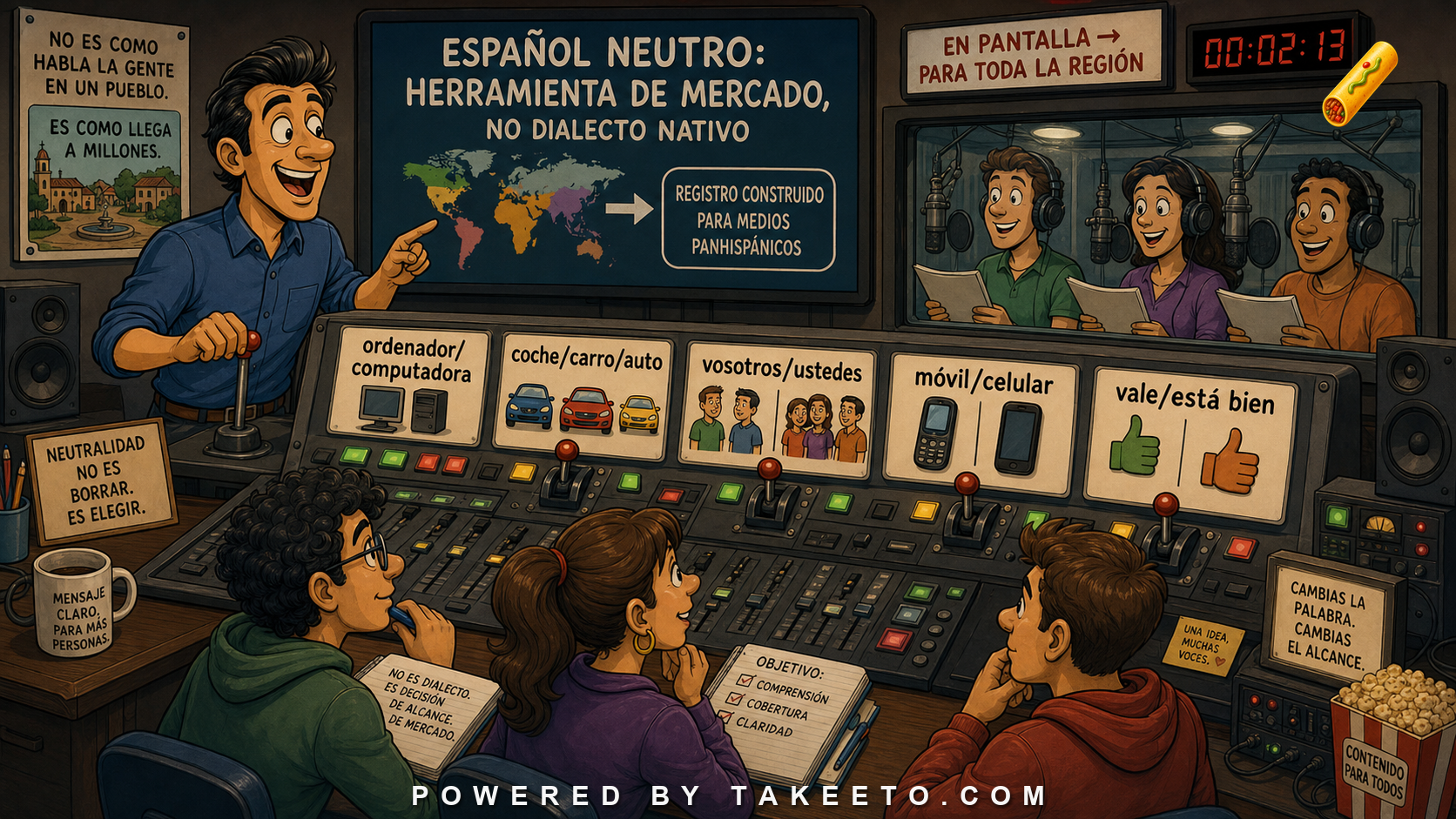
Neutral Spanish is made, not born
Learners sometimes hear about “neutral Spanish” and imagine a dialect that belongs to no country and all countries at once.
That is not quite right.
Neutral Spanish is a production strategy. It appears in dubbing, localization, publishing, customer support, educational materials, software, marketing, and international business. Its goal is to be widely understood and minimally distracting across many Spanish-speaking markets.
The key principle is:
Neutral Spanish is not a native dialect. It is an edited register designed for reach.
Nobody grows up speaking pure neutral Spanish at home in the full market sense. People grow up speaking Mexican Spanish, Colombian Spanish, Argentine Spanish, Castilian Spanish, Chilean Spanish, Caribbean varieties, Andean varieties, bilingual varieties, heritage varieties, and many others. Neutral Spanish is what editors create when they want one version to travel.
What neutral Spanish tries to avoid
Neutral Spanish often avoids words strongly associated with one region when a broader alternative exists.
Examples:
| Concept | Spain | Some Latin American options | Neutral strategy |
|---|---|---|---|
| computer | ordenador | computadora | choose based on market, often computadora for LatAm-wide content |
| car | coche | carro / auto | auto or vehículo may travel better in formal contexts |
| mobile phone | móvil | celular | choose by target market; teléfono may avoid conflict |
| okay / fine | vale | está bien / de acuerdo | avoid vale in broad LatAm localization |
| you plural informal | vosotros | ustedes | use ustedes for broad international reach |
Neutralization is not only vocabulary. It also affects pronouns, idioms, cultural references, humor, accent, and sometimes syntax.
Pronoun choices
The biggest obvious split is vosotros versus ustedes.
In most of Latin America, ustedes is used for plural “you,” both formal and informal. In much of Spain, vosotros is informal plural and ustedes is formal or regionally variable.
A Spain-specific interface may say:
Configurad vuestra cuenta.
A broadly neutral version would likely avoid that and use:
Configuren su cuenta.
Or better for UI:
Configurar cuenta
Configura tu cuenta
Configure su cuenta
The best choice depends on product voice and audience. Neutral Spanish often avoids plural address entirely by using infinitives, nouns, or impersonal structures.
Accent management in dubbing
In dubbing, neutral Spanish may involve pronunciation and intonation choices designed to reduce strong regional identification. The goal is not to erase accent completely; that is impossible. The goal is to avoid distracting markers for the target distribution.
This can make characters sound clear and widely acceptable. It can also make them sound less local, less textured, or emotionally flatter.
Learner action:
Do not assume dubbed neutral pronunciation is how people in every country speak in ordinary conversation.
It is a performance norm.
Benefits of neutral Spanish
Neutral Spanish exists for practical reasons.
It can:
- reduce localization cost,
- reach many countries with one version,
- avoid regional misunderstandings,
- make educational content broadly usable,
- support customer service scripts,
- simplify app and website interfaces,
- prevent slang from aging quickly,
- reduce political or cultural misfires.
For a language-learning product, neutral Spanish can be useful. A beginner does not always need highly local vocabulary. A pan-regional grammar explanation should not be overloaded with slang.
Losses of neutral Spanish
Neutral Spanish also has costs.
It may:
- sound bland,
- remove humor,
- flatten character identity,
- avoid useful regional vocabulary,
- underrepresent real speech,
- make all Spanish-speaking places sound the same,
- hide important sociolinguistic differences.
A tourism article, a novel, a historical dialogue, a local news clip, or a conversation lesson may lose power if neutralized too aggressively.
Learner rule:
Use neutral Spanish for broad comprehension. Do not mistake it for full cultural competence.
When neutral Spanish is a useful production target
Neutral Spanish is useful when the audience is international and the goal is clarity.
Good contexts:
- language-learning explanations,
- broad Latin American app localization,
- international customer support,
- generic product documentation,
- educational videos for mixed audiences,
- global Spanish marketing when no country is primary.
Less ideal contexts:
- local advertising,
- fiction with regional characters,
- legal documents for one jurisdiction,
- medical forms for one country,
- humor and slang-heavy content,
- political or cultural analysis.
A serious learner should eventually control both neutral and regional Spanish.
Example bank walkthrough
ordenador / computadora
Spain often uses ordenador; much of Latin America uses computadora.
Learner action: choose based on target audience. For broad LatAm, computadora is often safer.
coche / carro / auto
Regional variation is strong.
Learner action: in neutral formal prose, vehículo or automóvil may avoid regional flavor, but may sound more formal.
vosotros / ustedes
A major pronoun distinction between Spain and most of Latin America.
Learner action: use ustedes for broad international Spanish unless targeting Spain.
móvil / celular
Spain often uses móvil; much of Latin America uses celular.
Learner action: teléfono can sometimes avoid the choice, but context may require precision.
vale / está bien
Vale is very common in Spain and marked elsewhere.
Learner action: use está bien, de acuerdo, or listo depending on target region and tone.
Neutralization workflow
When producing neutral Spanish:
- Define the market. Global Spanish? Latin America? Spain? U.S. heritage speakers?
- Identify regional words. Mark vocabulary that may not travel.
- Choose pronoun strategy. tú, usted, ustedes, impersonal, infinitive?
- Avoid slang unless necessary. Slang is local and fast-changing.
- Check register. Neutral does not mean formal; it means broadly acceptable.
- Preserve clarity. Do not replace every word with bureaucratic vocabulary.
- Review with regional speakers. Neutralization is judgment, not a formula.
- Keep culture when culture matters. Do not erase local identity from local content.
Neutral Spanish is not “Spanish without an accent”
Neutral Spanish is often misunderstood as a pure middle point between dialects. That is not how it works. It is a production strategy. It reduces highly local vocabulary, avoids region-specific pronouns where possible, and selects forms likely to be understood across markets. It does not erase regional identity completely, and it does not produce a native dialect that children grow up speaking at home.
A dubbed series, a multinational help center, a language-learning app, and a software settings page may all use something called neutral Spanish. They will not use the same neutral Spanish. A children’s cartoon, a banking notice, and a grammar article have different tolerance for warmth, local flavor, and technical precision.
A useful definition:
Neutral Spanish is a designed register that trades local specificity for broad accessibility.
The trade is real. You gain reach. You lose texture.
Neutralization is more than vocabulary replacement
Vocabulary is the most visible layer:
| Local variation | More neutral option in many contexts |
|---|---|
| ordenador / computadora | equipo / computadora, depending on audience |
| coche / carro / auto | vehículo / auto, depending on region |
| móvil / celular | teléfono / celular, depending on market |
| piso / departamento / apartamento | vivienda / apartamento, depending on context |
| vale / sale / ok | está bien / de acuerdo |
But neutrality also involves sentence rhythm, politeness, and institutional tone.
Compare:
Vale, pulsa aquí y listo.
More neutral UI/help style:
Selecciona esta opción para continuar.
Or, in formal support:
Seleccione esta opción para continuar.
The neutral version avoids a Spain-specific vale, avoids the casual y listo, and chooses a direct instructional verb. But it also becomes less human. That may be good in a banking app and bad in a friendly learning product.
When neutral Spanish is the wrong target
Neutral Spanish is useful when the audience is wide and the cost of regional confusion is high. It is not always the best target.
Use regional Spanish when:
- the product is explicitly local;
- trust depends on local voice;
- legal, medical, or administrative vocabulary is country-specific;
- marketing needs cultural specificity;
- dialogue must sound like real people from a place;
- learners are studying a particular country or community.
A Mexican customer-support team should not necessarily sound like a pan-regional dubbing script. A Spanish legal form for Spain should not avoid Spain-specific institutional language just to sound “neutral.” A Colombian tourism text should not flatten place identity into generic international Spanish.
Neutral Spanish becomes harmful when it hides the very information the reader needs.
Neutral Spanish for learners
For learners, neutral Spanish can be a useful production baseline. It encourages widely recognized vocabulary, avoids overcommitting to a dialect too early, and keeps writing understandable. But receptive competence must go beyond neutral Spanish. A learner who only knows está bien may not recognize vale, sale, dale, or bueno as everyday agreement markers in different regions.
The production rule:
Use neutral Spanish when you need safe breadth.
The comprehension rule:
Learn regional forms so real Spanish does not surprise you.
A Takeeto-style module should therefore not teach neutrality as correctness. It should teach neutrality as a controlled choice with visible losses.
Neutralization mini-audit
Before neutralizing a text, ask:
- Who is the actual audience?
- Is the topic local, legal, technical, emotional, or generic?
- Which regional terms might confuse readers elsewhere?
- Which regional terms are necessary for accuracy?
- Does the text need warmth or institutional distance?
- Are pronouns part of the brand voice?
- Is the result clear, or merely bland?
A good neutral version is not the version with all personality removed. It is the version with unnecessary regional friction removed.
Neutral does not mean equally acceptable everywhere
Some neutral choices are widely understood but still feel marked. For example, computadora may be broadly understood, but in Spain many readers naturally say ordenador. Celular is common in much of Latin America, while móvil is ordinary in Spain. A “neutral” choice may avoid misunderstanding but still reveal market orientation.
This is why localization teams often choose a primary market rather than an imaginary everywhere-Spanish. A version for Mexico, a version for Spain, and a broad Latin American version can all be excellent. A single global version may be useful for a small UI string, but weak for humor, education, marketing, or trust-heavy communication.
The practical question is not “Which word is neutral?” but:
Which word will this audience understand quickly without feeling that the product is not for them?
That question forces neutrality to serve people rather than a spreadsheet.
Suggested interactive module: regional vocabulary replacement table
A strong tool for this article would let users choose target markets and see neutralization options.
Suggested functions:
- Input phrase: Vale, subid el archivo desde el móvil.
- Detected regional markers: vale, subid, móvil.
- Target market selector: Spain, Mexico, Southern Cone, Colombia, broad Latin America, global.
- Neutral rewrite: De acuerdo, carguen el archivo desde el celular.
- Register warning: cargar/subir, archivo/fichero, celular/teléfono.
- Cultural loss note: what flavor was removed.
Final rule
Neutral Spanish is useful, but it is not nobody’s accentless mother tongue.
It is an editorial solution for reach. Use it when you need broad clarity. Step outside it when local identity, legal precision, humor, character, or real conversation matters.
Neutral Spanish is a tool. Do not turn it into a myth.