
Service Spanish is scripted, but not mechanical
Service encounters have patterns: greeting, request, clarification, confirmation, payment, thanks, complaint, resolution. Learners often memorize travel phrases, but real service Spanish requires more than “I want” and “thank you.” Tone, region, formality, indirectness, and the tú/usted choice all affect how the interaction feels.
The key principle is:
Polite service Spanish balances clarity with social softness.
You need to be direct enough to be understood and polite enough not to sound abrupt. The right phrase depends on place, relationship, urgency, and local norms.
Greetings and attention-getting
Before making a request, Spanish often uses a greeting or attention marker.
Common forms:
Buenos días.
Buenas tardes.
Hola, buenas.
Disculpe.
Perdón.
Oiga, disculpe.
Por favor.
Disculpe is a safe formal attention-getter.
Disculpe, ¿me puede ayudar?
Excuse me, can you help me?
Perdón can also work, but tone matters. Oiga can sound natural in some regions and too sharp in others if not softened.
Quiero, quería, quisiera
Learners often overuse quiero because it is simple.
Quiero un café.
I want a coffee.
This is grammatical and not always rude, but it can sound blunt depending on context and tone. Softer options:
Quería un café, por favor.
I’d like a coffee, please.
Quisiera un café, por favor.
I would like a coffee, please.
Quería is very common in service encounters. It is imperfect tense used for politeness or softened request, not necessarily past desire.
Quería hacer una reserva.
I’d like to make a reservation.
Quisiera is more formal or careful. It is useful, but overusing it in casual fast service may sound slightly stiff.
Me da, me pone, me trae
Spanish often uses service request formulas that do not translate word-for-word into English.
¿Me da un café, por favor?
Could you give me a coffee, please?
¿Me pone un café, por favor?
Could I have a coffee, please? / Could you get me a coffee?
¿Me trae la cuenta, por favor?
Could you bring me the bill/check, please?
Regional variation matters. Me pone is common in Spain in bar/café contexts. Me da is widely understandable. Me trae is natural when asking for something to be brought to the table.
Learner action:
Learn local formulas, but keep ¿Me da...? and ¿Me puede traer...? as broadly useful polite options.
Poder and conditional politeness
Poder questions are useful for service requests.
¿Puede ayudarme?
Can you help me?
¿Podría ayudarme?
Could you help me?
¿Me puede cambiar esto?
Can you exchange this for me?
¿Podría revisar la cuenta?
Could you check the bill?
Podría is more formal/soft than puede. But politeness is not only verb form. Tone, por favor, and context matter.
A cold, impatient ¿Podría...? can still sound rude. A warm ¿Me puede...? can sound perfectly polite.
Clarification and repair
Service encounters often require clarification.
Useful phrases:
¿Perdón?
Sorry? / Pardon?
¿Podría repetirlo, por favor?
Could you repeat that, please?
No entendí bien.
I didn’t quite understand.
¿Eso incluye...?
Does that include...?
¿Cuál es la diferencia entre estos dos?
What is the difference between these two?
¿Se puede pagar con tarjeta?
Can one pay by card? / Is card payment accepted?
Se puede is useful because it asks about possibility/policy without directly demanding from the person.
Payment and closing
Common phrases:
La cuenta, por favor.
The bill/check, please.
¿Cuánto es?
How much is it?
¿Aceptan tarjeta?
Do you accept card?
¿Tiene cambio?
Do you have change?
Muchas gracias.
Thank you very much.
Que tenga buen día.
Have a good day.
Regional note: la cuenta is widely used in restaurants, but el ticket, el recibo, la boleta, la factura, or el comprobante may differ by country and document type.
Complaints: no funciona, hay un problema
Complaining politely requires precision.
Blunt:
Esto está mal.
This is wrong.
Better first move:
Disculpe, creo que hay un problema con la cuenta.
Excuse me, I think there is a problem with the bill.
Disculpe, esto no funciona.
Excuse me, this does not work.
Me parece que falta un artículo.
I think an item is missing.
Pedí esto sin queso, pero llegó con queso.
I ordered this without cheese, but it came with cheese.
Good complaint structure:
- Attention marker.
- Softener if appropriate.
- Clear problem.
- Evidence or order detail.
- Request for repair.
Example:
Disculpe, pedí la sopa sin crema, pero viene con crema. ¿Sería posible cambiarla?
Excuse me, I ordered the soup without cream, but it came with cream. Would it be possible to change it?
Usted, tú, and regional service norms
Some regions use usted widely in service. Others shift quickly to tú. Some contexts use vos. A hotel, bank, clinic, or government office is usually more formal than a casual café.
Safe learner strategy:
Start with usted in unfamiliar service encounters, especially with strangers, older adults, officials, or formal settings. Adjust if the local norm invites tú/vos.
Examples:
¿Me puede ayudar?
usted-compatible
¿Me puedes ayudar?
tú form
¿Me podés ayudar?
vos form in voseo regions
A learner does not need to master every regional pattern immediately, but should recognize them.
When directness is necessary
Politeness does not mean vagueness. In medical, safety, financial, or urgent contexts, be clear.
Soy alérgico al maní.
I am allergic to peanuts.
Necesito ayuda.
I need help.
La tarjeta fue cobrada dos veces.
The card was charged twice.
No puedo acceder a mi cuenta.
I cannot access my account.
Softness is useful, but not at the expense of critical information.
Example bank walkthrough
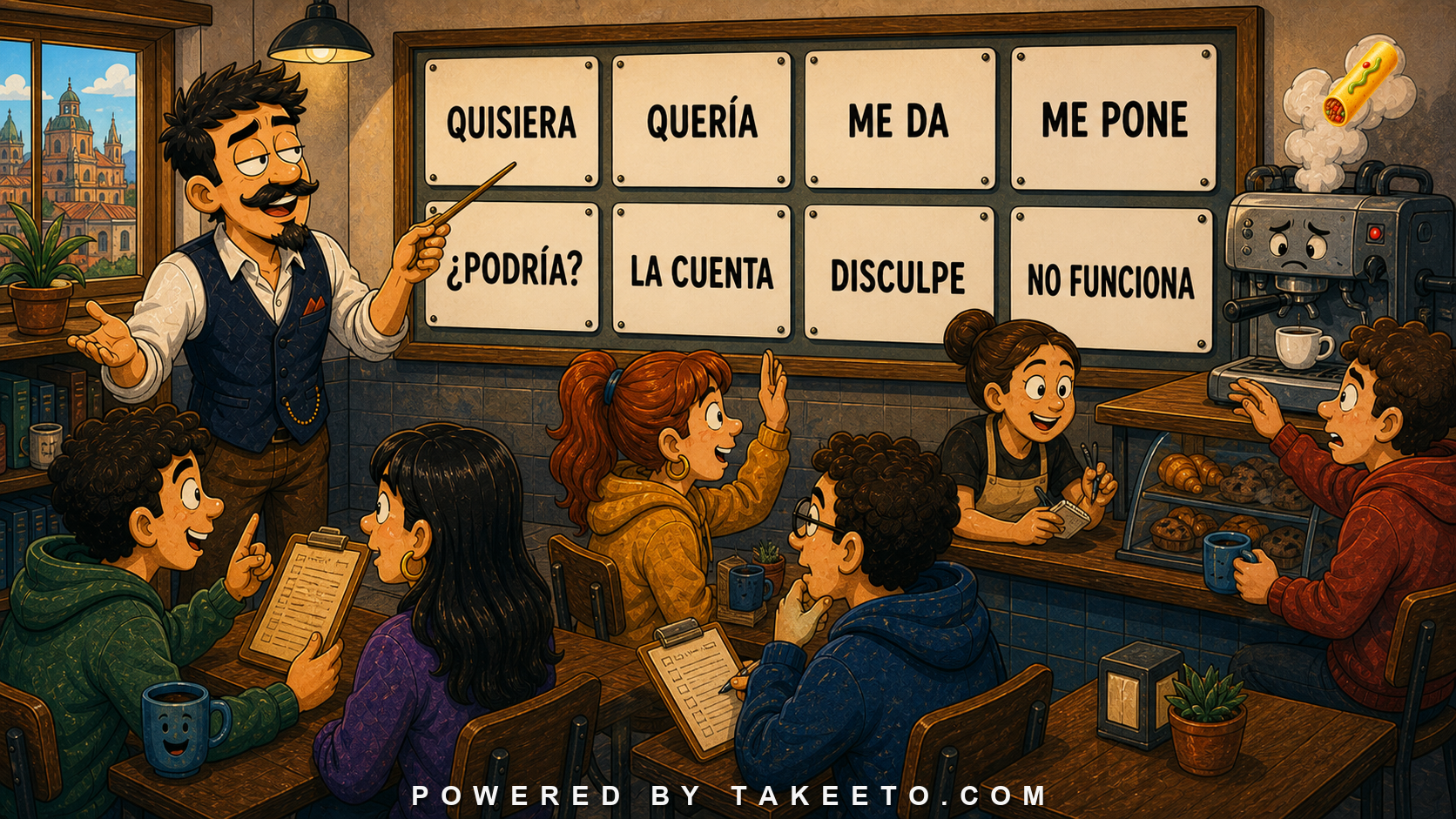
quisiera
Formal “I would like.”
Learner action: useful for careful requests; do not overuse where casual formulas are normal.
quería
Softened “I wanted/I’d like.”
Learner action: recognize imperfect politeness.
me da
Can you give me.
Learner action: broad service formula.
me pone
Can you get/serve me, regionally common especially Spain.
Learner action: understand but localize.
¿podría?
Could you?
Learner action: polite conditional.
la cuenta
Bill/check.
Learner action: pair with por favor.
disculpe
Excuse me.
Learner action: safe attention-getter.
no funciona
It does not work.
Learner action: state problems clearly.
Service-interaction workflow
- Open politely: greeting or disculpe.
- Make request clearly: quería, quisiera, me da, podría.
- Add por favor when appropriate.
- Clarify details: size, quantity, time, restriction, payment.
- Confirm if needed.
- Handle misunderstanding calmly.
- For complaints, describe the issue before assigning blame.
- Request repair: cambiar, revisar, reembolsar, ayudar.
- Close with thanks.
Remediation: politeness is sequencing, not just softer words
Service Spanish is often taught as phrase substitution:
Quiero → Quisiera.
Dame → ¿Me da...?
La cuenta → La cuenta, por favor.
Those substitutions help, but they are not enough. Real service encounters have a sequence:
- greeting or attention-getting,
- request or problem statement,
- clarification,
- confirmation,
- payment or action,
- thanks and closure.
A learner who says a polite phrase at the wrong moment may still sound abrupt. A learner who sequences well can use simple Spanish and still sound respectful.
Request ladders
Spanish offers several request forms with different force:
Quiero un café.
Me da un café, por favor.
¿Me pone un café?
Quería un café.
Quisiera un café.
¿Podría traerme un café?
¿Sería tan amable de traerme un café?
These do not form a universal ladder from rude to polite in every country. Me pone is normal in many service contexts in Spain, but may sound region-specific elsewhere. Quisiera is polite, but in some casual settings it may feel more formal than needed. Sería tan amable can be elegant or excessive depending on context.
The goal is not maximum politeness. The goal is appropriate politeness.
Mini-workshop: turn a complaint into a service sequence
Blunt complaint:
Esto no funciona. Quiero otro.
Better service sequence:
Disculpe, creo que hay un problema con este producto. Lo compré esta mañana, pero no enciende. ¿Podrían revisarlo o indicarme si es posible cambiarlo?
Annotation:
Disculpe = attention and soft entry.
creo que hay un problema = problem without immediate accusation.
lo compré esta mañana = relevant evidence.
no enciende = specific issue.
podrían revisar/indicar = request for next step.
si es posible cambiarlo = desired remedy, framed as policy-dependent.
The improved version is not weak. It is actionable.
Complaints: clarity beats emotional pressure
When complaining, learners often over-apologize or over-accuse. Both can fail. Good complaint Spanish gives the other person enough information to act:
product/service, date/time, order or reservation number, problem, attempted solution, desired outcome.
Useful phrases:
Hay un problema con...
No he recibido...
Me cobraron dos veces...
La reserva aparece cancelada...
¿Podría verificarlo?
¿Cuál sería el siguiente paso?
¿Sería posible solicitar un reembolso/cambio?
Regional formulas
Service encounters vary widely. In some places, ¿Me regala...? can be a polite service request; elsewhere it may sound odd if interpreted literally. ¿Me colaboras...? appears in some regions as a request for help. ¿Me pone...? is common in Spain for ordering. ¿Me da...? is broadly useful but still context-dependent.
A serious learner should recognize regional formulas before producing them widely. When in doubt, use clearer neutral forms:
¿Podría...?
¿Me puede...?
Necesito..., por favor.
Quisiera..., por favor.
Tone and repair
Politeness is also prosody: slower entry, moderate volume, final por favor, and a clear gracias after action. A perfectly polite written sentence can sound rude if delivered sharply. Conversely, a short phrase can sound fine when paired with warm tone and appropriate timing.
A Takeeto service module should train whole encounters, not isolated phrases. It should make the learner choose a request, answer a clarification, repair misunderstanding, and close the interaction.
Remediation drill: make complaints actionable
A service complaint works better when the other person can act on it.
Unhelpful:
Esto no sirve.
Actionable:
Disculpe, la tarjeta no funciona en el lector. ¿Podría revisar si el pago se procesó?
Unhelpful:
Me cobraron mal.
Actionable:
Disculpe, en el recibo aparece un cargo de 20 euros que no corresponde a mi pedido. ¿Podrían revisarlo?
Actionable complaints include object, error, evidence, and requested repair.
Polite insistence
Sometimes the first answer does not solve the problem. Spanish allows polite escalation:
Entiendo, pero el correo de confirmación indica otra cosa.
¿Sería posible hablar con la persona encargada?
¿Podría dejar constancia de la incidencia?
These phrases are useful because they are firm without becoming aggressive. The learner should not confuse politeness with surrender.
Suggested interactive module: service-interaction phrase ladder
A strong tool for this article would show request strength and formality.
Suggested functions:
- Request ladder: quiero → quería → quisiera → ¿podría?
- Regional variants: me da, me pone, me trae.
- Scenario templates: café, hotel, store, clinic, transport.
- Complaint builder: problem + evidence + repair request.
- Formality toggle: tú, usted, vos.
- Urgency mode: polite but direct safety/medical phrases.
Final rule
Polite service Spanish is clear, local, and socially weighted.
Use disculpe, quería, quisiera, ¿podría...?, ¿me da...?, and por favor with attention to context. Complaints should be precise, not aggressive. Start respectfully, state what you need, and adjust to local service norms.