
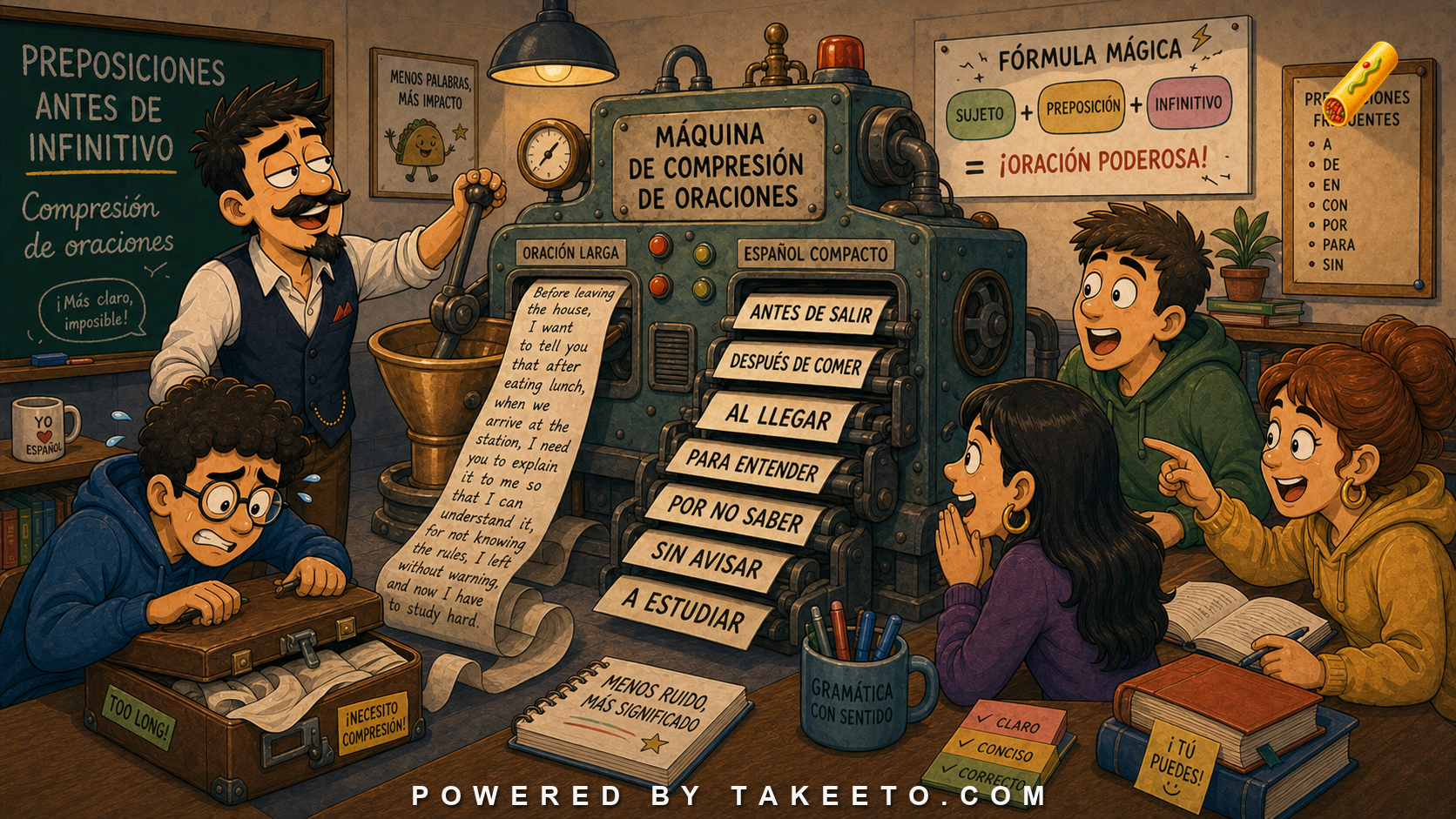
Spanish often uses an infinitive where English uses a gerund or clause
English says:
before leaving
after eating
on arriving
in order to understand
because of not knowing
without warning
Spanish uses prepositions followed by infinitives:
antes de salir
después de comer
al llegar
para entender
por no saber
sin avisar
This is one of the most important compression devices in Spanish. It allows Spanish to express time, purpose, cause, manner, absence, and condition without building a full subordinate clause every time.
The rule is simple:
After a preposition, Spanish uses the infinitive form of the verb.
The interpretation, however, depends on the preposition and context.
Antes de and después de
Antes de + infinitive marks an action before another action.
Antes de salir, apaga las luces.
Before leaving, turn off the lights.
Lee las instrucciones antes de usar el producto.
Read the instructions before using the product.
Después de + infinitive marks an action after another action.
Después de comer, salimos a caminar.
After eating, we went out for a walk.
Llámame después de terminar.
Call me after finishing.
English uses -ing after before/after. Spanish uses the infinitive: salir, usar, comer, terminar.
The subject of the infinitive is often the same as the main clause subject, but not always. Context supplies it.
Antes de salir Ana, revisamos los documentos.
Before Ana left, we reviewed the documents.
Spanish can sometimes place an explicit subject after the infinitive, especially in formal or literary style, though learners should use that structure carefully.
Al + infinitive
Al + infinitive means “when,” “upon,” or “in the act of.”
Al llegar, llamó a su madre.
Upon arriving / When he arrived, he called his mother.
Al abrir la puerta, vio el paquete.
When she opened the door, she saw the package.
Al leer el informe, entendí el problema.
When I read the report, I understood the problem.
The structure is compact and common in narration and formal prose.
It can often be expanded:
Al llegar Ana, empezó la reunión.
Cuando Ana llegó, empezó la reunión.
But al + infinitive is denser and often more elegant when the subject is clear.
Para + infinitive: purpose
Para + infinitive marks purpose or intended result.
Estudio para aprender.
I study in order to learn.
Necesito tiempo para pensar.
I need time to think.
Usa esta herramienta para practicar.
Use this tool to practice.
This is one of the most useful patterns for learners. It answers “for what purpose?”
Do not confuse purpose with cause:
Lo hice para ayudarte.
I did it in order to help you.
Lo hice por miedo.
I did it because of fear.
Por + infinitive: cause, reason, or pending action
Por + infinitive often gives a reason, especially with negation or evaluation:
Por no saber la respuesta, guardó silencio.
Because he/she did not know the answer, he/she stayed silent.
Gracias por venir.
Thank you for coming.
Lo criticaron por llegar tarde.
They criticized him/her for arriving late.
The infinitive names the action or non-action that motivates the response.
Por + infinitive can also mark something still to be done:
Quedan tres capítulos por leer.
There are three chapters left to read.
Hay mucho por hacer.
There is much to do.
The meaning depends on the larger construction.
Sin + infinitive: absence of action
Sin + infinitive means “without doing.”
Salió sin decir nada.
He/she left without saying anything.
Firmó sin leer el contrato.
He/she signed without reading the contract.
No se puede aprender sin practicar.
One cannot learn without practicing.
The action after sin does not happen. English uses a gerund; Spanish uses an infinitive.
When the subject of the “without” action differs clearly from the main subject, Spanish may need a full clause with sin que:
Salió sin que nadie lo viera.
He left without anyone seeing him.
That later touches the subjunctive, but the practical lesson is simple: sin + infinitive works best when the subject is recoverable.
Con + infinitive: means, condition, or sufficiency
Con + infinitive can express means or sufficient condition:
Con estudiar un poco cada día, mejorarás.
By studying / If you study a little every day, you will improve.
Con solo escucharlo, supe que era él.
Just by hearing him, I knew it was him.
This structure is less beginner-basic than para or sin, but common enough to recognize. It often suggests that the infinitive action is enough to produce the result.
A + infinitive
A + infinitive appears in several patterns.
After certain verbs:
aprender a leer
to learn to read
empezar a trabajar
to start working
volver a intentarlo
to try it again
After movement verbs in purpose-like contexts:
Vengo a ayudar.
I have come to help.
In commands or exhortations:
¡A estudiar!
Study! / Time to study!
And in the future construction ir a + infinitive:
Voy a llamar.
I am going to call.
The preposition a often marks an action as a target, beginning, return, or projected event.
Subject interpretation
One difficulty with preposition + infinitive structures is identifying the subject of the infinitive.
Antes de salir, cerré la ventana.
The most natural reading is: before I left, I closed the window. The subject of salir is recovered from cerré.
Antes de salir Ana, cerré la ventana.
Here Ana is explicitly the subject of salir.
Para entender el texto, hay que leerlo despacio.
The subject is generic: whoever wants to understand the text must read it slowly.
Spanish often leaves the infinitive subject implicit because context makes it clear. But in dense writing, ambiguity can arise. Good readers ask: who does the infinitive action?
Clause expansion as a reading strategy
When a preposition + infinitive phrase feels dense, expand it into a clause.
| Compressed phrase | Expanded idea |
|---|---|
| antes de salir | before someone leaves |
| después de comer | after someone eats |
| al llegar | when someone arrives |
| para entender | in order for someone to understand |
| por no saber | because someone does not know |
| sin avisar | without someone warning/notifying |
Apply it to a sentence:
Al llegar al aeropuerto, se dio cuenta de que había olvidado el pasaporte.
Expanded:
Cuando llegó al aeropuerto, se dio cuenta de que había olvidado el pasaporte.
The compressed form is not harder once you know how to unpack it.
Common learner errors
Error 1: Using gerunds after prepositions
antes de saliendo
Better:
antes de salir
Error 2: Omitting de in antes de/después de
antes salir
Better:
antes de salir
Error 3: Using para for every English “to”
I want to leave = quiero salir, not quiero para salir.
Use para + infinitive for purpose, not all infinitive meanings.
Error 4: Missing subject ambiguity
Antes de salir, llamó Ana.
Who left? The sentence may be unclear. Rewrite if needed:
Antes de que Ana saliera, llamó Pedro.
Before Ana left, Pedro called.
Error 5: Translating al + infinitive as “to the”
Al llegar = upon arriving / when arriving, not “to the arrive.”
Choosing between infinitive compression and full clauses
Preposition + infinitive structures are efficient, but they are not always the best choice. The central question is whether the subject of the infinitive is recoverable.
Same subject: infinitive compression is natural
Antes de salir, apagué las luces.
Before leaving, I turned off the lights.
The person who left and the person who turned off the lights are naturally the same. The infinitive is compact and clear.
Salió sin decir nada.
He/she left without saying anything.
The person who left is also the person who did not speak.
Generic subject: infinitive compression is also natural
Para entender el texto, hay que leerlo despacio.
To understand the text, one must read it slowly.
The subject of entender is generic: whoever wants to understand.
Different subjects: use a full clause when needed
If the subjects differ, a full clause may be clearer:
Antes de que Ana saliera, Pedro llamó.
Before Ana left, Pedro called.
If you write:
Antes de salir, Pedro llamó.
many readers will assume Pedro is the one leaving.
With sin, different subjects often require sin que + subjunctive:
Salió sin que nadie lo viera.
He left without anyone seeing him.
A bare infinitive would not express nadie as the subject clearly.
Formal Spanish often compresses aggressively
Academic and administrative prose uses infinitive phrases to pack information:
Para solicitar la beca, es necesario presentar los documentos antes de finalizar el plazo.
Expanded:
In order to apply for the scholarship, it is necessary to submit the documents before the deadline ends.
The Spanish sentence is dense but not vague if you track each preposition:
- para solicitar = purpose
- antes de finalizar = prior time boundary
Production rule
Use preposition + infinitive when the subject is the same, generic, or obvious. Use a full clause when the subject differs, when ambiguity matters, or when the structure requires a conjugated verb.
This gives you both power and restraint: compression when it helps, expansion when clarity demands it.
Common preposition + infinitive bundles to memorize
The pattern is productive, but several bundles are so common that they should become automatic.
| Bundle | Core meaning | Example |
|---|---|---|
| antes de + infinitive | before doing | antes de salir |
| después de + infinitive | after doing | después de comer |
| al + infinitive | when/upon doing | al llegar |
| para + infinitive | in order to do | para entender |
| por + infinitive | because of/for doing | gracias por venir |
| sin + infinitive | without doing | sin avisar |
| con + infinitive | by/if doing | con practicar cada día |
| a + infinitive | target after certain verbs | empezar a estudiar |
For production, the most important warning is that English -ing after a preposition usually becomes a Spanish infinitive:
before leaving → antes de salir
after eating → después de comer
without knowing → sin saber
for helping me → por ayudarme
But English “to” is not always para or a:
I want to go → quiero ir
I need to study → necesito estudiar
I study to learn → estudio para aprender
I start to understand → empiezo a entender
The Spanish structure depends on the governing word and the relation. Memorize the bundle, not the English surface form.
Diagnostic refinement: preposition + infinitive compresses a clause, but the subject must be recoverable
Spanish uses preposition + infinitive because infinitives can behave like compact clauses. The price of that compression is that the subject is often implicit.
Antes de salir, revisé el correo.
Before leaving, I checked email.
The natural reading is that the same person left and checked email. If the subject differs, Spanish often needs a fuller clause:
Antes de que saliera Ana, revisé el correo.
Before Ana left, I checked email.
This subject-recovery issue is central to every preposition + infinitive pattern:
| Compressed phrase | Expanded meaning |
|---|---|
| antes de salir | before leaving |
| después de comer | after eating |
| al llegar | upon/when arriving |
| para entender el texto | in order to understand the text |
| por no saber la regla | because of not knowing the rule |
| sin avisar | without notifying |
| con estudiar más | by studying more / if one studies more |
Al + infinitive deserves special attention because it often translates as a time clause:
Al llegar al hotel, llamé a mi familia.
When I arrived at the hotel, I called my family.
Por + infinitive can mark cause:
Perdió puntos por no citar las fuentes.
He/she lost points for not citing the sources.
It can also appear in pending-action expressions:
Quedan varios temas por resolver.
Several issues remain to be resolved.
Para + infinitive usually points to purpose:
Lee el párrafo otra vez para entender el argumento.
Read the paragraph again in order to understand the argument.
The repair method is simple:
- Identify the preposition.
- Expand the infinitive into a clause in your own words.
- Ask whose action the infinitive names.
- If the subject is unclear or different, consider que + finite verb instead of an infinitive.
- Recompress only when the relation remains clear.
This is why preposition + infinitive structures are powerful in formal Spanish: they pack timing, cause, purpose, absence, and condition into short phrases. They are elegant only when the reader can recover the missing subject.
Suggested interactive module: clause expander
A useful tool for this article would expand compressed infinitive phrases into full clauses.
Suggested functions:
- Preposition labeler: time before/after, event trigger, purpose, cause, absence, means, target.
- Infinitive detector: flags gerunds after Spanish prepositions.
- Subject recovery: asks who performs the infinitive action.
- Clause expansion: converts al llegar into cuando llegó/llegue, depending on context.
- Ambiguity warning: suggests full clauses when subjects differ.
Example input:
Sin leer el contrato, firmó.
Possible output:
- sin leer = without reading.
- Likely subject of leer = same as firmó.
- Expanded: “He/she signed without reading the contract.”
Final rule
Spanish prepositions take infinitives where English often uses gerunds or full clauses: antes de salir, después de comer, al llegar, para entender, por no saber, sin avisar.
The infinitive compresses a clause. To read it well, identify the preposition’s meaning and recover the subject of the infinitive. To write it well, avoid English gerund interference and learn the fixed prepositional patterns: antes de, después de, al, para, por, sin, con, and a.