
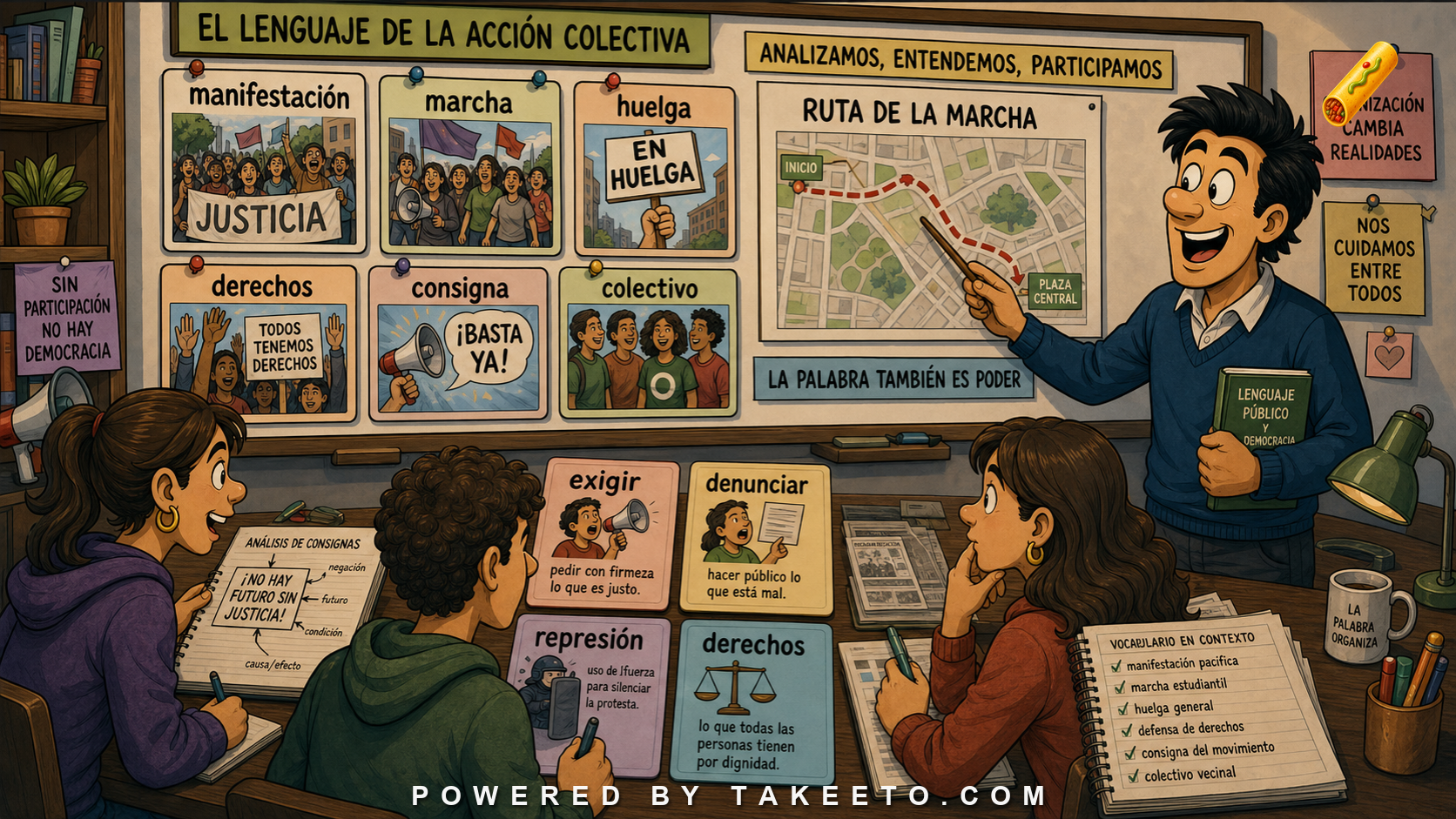
Protest language is compressed public argument
Protest Spanish appears in chants, signs, press releases, legal complaints, movement statements, social media posts, news headlines, and government responses. It can be poetic, urgent, accusatory, legalistic, emotional, or institutional.
The key principle is:
Protest language compresses identity, demand, grievance, and audience into short public forms.
A slogan may omit verbs. A statement may use legal vocabulary. A chant may use rhyme and repetition. A news article may reframe the same event through institutional terms.
Manifestación, marcha, protesta
Common action words:
manifestación
demonstration / protest
marcha
march
protesta
protest
concentración
gathering / rally
plantón
sit-in / protest camp or standing protest, depending on country
movilización
mobilization
Examples:
La manifestación reunió a miles de personas.
The demonstration brought together thousands of people.
Convocaron una marcha por el centro de la ciudad.
They called a march through the city center.
Convocar is important:
convocar una protesta
to call/organize a protest
The subject may be a union, collective, party, family group, student organization, or civil-society network.
Huelga and labor action
huelga
strike
paro
work stoppage / strike / shutdown, depending on country and context
sindicato
union
trabajadores / trabajadoras
workers
negociación
negotiation
convenio
collective agreement, especially in labor contexts
Example:
El sindicato anunció una huelga de 48 horas.
The union announced a 48-hour strike.
Paro is regionally variable. In some countries it can refer to unemployment; in protest contexts it may refer to a work stoppage or broader shutdown. Context is essential.
Derechos and claims
Movement language often centers on:
derechos
rights
justicia
justice
igualdad
equality
dignidad
dignity
memoria
memory
reparación
reparations / repair / redress
reconocimiento
recognition
Examples:
Exigen el reconocimiento de sus derechos.
They demand recognition of their rights.
Reclaman justicia para las víctimas.
They demand justice for the victims.
Exigir and reclamar are central verbs.
Exigir, denunciar, reclamar
Important action verbs:
exigir
to demand
reclamar
to demand / claim
denunciar
to denounce / report
reivindicar
to claim / assert / vindicate
convocar
to call/organize
visibilizar
to make visible
Examples:
Denunciaron la falta de respuesta oficial.
They denounced the lack of official response.
El colectivo reivindica el derecho a la vivienda.
The collective asserts/claims the right to housing.
Denunciar can mean to report to authorities or to publicly denounce. Translation depends on context.
Colectivo, organización, movimiento
Group vocabulary:
colectivo
collective / group
organización
organization
movimiento
movement
asamblea
assembly
plataforma
platform / coalition group, depending on context
activista
activist
portavoz
spokesperson
Examples:
El colectivo publicó un comunicado.
The collective published a statement.
Una portavoz del movimiento explicó las demandas.
A spokesperson for the movement explained the demands.
Colectivo does not always mean a formal organization. It may refer to a group organized around identity, labor, territory, cause, or campaign.
Consigna and slogan language
consigna
slogan / chant / rallying phrase
lema
motto / slogan
pancarta
banner / protest sign
cartel
sign / poster
cántico
chant
Slogans often compress grammar:
Ni una menos.
Not one less.
Agua para todos.
Water for everyone.
Justicia ya.
Justice now.
These are not full classroom sentences, but they are effective public language. They rely on ellipsis, repetition, parallelism, rhythm, and shared context.
Public-order and state-response terms
News and official documents may use:
orden público
public order
operativo
operation / deployment
policía
police
detención
arrest / detention
represión
repression
disturbios
disturbances / riots, often framing-loaded
enfrentamientos
clashes
desalojo
eviction / removal
These terms can frame legitimacy. A movement may say represión; an official statement may say operativo de seguridad; a news outlet may say enfrentamientos. Each term assigns agency and responsibility differently.
Learner action: compare actor language, official language, and media language.
Register range
Protest Spanish moves across registers:
- chant: short, rhythmic, collective,
- sign: compressed, visual, often witty or severe,
- press release: formal, argumentative,
- legal complaint: precise, institutional,
- social media: fast, emotional, slogan-like,
- academic writing: analytical, historical,
- government statement: administrative or security-focused.
Do not judge all movement language by formal grammar standards. A chant is not an essay. But do not assume all activist language is informal; movement statements can be legally and rhetorically sophisticated.
Example bank walkthrough
manifestación / marcha
Demonstration and march.
Learner action: identify whether movement, news, or official language is naming the event.
huelga
Strike.
Learner action: connect to labor actors, duration, demands, and negotiation.
derechos
Rights.
Learner action: note which right is claimed and who is addressed.
consigna
Slogan or chant.
Learner action: expand compressed grammar into full meaning.
colectivo
Collective/group.
Learner action: identify whether formal organization or loose movement group.
exigir / denunciar
Demand and denounce/report.
Learner action: translate by function, not one fixed English word.
represión
Repression.
Learner action: recognize it as a strong framing term.
Protest-language reading routine
- Identify genre: slogan, sign, statement, news report, legal complaint, official notice.
- Identify actor: movement, union, family group, government, police, journalist.
- Identify demand: what is being asked for?
- Identify grievance: what harm or problem is named?
- Mark verbs: exigir, denunciar, reclamar, convocar, reivindicar.
- Mark rights language and legal terms.
- Expand slogans into full propositions.
- Compare framing terms across sources.
- Avoid assuming one text represents an entire movement.
- Be careful with high-stakes political translation.
Remediation: slogans are not ordinary sentences
Protest Spanish often appears in slogans, chants, banners, legal statements, social media posts, and news reports. These genres use different grammar. A chant may omit verbs, intensify rhythm, rhyme, repeat, insult, or compress an entire political argument into four words.
Examples:
Ni una menos.
El pueblo unido jamás será vencido.
Educación pública y gratuita.
No es sequía, es saqueo.
These are not “incomplete Spanish” in the ordinary sense. They are public, rhythmic, collective language. The learner should not correct them into textbook prose. Instead ask:
What claim is being compressed?
Who is included in the “we”?
Who is being accused?
What emotion is being mobilized?
What institutional demand is implied?
Denunciar, exigir, reclamar
Protest and social-movement Spanish relies on verbs that encode public stance.
denunciar — to denounce, report, or publicly expose; not always a formal police complaint.
exigir — demand as a right or urgent claim.
reclamar — claim, demand, call for, complain about depending on region and context.
convocar — call a protest/strike/meeting.
adherirse — join/support a call or action.
repudiar / rechazar — reject/condemn.
A learner who translates denunciar only as “file a complaint” will misread activist statements. A learner who translates exigir as merely “ask for” will weaken the force of the demand.
Mini-workshop: read a movement statement
Statement:
Diversos colectivos convocaron a una marcha para exigir el cumplimiento de los acuerdos y denunciar la falta de respuesta de las autoridades.
Annotations:
diversos colectivos = organized groups, not random individuals.
convocaron a una marcha = called for a demonstration.
para exigir = purpose: demand.
el cumplimiento de los acuerdos = implementation/compliance, not just “agreement exists.”
denunciar = publicly expose/condemn.
falta de respuesta de las autoridades = institutional inaction frame.
The sentence contains actor, action, purpose, grievance, and target.
Register range: chant to legal statement
The same movement may use very different Spanish:
chant: ¡El agua no se vende, se defiende!
poster: Derecho a la vivienda digna.
press release: Exigimos la derogación inmediata de la medida.
legal complaint: Se interpone recurso contra la resolución administrativa.
social media: Nos vemos en la plaza a las seis.
A learner should not judge one register by another. Chants are designed for memory and force. Legal texts are designed for procedure. Press releases are designed for public legitimacy. Social media posts mobilize attendance and attention.
Collective nouns and identity
Protest Spanish often uses collective identity terms:
movimiento, colectivo, plataforma, asamblea, sindicato, comunidad, pueblo, estudiantes, trabajadoras, familiares, víctimas, vecindario.
These words are political. El pueblo may mean the people, the town, popular classes, national community, or a rhetorical subject. Comunidad may mean locality, identity group, indigenous community, or organized constituency. Víctimas can be a legal, moral, or political category.
Ask who is authorized to speak for the group and how the text constructs that “we.”
Media framing
News reports may frame protest through verbs such as:
protestaron, bloquearon, marcharon, exigieron, denunciaron, se enfrentaron, fueron desalojados, fueron reprimidos, causaron disturbios.
The verb changes the reader’s perception. Marcharon is neutral. Bloquearon emphasizes disruption. Fueron reprimidos emphasizes state force. Causaron disturbios may criminalize or delegitimize. Critical media reading matters.
A Takeeto tool could show the same protest described by organizers, police, government, and newspaper headlines. The learner would tag actors, claims, verbs of blame, and omitted context. That would teach protest Spanish as discourse, not just vocabulary.
Remediation drill: distinguish demand, diagnosis, and accusation
Movement language often combines what people want, what they say is wrong, and who they hold responsible.
Demand:
Exigimos salarios dignos.
Diagnosis:
La precariedad afecta a miles de familias.
Accusation:
El gobierno ha incumplido sus compromisos.
Identity claim:
Somos trabajadoras esenciales.
Call to action:
Convocamos a una marcha el viernes.
These moves may appear in one statement. A learner should not flatten all of them into “they protest.”
Mini-workshop:
Denunciamos la falta de respuesta de las autoridades y exigimos medidas inmediatas para garantizar el acceso a la vivienda.
Move 1:
denunciamos la falta de respuesta — accusation/critique
Move 2:
exigimos medidas inmediatas — demand
Goal:
garantizar el acceso a la vivienda — rights frame
Functional translation:
We denounce the authorities' lack of response and demand immediate measures to guarantee access to housing.
Register contrast
A chant can be fragmentary:
Vivienda digna ya.
A policy demand is fuller:
Exigimos la implementación de medidas que garanticen el acceso efectivo a una vivienda digna.
A legal brief is even more formal:
Se solicita a la autoridad competente que adopte las medidas necesarias para asegurar el ejercicio efectivo del derecho a la vivienda.
Same issue, three registers. The learner's job is not to choose the most formal version every time. It is to match genre.
Safety and documentation caution
In contexts involving detention, violence, immigration, labor retaliation, or police action, exact wording can matter. Do not improvise legal claims from protest vocabulary. Recognize terms, document them accurately, and seek qualified support when consequences are serious.
Extra practice: identify collective nouns
Protest Spanish often uses collective nouns that compress organization and identity:
el movimiento
el colectivo
la asamblea
el sindicato
la plataforma
las organizaciones firmantes
la comunidad
las víctimas
las familias
Each collective noun frames legitimacy differently. El sindicato suggests labor representation. Las familias emphasizes human impact. Las víctimas foregrounds harm. La plataforma may suggest an organized campaign or coalition.
When translating, preserve the collective frame when it matters. Do not reduce all of them to “the group.”
Example:
Las familias exigieron una investigación independiente.
This is not just “people demanded.” The word familias makes kinship and harm central to the claim.
Suggested interactive module: protest-language register map
A strong tool for this article would compare the same event across registers.
Suggested functions:
- Genre selector: chant, banner, statement, news article, official communiqué.
- Demand extractor: rights, actor, action requested, target audience.
- Slogan expander: ellipsis to full sentence.
- Framing comparison: represión, operativo, disturbios, enfrentamientos.
- Verb labels: demand, denounce, call, claim, warn.
- Register warning: informal slogan vs legal statement.
Final rule
Protest Spanish is public argument under pressure.
Learn manifestación, marcha, huelga, derechos, consigna, colectivo, exigir, denunciar and represión, but always ask who is speaking, to whom, in what genre, and with what framing. The same event sounds different in a chant, a police notice, a newspaper headline, and a legal complaint.