
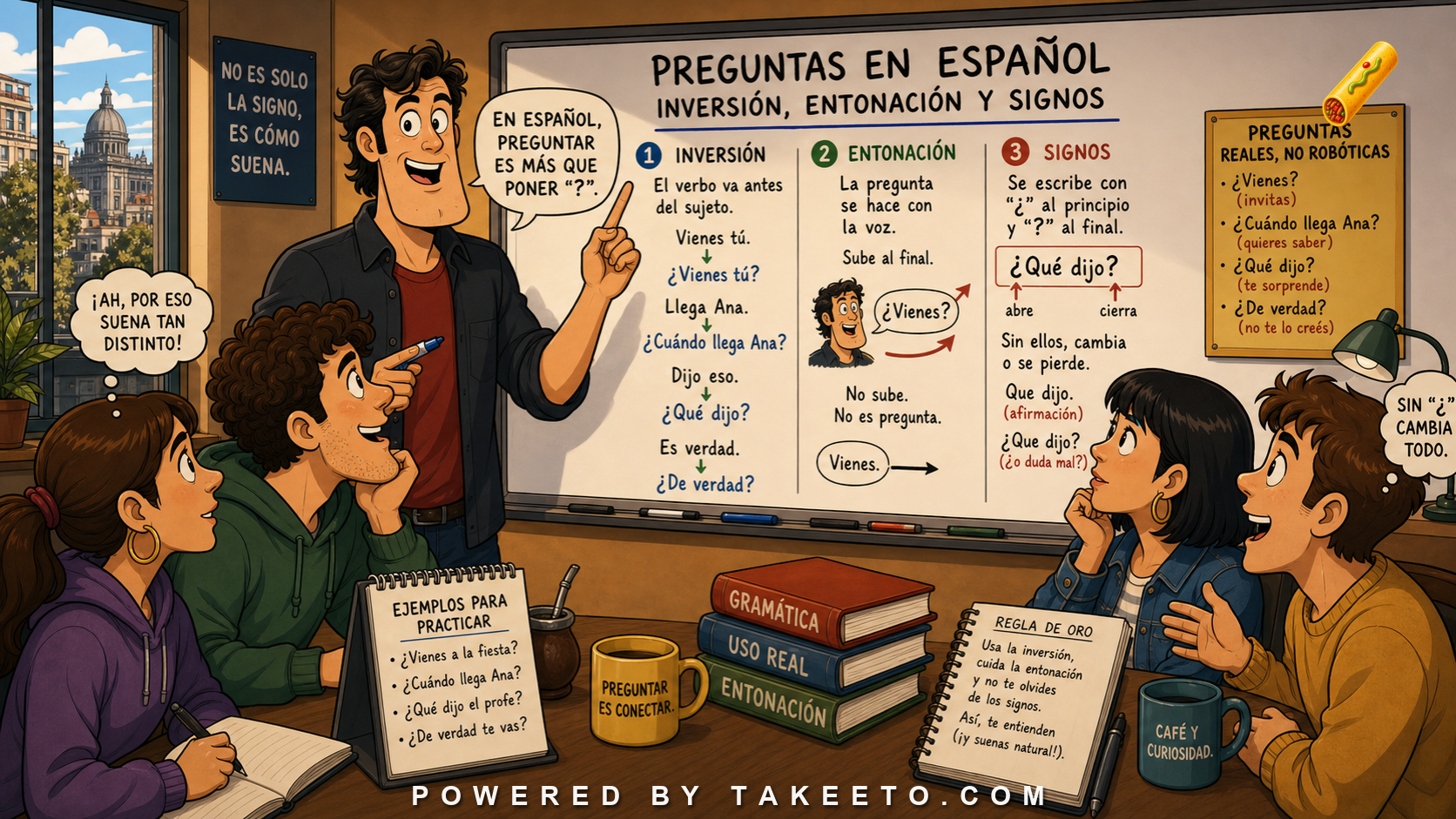
A Spanish question is not just a sentence with question marks
Beginners often learn that Spanish uses an upside-down question mark at the beginning and a normal question mark at the end. That is true, but it is not the grammar of questions. It is the writing system’s way of marking the question boundary.
Spanish questions are formed through several interacting resources:
- intonation;
- interrogative words such as qué, quién, cuándo, dónde, cómo;
- word order choices;
- subject placement;
- context;
- punctuation in writing.
A yes/no question can look almost identical to a statement:
Vienes.
You are coming.
¿Vienes?
Are you coming?
In speech, intonation and context do the work. In writing, the question marks tell the reader how to interpret the sentence.
The deeper rule:
Spanish questions are built by marking interrogative force, not by one fixed word-order transformation.
English relies heavily on auxiliary inversion: “You are coming” → “Are you coming?” Spanish does not work that way.
Yes/no questions
A yes/no question asks whether a proposition is true.
¿Vienes?
Are you coming?
¿Tienes tiempo?
Do you have time?
¿La reunión empieza a las diez?
Does the meeting start at ten?
In neutral Spanish, the word order may remain the same as the statement. Intonation and punctuation mark the question.
Statement:
Ana trabaja aquí.
Ana works here.
Question:
¿Ana trabaja aquí?
Does Ana work here?
Spanish can also vary word order:
¿Trabaja Ana aquí?
Does Ana work here?
This may sound more formal, contrastive, literary, or regionally variable depending on context. It is not the only way to form the question.
Learners should not force English-style auxiliary patterns into Spanish. There is no equivalent of “do-support.”
Incorrect: ¿Hace Ana trabaja aquí?
Correct: ¿Ana trabaja aquí? / ¿Trabaja Ana aquí?
Subject pronouns in questions
Because Spanish verb endings often identify the subject, subject pronouns are frequently omitted in both statements and questions.
¿Vienes?
Are you coming?
¿Entiende?
Do you understand? / Does he/she understand? depending on context
When a subject pronoun appears, it often adds contrast, emphasis, clarification, or social meaning.
¿Tú vienes o se queda Juan?
Are you coming, or is Juan staying?
¿Usted entiende la instrucción?
Do you understand the instruction?
¿Ella trabaja aquí?
Does she work here?
The pronoun is not always wrong. But translating every English “you/he/she/they” into Spanish can make questions sound heavy or contrastive when no contrast is intended.
Wh-questions and interrogative words
Wh-questions ask for a missing piece of information. Spanish uses accented interrogative words:
| Spanish | Basic English equivalent |
|---|---|
| qué | what / which kind of |
| quién / quiénes | who / whom |
| cuál / cuáles | which / what one(s) |
| cuándo | when |
| dónde | where |
| adónde / a dónde | to where |
| de dónde | from where |
| cómo | how |
| cuánto/a/os/as | how much / how many |
| por qué | why |
Examples:
¿Qué dijo?
What did he/she say?
¿Cuándo llega Ana?
When does Ana arrive?
¿Dónde está el documento?
Where is the document?
¿Por qué no llamaste?
Why didn’t you call?
In neutral wh-questions, the subject often follows the verb when it is expressed:
¿Cuándo llega Ana?
When does Ana arrive?
¿Qué dijo el ministro?
What did the minister say?
The order ¿Cuándo Ana llega? is not the neutral model in most standard contexts, though subject position can vary with focus, contrast, dialect, and discourse. The safe learner habit is: interrogative word first, then verb, then subject if needed.
Prepositions move with interrogative words
When the missing information is governed by a preposition, Spanish places that preposition before the interrogative word.
¿Con quién hablaste?
Who did you speak with?
¿De qué depende?
What does it depend on?
¿A dónde vas?
Where are you going to?
¿Para qué sirve?
What is it for?
¿En qué ciudad vive?
What city does he/she live in?
English often strands prepositions at the end: “Who did you talk to?” Spanish does not normally do that.
Incorrect: ¿Quién hablaste con?
Correct: ¿Con quién hablaste?
This same principle appears in relative clauses:
la persona con quien hablé
the person I spoke with
Question formation and relative formation share the need to preserve prepositions.
Inverted question marks are boundary markers
Spanish opening question marks are not decorative. They tell the reader where the question begins.
Si tienes tiempo, ¿puedes revisar el informe?
If you have time, can you review the report?
The whole sentence is not a question from the first word. The conditional phrase Si tienes tiempo sets the context. The question begins at ¿puedes.
Another example:
Después de la reunión, ¿quién va a enviar el resumen?
After the meeting, who is going to send the summary?
The opening mark prevents the reader from waiting until the end to discover that the clause was interrogative. This is especially useful in long sentences.
In informal digital writing, people often omit opening punctuation. Learners should still learn and use it in careful Spanish. It is part of standard orthography.
Direct and indirect questions
A direct question is written with question marks:
¿Qué quieres?
What do you want?
An indirect question is embedded inside another sentence and is not written with question marks unless the whole sentence is also a question.
No sé qué quieres.
I do not know what you want.
Dime cuándo llega.
Tell me when he/she arrives.
Me preguntó dónde estaba el hotel.
He/she asked me where the hotel was.
The interrogative words keep their accent marks in indirect questions because they still have interrogative force.
Compare:
No sé qué dijo.
I do not know what he/she said.
El libro que dijo eso está agotado.
The book that said that is sold out.
The first qué is interrogative. The second que is relative.
Echo questions and confirmation questions
Spanish also uses echo questions, often to express surprise, confusion, or request for repetition.
—Me voy mañana.
—¿Te vas mañana?
“I’m leaving tomorrow.”
“You’re leaving tomorrow?”
A question can repeat statement order because the interrogative force comes from intonation.
Spanish also uses short confirmation questions:
Vienes mañana, ¿verdad?
You’re coming tomorrow, right?
Ya lo enviaste, ¿no?
You already sent it, didn’t you?
Está claro, ¿sí?
It’s clear, yes?
These are not always equivalent in tone. ¿Verdad? is neutral and confirmation-seeking. ¿No? can be casual, expected-confirmation, or slightly pressuring depending on intonation. ¿Sí? can sound instructional in some contexts.
Rhetorical and partial questions
Not every question seeks information.
¿Quién sabe?
Who knows?
¿Cómo no?
Of course / how could I not?
¿De verdad?
Really?
¿Y ahora qué?
And now what?
Spanish writing marks these as questions because the structure is interrogative, even when the pragmatic function is surprise, challenge, resignation, or emphasis.
Partial questions can be embedded in larger statements:
El problema es este: ¿quién paga?
The problem is this: who pays?
Solo quiero saber una cosa: ¿cuándo termina?
I only want to know one thing: when does it end?
The opening question mark again helps the reader find the boundary.
Common learner mistakes
Mistake 1: Adding English do-support
Incorrect: ¿Do tienes tiempo?
Correct: ¿Tienes tiempo?
Spanish does not use an auxiliary equivalent to English “do” for ordinary questions.
Mistake 2: Forgetting prepositions
Incorrect: ¿Quién hablaste? if the intended verb is hablar con
Correct: ¿Con quién hablaste?
Mistake 3: Treating all subject-verb inversion as required
Correct: ¿Ana viene mañana?
Also possible: ¿Viene Ana mañana?
Word order depends on question type, focus, region, style, and discourse. It is not a single English-like rule.
Mistake 4: Dropping accents in interrogatives
¿Que quieres? means something different or looks wrong for “What do you want?”
Correct: ¿Qué quieres?
Mistake 5: Misplacing the opening mark
Weak: ¿Si tienes tiempo, puedes revisar esto?
Better: Si tienes tiempo, ¿puedes revisar esto?
The question begins at the request, not at the conditional phrase.
Diagnostic workflow: building questions from the Spanish verb phrase
The cleanest way to form Spanish questions is to begin with the Spanish predicate, not with the English auxiliary. If the English question is “Do you live here?”, remove do from your thinking. The Spanish predicate is vivir aquí with a second-person verb form:
¿Vives aquí?
If the English question is “Does Ana work today?”, the Spanish predicate is trabajar hoy with Ana as subject:
¿Trabaja Ana hoy?
¿Ana trabaja hoy?
Both can occur, with differences in focus and rhythm. The important point is that Spanish does not create a question by adding a support verb equivalent to English do.
For wh-questions, build the missing-information slot. If the missing element is the object of decir, Spanish uses qué:
Dijo algo. → ¿Qué dijo?
If the missing element is a prepositional complement, keep the preposition:
Hablaste con alguien. → ¿Con quién hablaste?
If the missing element is time:
Llega a las ocho. → ¿Cuándo llega?
If the missing element is destination:
Vas a Madrid. → ¿Adónde vas? / ¿A dónde vas?
This method also helps with subject placement. In neutral broad-standard wh-questions, the subject often follows the verb:
¿Qué dijo Ana?
¿Cuándo llega el tren?
¿Dónde está tu pasaporte?
A preverbal subject may be contrastive, topical, or regional:
¿Ana qué dijo?
This is not just a neutral substitute for ¿Qué dijo Ana? in many contexts. It can mean something like “As for Ana, what did she say?”
When writing, place the opening question mark exactly where question force begins:
Entonces, ¿qué hacemos?
Si no responde, ¿llamamos otra vez?
That punctuation is a parsing aid. It tells the reader when to switch into question intonation and structure.
Intonation, information structure, and why word order varies
Spanish question word order is flexible because Spanish has several ways to signal what is being asked. Intonation marks yes/no force in speech. Interrogative words mark missing information. Verb morphology often identifies the subject. Subject placement then becomes available for focus, contrast, rhythm, or regional patterning.
Compare these questions:
¿Viene Ana mañana?
¿Ana viene mañana?
Both can ask whether Ana is coming tomorrow. The first may sound like a neutral inquiry in many contexts. The second can be neutral in some varieties, but it can also put stronger topical focus on Ana: “Is Ana coming tomorrow?” as opposed to someone else.
Now compare:
¿Cuándo llega Ana?
¿Cuándo Ana llega?
The first is the broad standard model for a neutral information question. The second is not the usual target in most formal or classroom standard Spanish, though subject position can vary in Caribbean Spanish, contrastive contexts, echo questions, or stylized speech. This is why a learner should not turn word order into a single absolute rule. The safer production model is conservative; the listening model should be flexible.
In reading, ask what the question is doing. Is it requesting information, confirming something already assumed, echoing surprise, or contrasting one person with another? A sentence like ¿Tú vienes? is not just a longer version of ¿Vienes?. The pronoun may imply contrast, disbelief, or explicit address. The grammar of questions is also the grammar of attention.
V2 remediation refinement: mark the real question span
Spanish opening question marks are not ornamental. They show where the question begins, and that beginning is not always the start of the sentence.
Compare:
Ana, ¿vienes mañana?
Ana, are you coming tomorrow?
Si termina la reunión temprano, ¿podemos salir?
If the meeting ends early, can we leave?
Entonces, ¿qué hacemos?
So, what do we do?
The opening ¿ comes before the interrogative part, not automatically before every preliminary topic, vocative, or connector. Learners who always put ¿ at the beginning of the written sentence lose a useful visual boundary.
This matters in long questions:
En vista de los resultados, ¿qué medidas propone el comité?
In view of the results, what measures does the committee propose?
Only qué medidas propone el comité is the question proper. The introductory phrase frames it.
Question word order also needs remediation. Spanish does not create questions with English-style do support, and it does not require one fixed inversion pattern. With many wh-questions, a full noun subject naturally follows the verb:
¿Cuándo llega el tren?
¿Qué dijo la ministra?
¿Dónde viven tus padres?
But a topic can be placed first:
¿Y tus padres dónde viven ahora?
¿Ese documento quién lo firmó?
The fronted topic changes information structure; it is not the basic beginner template. A strong editing workflow is:
- Remove English do/does/did from your mental draft.
- Place the interrogative word or yes/no question boundary.
- Decide whether the subject is ordinary new information, contrastive topic, or pronoun emphasis.
- Put ¿ where the question itself begins.
This turns question writing into sentence architecture rather than punctuation decoration.
Suggested interactive module: question-type annotator
A useful tool would let learners enter a Spanish sentence and classify the question mechanics.
Suggested functions:
- Question type: yes/no, wh-question, echo, rhetorical, tag, indirect.
- Boundary marker: show where the opening question mark belongs.
- Interrogative detector: identify accented question words.
- Preposition checker: flag missing prepositions in questions like ¿Quién hablaste con?.
- Word-order notes: mark neutral, contrastive, formal, or regionally variable subject placement.
Example input:
Si mañana llueve, ¿dónde nos reunimos?
Output:
- Context clause: Si mañana llueve.
- Question begins at dónde.
- Dónde is interrogative and requires an accent.
- Verb-subject order: subject omitted; verb morphology and context carry it.
Final rule
Spanish questions are not made by copying English word order. Yes/no questions can keep statement order and rely on intonation. Wh-questions use accented interrogative words and often place the expressed subject after the verb. Prepositions stay with interrogatives: con quién, de qué, a dónde. Written Spanish uses opening question marks to show where the question begins.
The real skill is to identify the kind of question being asked and the boundary of the interrogative force. Once you can do that, Spanish questions stop looking like statements with unusual punctuation and start looking like a flexible, precise system.