
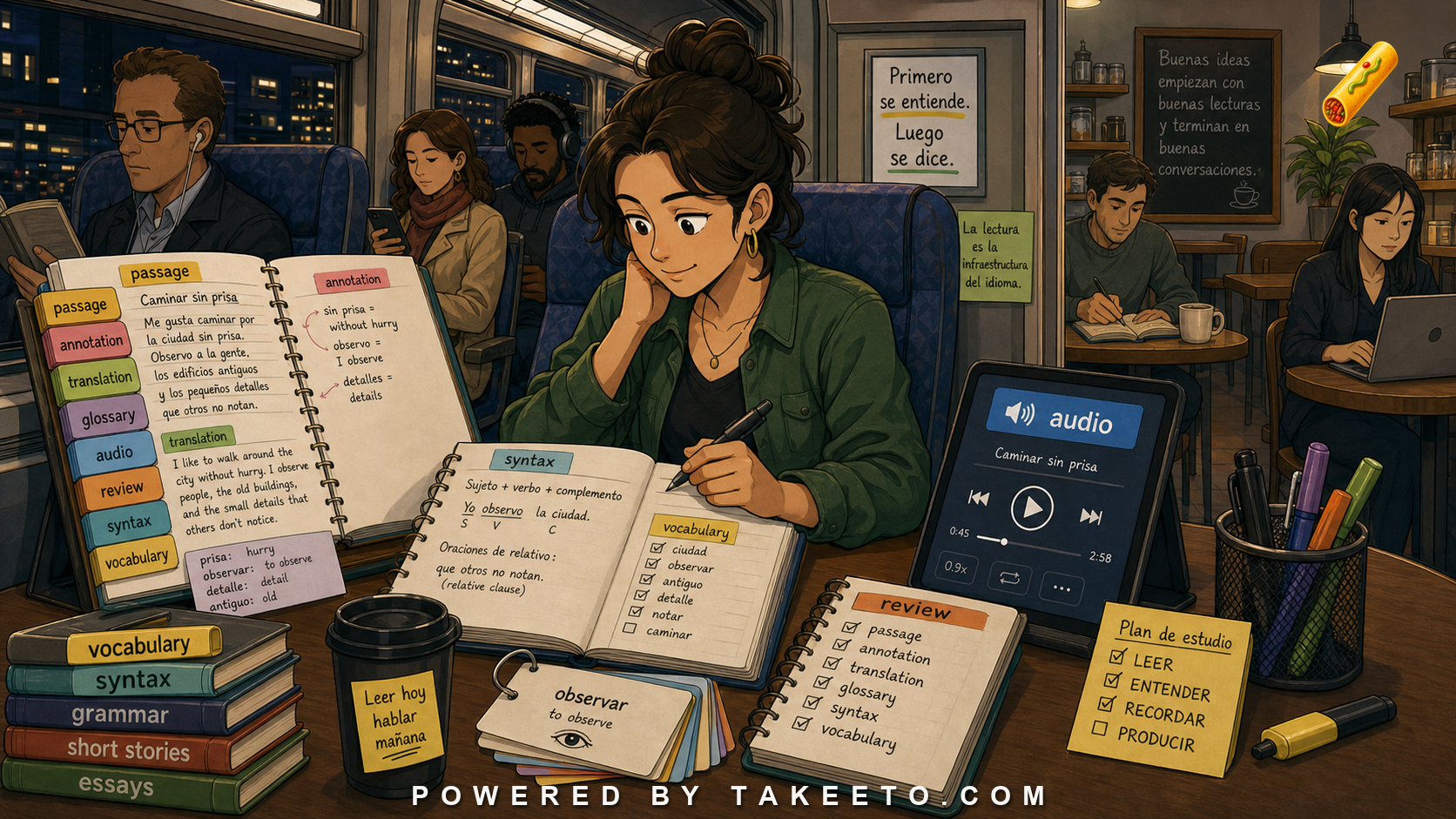
Reading first is not laziness when it is active
Many adult learners feel pressure to speak immediately. Speaking matters. But speaking without enough input often produces fragile fluency: fast guesses, memorized phrases, and repeated errors. Reading can build a deeper foundation if it is done actively.
A reading-first path does not mean silent, passive decoding for years. It means using texts to build grammar, vocabulary, syntax, discourse awareness, and eventually better speaking.
The key principle is:
Reading is powerful when it becomes structured exposure, not avoidance.
A learner who reads carefully, annotates, listens, reviews, and reuses language is not hiding from Spanish. They are building the internal material that speaking will later draw from.
Passages reveal grammar in context
Grammar explanations are useful, but passages show grammar doing real work.
A single paragraph may contain:
- preterite and imperfect contrast,
- object pronouns,
- relative clauses,
- connectors,
- gender and number agreement,
- subjunctive triggers,
- topic continuity,
- collocations,
- register signals.
A sentence such as:
Aunque el informe reconoce avances, advierte que aún faltan medidas concretas para garantizar el cumplimiento de los objetivos.
This sentence teaches concession, attribution, abstract nouns, formal register, and policy vocabulary. A speaking-only approach might not expose the learner to this density soon enough.
Annotation turns reading into study
Passive reading says: “I mostly understood it.”
Active reading asks:
What is the main verb?
What does this pronoun refer to?
Why is the subjunctive used here?
What phrase should I save?
What connector shows the argument?
What register is this?
Annotation can mark:
- unknown words,
- reusable phrases,
- verb forms,
- connectors,
- pronoun references,
- sentence boundaries,
- argument structure,
- translation problems.
The goal is not to mark everything. The goal is to make the text teach.
Translation as a tool, not a crutch
Translation can be useful if done carefully. It forces precision. It reveals structures that English would handle differently.
Example:
Se me olvidó la cita.
A literal analysis might be:
The appointment forgot itself on me.
A functional translation:
I forgot the appointment.
The literal layer helps the learner see Spanish structure. The functional layer helps the learner communicate meaning.
Bad translation skips the structure. Good translation exposes it.
Glossary building
A reading-based learner should build glossaries from passages, not random word lists.
A glossary entry should include:
palabra or phrase
meaning in this context
example sentence
collocation or preposition
register note
related forms
Example:
cumplir un objetivo
meet/fulfill a goal
garantizar el cumplimiento de los objetivos
formal policy/administrative register
This is much stronger than cumplir = fulfill alone.
Audio alignment
Reading first should not mean ignoring sound. Whenever possible, pair reading with audio.
A strong routine:
- Read silently for general meaning.
- Listen without reading.
- Read while listening.
- Mark pronunciation and phrase boundaries.
- Shadow selected sentences.
- Review vocabulary through audio.
This connects orthography, sound, and syntax. It also prevents the learner from building a purely visual Spanish.
From reading to speaking
Reading supports speaking when learners actively extract production material.
From a passage, save:
useful sentence frames,
connector phrases,
collocations,
topic vocabulary,
summary sentences,
opinion phrases,
question forms.
Then speak from the text:
Summarize the paragraph in Spanish.
Explain one sentence aloud.
Retell the passage in simpler language.
Give your opinion using two phrases from the text.
Ask three questions about the passage.
Now reading becomes rehearsal for speaking.
Adult learners and structural advantage
Adults often have advantages: literacy, metalinguistic awareness, study discipline, background knowledge, and ability to compare systems. Reading uses those strengths.
Children may acquire spoken language through massive immersion. Adults rarely get equivalent conditions. Deep reading gives adults concentrated exposure to grammar and vocabulary that conversation alone may not supply.
This is especially true beyond beginner level, where discourse, register, and domain vocabulary matter.
The danger: hiding forever
Reading-first can become avoidance if the learner never listens, speaks, writes, or gets feedback. The answer is not to abandon reading. The answer is to connect reading to output.
Signs of avoidance:
- reading only silently,
- never reviewing aloud,
- collecting vocabulary but not using it,
- translating everything into English,
- avoiding listening because it feels harder,
- waiting to speak until “ready.”
A serious reading-first path includes planned speaking, just not premature speaking as the only method.
Example bank walkthrough
Passage is the unit of serious reading, larger than isolated sentences.
Annotation turns noticing into learning.
Translation can reveal structure when used carefully.
Glossary should preserve context and collocation.
Audio connects text to sound.
Review makes reading durable.
Syntax is visible in long sentences.
Vocabulary becomes meaningful when attached to discourse.
Reading routine for adult learners
- Choose a passage slightly above comfort level.
- Read once for gist.
- Mark unknown but important words.
- Identify sentence structure in difficult lines.
- Build a short contextual glossary.
- Translate two or three hard sentences.
- Listen to audio if available.
- Read aloud or shadow selected lines.
- Summarize the passage in Spanish.
- Turn five useful phrases into review items.
Mini-workshop: speak from a paragraph
After reading one paragraph, close the text and give a thirty-second summary in Spanish. Then reopen the text and steal two useful phrases. Repeat the summary using those phrases. This bridges reading and speaking without pretending they are the same skill. The learner first understands, then retrieves, then upgrades production from the passage. That is how reading becomes active output preparation.
Reading-to-output bridge
Every reading session should produce a small output. After a news paragraph, summarize the claim in two sentences. After a policy paragraph, make a table. After a literary paragraph, describe one stylistic choice. After a grammar explanation, create an original example. After an opinion column, state the argument and one objection.
This bridge prevents reading from staying receptive only. It also reveals whether comprehension is real. A learner may feel they understand aunque, sin embargo, según, and por lo tanto while reading. Producing a short paragraph with those connectors exposes gaps.
A useful routine is read, mark, borrow, produce. Read the paragraph. Mark verbs and connectors. Borrow one phrase. Produce one sentence of your own using that phrase. For example, borrow los datos sugieren que and write Los datos sugieren que el problema no se limita a una sola región. That is how reading becomes writing material.
Remediation drill: turn a reading into output
After reading one passage, produce three outputs. First, a one-sentence summary in Spanish. Second, a phrase bank of five reusable expressions. Third, one spoken retelling of thirty seconds.
Example phrase bank from a policy passage:
según el informe
se desprende de los datos
aunque la medida busca
no obstante
a largo plazo
Now use two of those phrases in your own sentences. This turns reading into writing preparation. Then read one paragraph aloud or shadow an audio version if available. This turns reading into pronunciation and listening support.
The goal is not to rush into speaking before you have structure. The goal is to make reading feed every other skill. A learner who only reads silently may become knowledgeable but slow in conversation. A learner who mines reading for phrases, grammar, and audio builds transferable Spanish.
For remediation, limit lookup. Choose words that repeat, words that carry argument, and phrases you might reuse. Do not let the dictionary consume the whole session. Reading volume matters, and too much lookup kills volume.
A strong reading-first routine is disciplined, not passive: read, annotate, listen, summarize, reuse, review.
Suggested interactive module: annotated reading workflow
A strong tool would guide learners through active reading.
Suggested functions:
- Passage display: with line numbers and annotation layers.
- Syntax mode: finite verbs, connectors, clauses, pronouns.
- Glossary builder: phrase-based, not word-only.
- Translation layer: literal, structural, functional.
- Audio alignment: sentence playback and shadowing.
- Review export: flashcards from phrases and sentences.
- Output prompts: summarize, retell, explain, respond.
- Progress map: reading speed, unknown words, grammar targets.
Applied reading drill: one paragraph, three passes
Choose a short paragraph. First pass: underline finite verbs. Second pass: circle connectors such as aunque, por eso, sin embargo, según. Third pass: extract five useful phrases. Only after those passes should you translate a difficult sentence.
This routine prevents passive reading. You are not merely asking “What does this mean?” You are asking “How is this Spanish built?” That question turns reading into preparation for listening, writing, and speaking.
Remediation focus: making reading-first study active enough to become language acquisition, not avoidance
Reading Spanish before speaking it can be a serious path for adult learners, but only if reading is active. Passive reading can become a hiding place. The learner recognizes many words, nods through the gist, and avoids the discomfort of retrieval, pronunciation, writing, and conversation. That is not a reading-first method; it is a comprehension comfort zone.
The remediation move is to make every passage produce evidence of learning. After reading, the learner should be able to mark grammar, paraphrase sentences, extract collocations, listen to audio, summarize aloud, rewrite a sentence, and review selected items. Reading becomes a foundation for speaking when it creates structured output.
Common failure modes to repair
- Mistaking gist for mastery: Understanding the general topic does not mean the syntax, connectors, verb forms, and reference chains are controlled.
- Overusing translation: Translation is useful for checking meaning. It becomes a crutch when every Spanish sentence must pass through English before being understood.
- Avoiding pronunciation: Reading silently may improve vocabulary while leaving listening and speech weak.
- Choosing only easy texts: A good reading routine needs comprehensible passages plus targeted stretch material.
Before/after: turn a paragraph into speaking practice
Weak version:
Read the paragraph and look up unknown words.
Stronger version:
Read the paragraph, bracket the clauses, underline three collocations, listen once with audio, summarize it aloud in two sentences, then rewrite one sentence using a different connector.
The stronger routine turns reading into grammar, listening, retrieval, and production.
Upgrade workshop: three-pass reading routine
- Pass one: read for situation. Who is involved, what happened, what is the text type?
- Pass two: read for structure. Mark finite verbs, connectors, pronouns, topic shifts, and embedded clauses.
- Pass three: read for reuse. Extract phrases you could use in writing or speech.
- Close the text and summarize aloud. Do not read your notes while speaking.
- Return the next day and reconstruct the paragraph from keywords.
Quality-control checklist
- Does the text contain one clear grammar target or too many new problems at once?
- Did the learner listen to the passage, not only read it?
- Did the glossary include collocations and phrases, not just single words?
- Did the session produce any output: summary, rewrite, recording, or question?
- Is the learner gradually increasing domain variety and register difficulty?
Applied remediation drill: prove that reading has become active
Use this source-style excerpt:
The learner reads a 500-word article, understands the topic, highlights twelve unknown words, and moves on.
A fast but weak reading might say:
The session was successful because the learner understood the article and collected vocabulary.
That reading is incomplete. A stronger reading says:
The session produced partial comprehension but little retrieval. The learner needs evidence: a summary, parsed sentence, audio pass, collocation list, and one spoken or written reuse task.
The repair comes from five checks:
- Topic understanding is only the first layer.
- Highlighting unknown words does not guarantee future recall.
- A parsed sentence trains syntax and slows down false fluency.
- Audio alignment connects print to listening.
- Output turns recognition into retrieval.
Upgrade the session record: Summary: 3 sentences. Syntax: one long sentence bracketed. Vocabulary: five phrases, not twelve isolated words. Audio: one listen after reading. Output: one 60-second oral summary. Review: revisit tomorrow. This makes reading-first study measurable and prevents the learner from confusing exposure with acquisition.
Final rule
Reading Spanish before speaking it can be a serious path if reading is active, audible, and connected to output.
Use passages, annotation, translation, glossaries, audio, review, syntax, and vocabulary to build the language deeply. Then speak from what you have read. Reading is not the opposite of speaking. It is one way to prepare the mind for speech.