
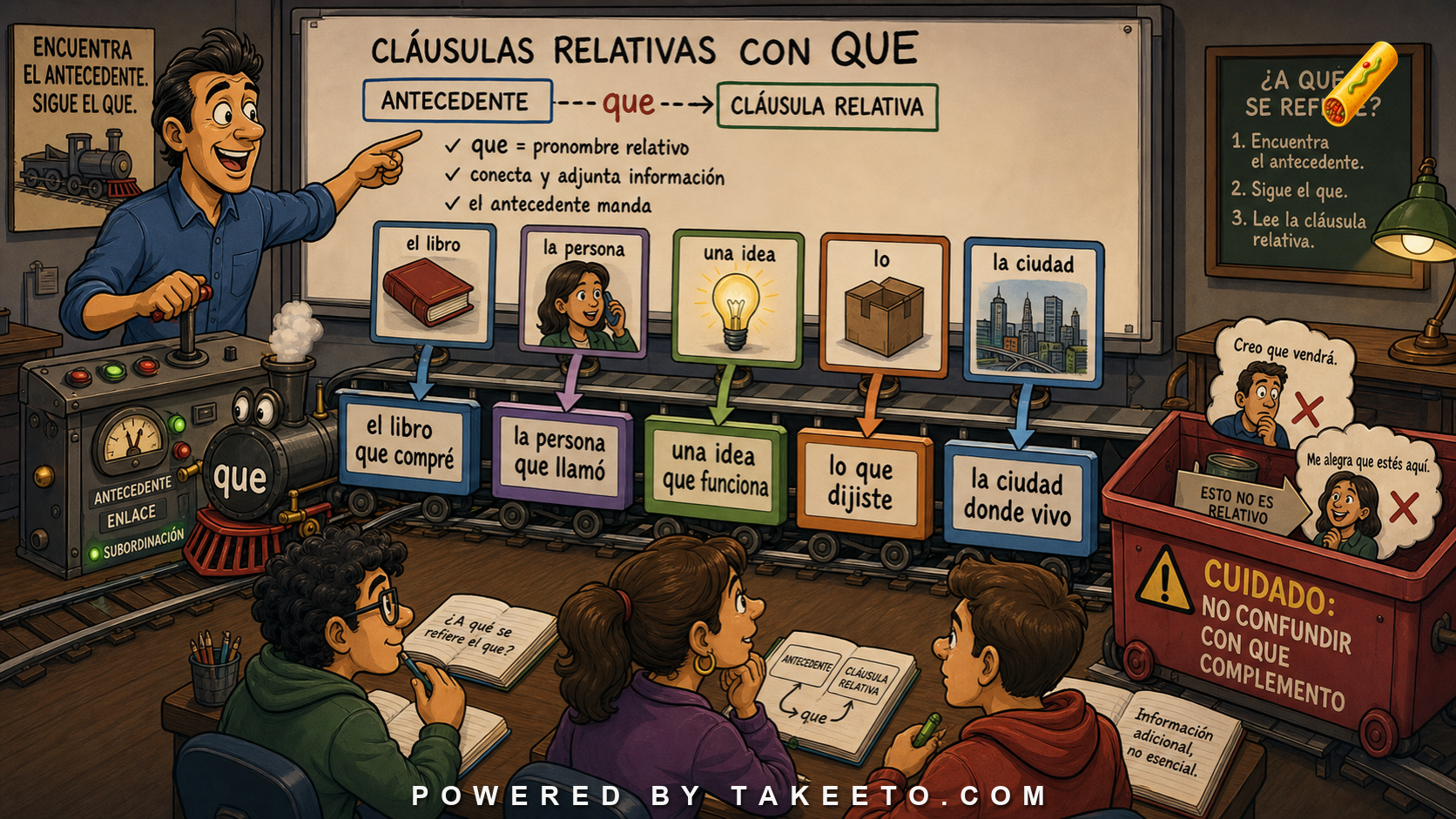
The problem is not that que has too many meanings
Spanish learners usually meet que early, then underestimate it. They learn creo que, el libro que, más que, qué with an accent, and perhaps lo que, then decide that que is simply an all-purpose connector. That shortcut works for a few translations, but it fails when sentences become longer.
The most important first distinction is between relative que and complement que.
Creo que Ana llamó.
I believe that Ana called.
Here que Ana llamó is a complement clause. It completes the meaning of creo. The clause gives the content of the belief.
La persona que llamó era Ana.
The person who called was Ana.
Here que llamó is a relative clause. It modifies la persona. It identifies which person we mean.
The same written word appears in both sentences, but the architecture is different. In a complement clause, que introduces a proposition. In a relative clause, que links a modifying clause to a noun or noun-like antecedent.
A practical learner rule is this:
Relative que points backward to an antecedent. Complement que usually completes a verb, noun, or adjective.
That one distinction prevents a large amount of misreading.
What a relative clause does
A relative clause is a clause that modifies a noun phrase. It gives information about a person, thing, place, idea, or whole proposition.
el libro que compré
the book that I bought
The noun phrase is el libro. The relative clause is que compré. The relative clause does not stand alone as a full sentence in normal use; it depends on the noun it modifies.
The noun being modified is called the antecedent. In el libro que compré, the antecedent is el libro.
Relative clauses can identify, restrict, explain, or comment. They let Spanish build dense sentences without repeating nouns.
Compare:
Compré un libro. El libro explica la historia de México.
I bought a book. The book explains the history of Mexico.
A relative clause compresses the repetition:
Compré un libro que explica la historia de México.
I bought a book that explains the history of Mexico.
Spanish uses this compression constantly in writing, conversation, academic prose, journalism, instructions, and literary narration. Relative clauses are not decorative grammar. They are one of the main engines of Spanish sentence building.
Que can be a subject relative marker
In a subject relative, que represents the subject of the relative clause.
la persona que llamó
the person who called
Inside the relative clause, the meaning is “the person called.” The person is doing the calling.
More examples:
| Spanish | Structure | Meaning |
|---|---|---|
| la mujer que llegó tarde | que = subject of llegó | the woman who arrived late |
| una idea que funciona | que = subject of funciona | an idea that works |
| los estudiantes que aprobaron | que = subject of aprobaron | the students who passed |
| el tren que sale a las ocho | que = subject of sale | the train that leaves at eight |
Notice that que itself does not change for gender or number. It can refer to masculine, feminine, singular, plural, human, or nonhuman antecedents.
el hombre que vino
la mujer que vino
los hombres que vinieron
las mujeres que vinieron
The verb inside the relative clause agrees with the understood subject. Que does not carry visible agreement, but the clause still has agreement.
Que can be an object relative marker
In an object relative, que represents the object inside the relative clause.
el libro que compré
the book that I bought
Inside the relative clause, the meaning is “I bought the book.” The book is the object of compré.
More examples:
| Spanish | Hidden role inside the clause | Meaning |
|---|---|---|
| la película que vimos | we saw the movie | the movie that we watched |
| los documentos que envié | I sent the documents | the documents that I sent |
| la decisión que tomaron | they made the decision | the decision that they made |
| el problema que resolviste | you solved the problem | the problem that you solved |
English sometimes drops the relative marker in object relatives: “the book I bought.” Spanish normally keeps que.
the book I bought
el libro que compré
A common English-speaking error is to omit que:
Incorrect: el libro compré
Correct: el libro que compré
Spanish does allow participial and reduced constructions in other contexts, but ordinary finite relative clauses need a relative marker.
Restrictive and nonrestrictive relatives
Relative clauses do two major discourse jobs.
A restrictive relative identifies which noun we mean. It narrows the reference.
Los estudiantes que entregaron el ensayo recibirán comentarios.
The students who submitted the essay will receive comments.
This does not necessarily include all students. It means the subset who submitted the essay.
A nonrestrictive or explanatory relative adds extra information about an already identified noun. In writing, Spanish normally marks it with commas.
Los estudiantes, que entregaron el ensayo ayer, recibirán comentarios.
The students, who submitted the essay yesterday, will receive comments.
This suggests that the students as a group submitted the essay. The relative clause comments on them rather than selecting a subset.
The difference matters. It can change who is included.
| Sentence | Meaning |
|---|---|
| Los empleados que trabajan desde casa deben conectarse a las nueve. | Only employees who work from home are included. |
| Los empleados, que trabajan desde casa, deben conectarse a las nueve. | The employees are described as working from home; the clause is extra information. |
Spanish punctuation is not cosmetic here. Commas tell the reader how the relative clause attaches to the noun phrase.
Que is not enough after many prepositions
Simple que is extremely powerful when it functions as subject or direct object. But when the relative element is governed by a preposition, Spanish normally has to show that preposition.
Compare:
el tema que estudiamos
the topic that we studied
Here que is the direct object of estudiamos.
el tema del que hablamos
the topic that we talked about
Here the verb is hablar de algo. The preposition de is part of the structure. Spanish cannot simply erase it in careful standard style.
Other examples:
| We want to say | Natural Spanish |
|---|---|
| the person I spoke with | la persona con la que hablé / la persona con quien hablé |
| the issue we depend on | el asunto del que dependemos |
| the city I live in | la ciudad en la que vivo / la ciudad donde vivo |
| the reason I did it for | la razón por la que lo hice |
Learners often produce English-shaped sentences like:
la persona que hablé
el tema que hablamos
In some regions and casual styles, preposition loss can appear in speech, but it is not the safe model for careful Spanish. If the verb or expression requires a preposition, preserve it.
Que and quien, el cual, donde, lo que
Relative que is the workhorse, but it is not the whole system.
Spanish also has quien/quienes for human antecedents, especially after prepositions:
la profesora con quien estudié
the professor with whom I studied
It has el que, la que, los que, las que for clarity, especially after prepositions:
el tema del que hablamos
the topic we talked about
It has el cual, la cual, los cuales, las cuales, often formal or written:
una decisión contra la cual protestaron
a decision against which they protested
It has donde for places:
la ciudad donde vivo
the city where I live
And it has lo que for abstract or neuter reference:
lo que dijiste
what you said
The beginner does not need to replace que everywhere. The serious learner needs to know when que is enough and when a more explicit relative form is clearer, required, or more formal.
How to distinguish relative que from complement que
Use a three-question test.
1. Is there an antecedent immediately before or nearby?
la idea que propusiste
the idea that you proposed
La idea is the antecedent. This is a relative clause.
Creo que propusiste una idea.
I think that you proposed an idea.
There is no antecedent before que. The clause gives the content of creo. This is complement que.
2. Can the que-clause be paraphrased as information about a noun?
el informe que leí
the report that I read
The clause tells us which report.
Me alegra que hayas leído el informe.
I am glad that you read the report.
The clause is what causes the emotional reaction. It does not modify alegra as a noun.
3. Is there a missing role inside the que-clause?
In a relative clause, something is often “missing” because the antecedent fills that role.
el libro que compré __
the book that I bought __
The object position is filled by the antecedent.
In a complement clause, there is usually no such gap:
Dijo que compró el libro.
She said that she bought the book.
The complement clause is complete: compró el libro.
Relative clauses in dense writing
Spanish formal prose often stacks relative clauses with prepositional phrases and participles. A learner must learn to mark boundaries.
La propuesta que presentó el comité, que había trabajado durante meses con expertos externos, fue aprobada por la universidad.
A slow reading:
- La propuesta = main noun phrase.
- que presentó el comité = restrictive relative: which proposal?
- que había trabajado... = explanatory relative about el comité.
- fue aprobada = main predicate.
Without boundary awareness, the sentence becomes a blur of que. With antecedent tracking, it becomes manageable.
A good reading habit is to draw arrows:
propuesta ← que presentó el comité
comité ← que había trabajado...
Every relative clause needs an anchor. Find the anchor before translating.
Diagnostic workflow: finding the clause skeleton
The best way to read a sentence with que is not to translate immediately. First recover the sentence skeleton without the relative clause.
Take this sentence:
La propuesta que presentó la comisión generó muchas dudas.
A word-by-word reader may get lost after que. A structural reader does this:
- Antecedent: la propuesta.
- Relative clause: que presentó la comisión.
- Role of antecedent inside the relative clause: object of presentó.
- Main skeleton: La propuesta generó muchas dudas.
Now the whole sentence is easy:
The proposal that the committee presented raised many doubts.
The same method works when the antecedent is the subject of the relative clause:
La propuesta que generó muchas dudas fue retirada.
Here la propuesta is the thing that generated doubts. The main skeleton is:
La propuesta fue retirada.
The relative clause identifies which proposal.
A useful classroom drill is to give learners pairs that differ only in relative-clause role:
| Sentence | Antecedent role | Meaning |
|---|---|---|
| La persona que llamó dejó un mensaje. | subject of llamó | The person called. |
| La persona que llamé no contestó. | object of llamé | I called the person. |
| El informe que criticó el ministro era falso. | object of criticó | The minister criticized the report. |
| El informe que criticó al ministro era falso. | subject of criticó | The report criticized the minister. |
The last pair shows why grammar matters. Que itself does not tell you who criticized whom. The verb agreement, the personal a, and the noun phrases do.
For writing, use the same workflow in reverse. Before adding a relative clause, ask whether the reader will know exactly which noun it modifies. If two nouns compete for the same relative clause, rewrite. A sentence like El informe del comité que fue publicado ayer... may be clear in context, but it can also leave the reader wondering whether the report or the committee was published. Good Spanish is not just grammatical; it makes the antecedent recoverable.
Diagnostic workflow: finding the real clause boundary
When a sentence contains more than one que, do not translate from left to right as if every que had the same job. First separate the main clause from the dependent clauses. Then ask which noun, if any, each relative clause modifies.
Take this sentence:
El informe que publicó la comisión dice que las medidas que propuso el ministerio no son suficientes.
There are three instances of que. They do not do the same work.
| Segment | Function |
|---|---|
| que publicó la comisión | relative clause modifying el informe |
| que las medidas... no son suficientes | complement clause giving the content of dice |
| que propuso el ministerio | relative clause modifying las medidas |
The sentence means: the report published by the committee says that the measures proposed by the ministry are not sufficient. If you treat all three que forms as “that” without structure, the sentence stays cloudy. If you identify antecedents and complements, it becomes transparent.
A good editing habit is to bracket relative clauses and temporarily remove them:
El informe [que publicó la comisión] dice que las medidas [que propuso el ministerio] no son suficientes.
Now the skeleton is visible:
El informe dice que las medidas no son suficientes.
This skeleton method is especially useful in legal, academic, and journalistic Spanish, where relative clauses often carry definitions, restrictions, and institutional details. It also prevents one of the most common learner errors: attaching a relative clause to the nearest noun automatically when meaning or punctuation points elsewhere.
V2 remediation refinement: recover the missing preposition before choosing que
The most important repair for this article is not adding more relative pronouns. It is forcing the learner to reconstruct the full clause before compressing it into a relative clause. Most bad relative clauses come from skipping that reconstruction step.
Start with the independent sentence:
Hablé con la profesora.
I spoke with the professor.
Now turn la profesora into an antecedent:
la profesora con la que hablé
la profesora con quien hablé
The preposition con survives because it belongs to hablar con alguien. If the learner writes la profesora que hablé, the sentence has not merely chosen a less elegant pronoun. It has lost a grammatical relation.
Use the same method with nonhuman antecedents:
| Independent pattern | Relative phrase |
|---|---|
| depender de los datos | los datos de los que depende el análisis |
| trabajar con una herramienta | la herramienta con la que trabajo |
| pensar en una solución | la solución en la que pensé |
| luchar por una causa | la causa por la que luchamos |
| referirse a un problema | el problema al que se refiere |
This also separates relative que from complement que. In creo que vendrá, there is no noun antecedent and no missing role inside the second clause. Que vendrá is the content of the belief. In la persona que vendrá, the clause modifies la persona, and que fills the subject role inside the relative clause.
A reliable editing drill is to put brackets around the antecedent and then write the full internal clause under it:
el informe [que citaste]
citaste el informe
el informe [del que hablaste]
hablaste del informe
el informe [en el que se basa la propuesta]
la propuesta se basa en el informe
If the reconstructed clause requires de, en, a, con, por, or another preposition, the relative clause normally has to keep that relation visible. This is the fastest way to move from beginner que to adult relative-clause control.
Suggested interactive module: clause-boundary highlighter
A tool for this article should let the learner paste a sentence and mark every que by function.
Suggested functions:
- Que classifier: relative marker, complementizer, comparative connector, interrogative/exclamative if accented.
- Antecedent arrows: draw a line from relative que to the noun it modifies.
- Gap detector: show whether que is subject, direct object, or part of a prepositional relative.
- Comma mode: explain restrictive vs nonrestrictive relative clauses.
- Repair mode: flag likely missing prepositions, such as el tema que hablamos → el tema del que hablamos.
Example input:
La ciudad donde vivo tiene un museo que abrió el año pasado y que muchos turistas visitan.
The output should show:
- donde vivo modifies la ciudad.
- que abrió el año pasado modifies un museo; que is subject.
- que muchos turistas visitan modifies un museo; que is object.
Final rule
Relative que is not just “that.” It is a clause-building tool that links a modifying clause to an antecedent.
Use que comfortably for subject and object relatives: la persona que llamó, el libro que compré. Watch punctuation to distinguish restrictive and explanatory relatives. Do not confuse relative que with complement que in sentences like creo que viene. And when the relative relationship requires a preposition, do not erase it: el tema del que hablamos, la persona con quien hablé, la ciudad en la que vivo.
The serious reader does not translate que mechanically. The serious reader asks: What clause is this? What does it modify? What role is missing inside it? That is how Spanish subordination becomes readable.