
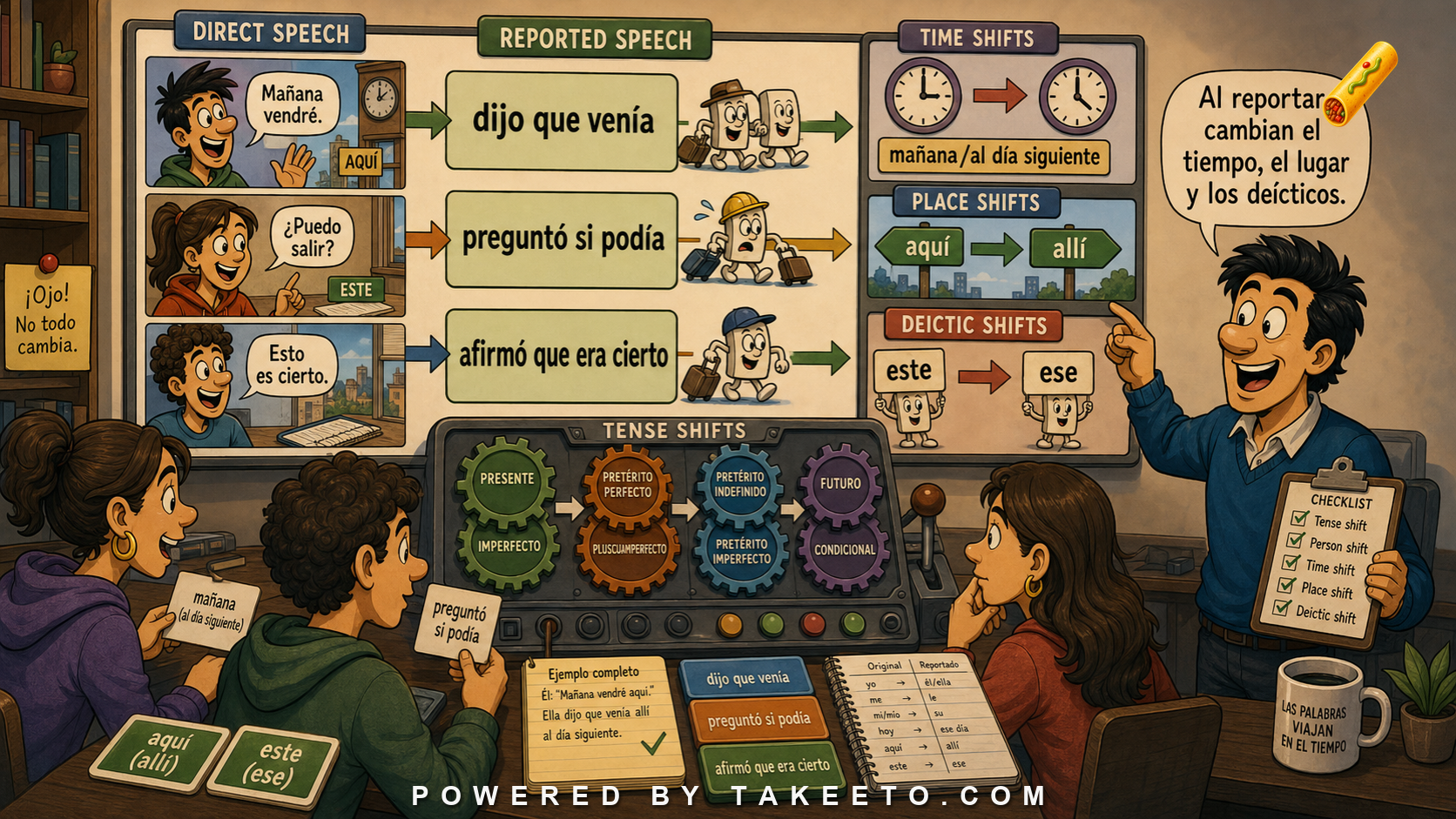
Reporting speech means moving the center of the sentence
Direct speech preserves a speaker’s original words:
Ana dijo: “Voy mañana.”
Reported speech rebuilds those words from another viewpoint:
Ana dijo que iba al día siguiente.
Ana said she was going the next day.
The transformation is not only about changing quotation marks. It changes person, tense, time words, place words, demonstratives, and responsibility for the claim.
The key principle is:
Reported speech shifts the deictic center: who is speaking, when, where, and from whose viewpoint the words are presented.
Spanish makes these shifts through que, si, question words, tense choices, pronouns, and adverbs.
Dijo que: reporting statements
Statements are commonly reported with decir que and related verbs.
Dijo que venía.
He said he was coming.
Afirmó que era cierto.
She stated that it was true.
Respondió que no sabía nada.
He answered that he did not know anything.
Negó que fuera responsable.
He denied that he was responsible.
The verb after the reporting verb depends on meaning and sequence of tenses. Indicative is used for asserted content. Subjunctive can appear after denial, doubt, command, or non-assertion.
Preguntó si: reporting yes/no questions
Yes/no questions are reported with si.
Direct:
“¿Puedes venir?”
Reported:
Preguntó si podía venir.
She asked whether I/he/she could come.
More examples:
Me preguntó si tenía tiempo.
He asked me whether I had time.
Preguntaron si habíamos terminado.
They asked whether we had finished.
This si means “whether,” not a conditional “if.” Do not apply conditional si rules automatically.
Question words stay question words
Information questions keep their question word, but the structure becomes indirect.
Direct:
“¿Dónde vives?”
Reported:
Me preguntó dónde vivía.
He asked me where I lived.
Direct:
“¿Qué quieres?”
Reported:
Preguntó qué quería.
She asked what I wanted.
Common reporting patterns:
preguntó qué...
asked what...
preguntó cuándo...
asked when...
preguntó dónde...
asked where...
preguntó por qué...
asked why...
Accent marks remain on indirect question words:
No sé qué quiere.
I do not know what he wants.
Tense backshift: common but not automatic
If the reporting verb is past, Spanish often shifts the reported verb into a past tense.
Dice: “Estoy cansado.”
He says: “I am tired.”
Dijo que estaba cansado.
He said he was tired.
Direct:
“Voy a salir.”
Reported:
Dijo que iba a salir.
She said she was going to leave.
But Spanish does not always backshift mechanically. If the content is still true or intentionally presented as current, the present can remain.
Dijo que vive en Lima.
He said he lives in Lima.
This may imply he still lives there, or the speaker chooses not to distance the fact.
Dijo que vivía en Lima.
He said he lived in Lima.
This may be neutral past reporting or imply uncertainty about current status.
Tense choice can shape how current or distant the reported information feels.
Person shifts
Direct speech uses pronouns from the original speaker’s viewpoint.
Marta dijo: “Yo te llamo.”
Reported from another speaker’s viewpoint:
Marta dijo que me llamaba.
Marta said she would call me.
The original yo becomes Marta/ella. The original te changes depending on who is now reporting to whom.
Learner action: identify the original speaker, original listener, current reporter, and current listener.
Time adverbs shift
Time words often shift when speech is reported later.
hoy → ese día / aquel día
today → that day
mañana → al día siguiente
tomorrow → the next day
ayer → el día anterior
yesterday → the previous day
ahora → entonces
now → then
esta semana → esa semana
this week → that week
Example:
Dijo: “Mañana salgo.”
He said: “I leave tomorrow.”
Dijo que salía al día siguiente.
He said he was leaving the next day.
If the report happens on the same day, the original adverb may remain possible. Context controls the shift.
Place adverbs and demonstratives shift
Place words also depend on viewpoint.
aquí → allí / ahí
here → there
este → ese / aquel
this → that
estos documentos → esos documentos / aquellos documentos
these documents → those documents
Direct:
“Firma aquí.”
Reported later elsewhere:
Me dijo que firmara allí.
He told me to sign there.
Demonstratives are not just grammar. They encode distance from the speaker’s center.
Reporting commands
Commands often become que + subjunctive after verbs like decir, pedir, ordenar, recomendar, or aconsejar.
Direct:
“Ven temprano.”
Reported:
Me dijo que viniera temprano.
He told me to come early.
Direct:
“No salgan.”
Reported:
Les pidió que no salieran.
He asked them not to leave.
This is one of the most practical uses of the imperfect subjunctive after a past reporting verb.
Journalism and responsibility
Reported speech is central in news writing. Different reporting verbs signal different stances:
dijo
said
afirmó
stated
aseguró
assured / claimed firmly
señaló
pointed out
advirtió
warned
denunció
denounced / alleged
A journalist’s verb choice can affect how readers interpret the source. Afirmar, denunciar, admitir, and reconocer do not carry the same framing.
Learner action: read attribution verbs as part of the message.
Dijo que can report a statement or a command
A high-value contrast is decir que + indicative versus decir que + subjunctive.
Statement:
Me dijo que venía.
He/she told me that he/she was coming.
Command or instruction:
Me dijo que viniera.
He/she told me to come.
The reporting verb is the same, but the subordinate mood changes the speech act. Indicative reports content. Subjunctive reports a directive.
More contrasts:
Dijo que cerraban la puerta.
He/she said they were closing the door.
Dijo que cerraran la puerta.
He/she told them to close the door.
Nos dijo que esperábamos allí.
He/she said we were waiting there.
Nos dijo que esperáramos allí.
He/she told us to wait there.
This is one of the most practical reasons to master the imperfect subjunctive. It changes reported speech from “what someone said was true” to “what someone told someone else to do.”
Deictic shifts are optional only when the center stays the same
Sometimes learners over-convert every time word.
If Ana says at 9 a.m. today:
Voy hoy.
and you report it later the same day, you can still say:
Ana dijo que iba hoy.
If you report it next week, hoy is no longer anchored correctly:
Ana dijo que iba ese día.
The same is true for aquí, este, and mañana. Shift them when the reporting center has changed. Preserve them when the original center and the reporting center still overlap.
Example bank walkthrough
dijo que venía
Reported statement with past reporting verb.
Learner action: interpret venía as future-in-the-past or ongoing movement depending on context.
preguntó si podía
Reported yes/no question.
Learner action: this si means whether.
afirmó que era cierto
Reported assertion.
Learner action: afirmó frames the statement as a claim.
mañana / al día siguiente
Time shift from original speech to reported viewpoint.
Learner action: track when the report occurs.
aquí / allí
Place shift.
Learner action: track the reporting location.
este / ese
Demonstrative shift.
Learner action: track speaker distance.
Reported-speech workflow
To report speech, identify:
- Original speaker.
- Original listener.
- Current reporter.
- Current listener.
- Original time and reporting time.
- Original place and reporting place.
- Statement, yes/no question, information question, or command.
- Whether the content is asserted, denied, requested, or doubted.
Then adjust pronouns, tense, time words, place words, and mood.
Suggested interactive module: direct-to-indirect transformer
A strong tool for this article would transform direct speech step by step.
Suggested functions:
- Speech type selector: statement, yes/no question, wh-question, command.
- Reporting verb selector: dijo, preguntó, pidió, negó, afirmó.
- Deictic map: original speaker/listener/time/place.
- Shift suggestions: mañana → al día siguiente, aquí → allí.
- Mood warning: commands become que + subjunctive.
- Current relevance toggle: present preserved or backshifted.
- Journalistic stance notes: attribution verb meanings.
Final rule
Reported speech is not quotation without quotation marks.
It rebuilds speech from a new center. Track person, tense, time, place, demonstratives, and source responsibility.
In Spanish, dijo que, preguntó si, and pidió que are not just connectors. They are viewpoint machines.