
Se is not one word with one meaning
Few Spanish words cause as much learner frustration as se. It appears in reflexive verbs, reciprocal actions, passive clauses, impersonal sentences, pronominal verbs, accidental events, and double-object pronoun sequences. The surface form stays the same, but the syntax changes.
The best way to begin is not to memorize every se at once. Start with the most concrete use: reflexive se.
In a reflexive construction, the subject and object refer to the same participant.
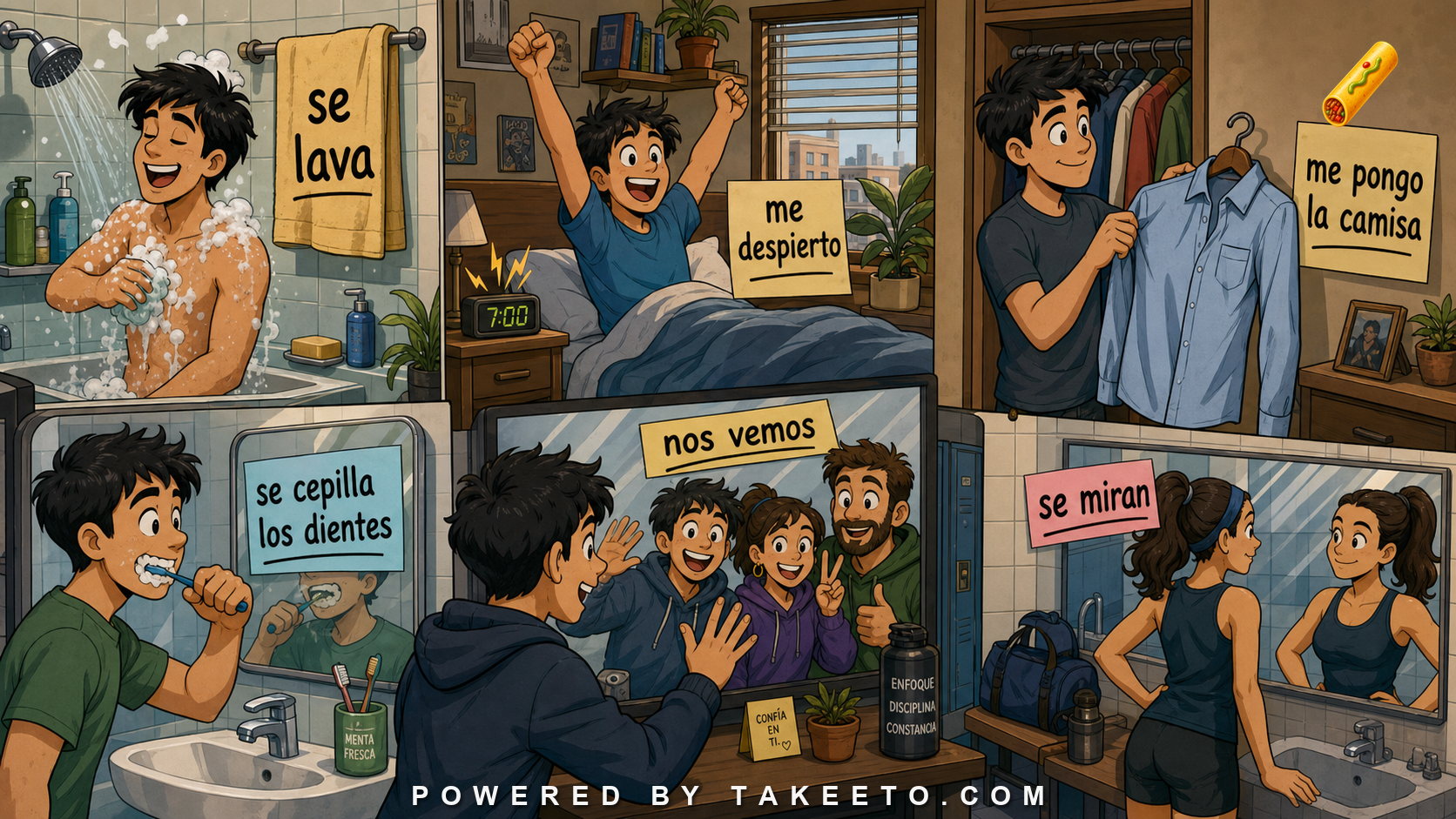
Ana se lava.
Ana washes herself.
Ana is the person doing the washing, and Ana is also the person washed. The reflexive pronoun marks that overlap.
But even here, Spanish does more than English. Reflexive marking appears with body care, clothing, posture, reciprocal relationships, and many verbs that English does not mark in the same way.
The first rule is:
Reflexive pronouns mark that an action returns to, affects, or is internally tied to the subject.
The reflexive pronoun set
The third-person form is se, but reflexive constructions use a full set of pronouns.
| Subject | Reflexive pronoun | Example |
|---|---|---|
| yo | me | Me lavo. |
| tú | te | Te lavas. |
| él/ella/usted | se | Se lava. |
| nosotros/as | nos | Nos lavamos. |
| vosotros/as | os | Os laváis. |
| ellos/ellas/ustedes | se | Se lavan. |
The pronoun agrees with the subject. That is why me appears with yo, te with tú, nos with nosotros, and se with third person.
Compare:
Lavo el coche.
I wash the car.
Me lavo.
I wash myself.
Ana lava al niño.
Ana washes the child.
Ana se lava.
Ana washes herself.
The reflexive pronoun changes the participant structure of the sentence.
Direct reflexives: the subject is the direct object
In the most transparent cases, the reflexive pronoun functions like a direct object.
Ana se mira en el espejo.
Ana looks at herself in the mirror.
Pablo se critica demasiado.
Pablo criticizes himself too much.
Los niños se esconden.
The children hide themselves.
A useful test is to replace se with a non-reflexive object:
Ana mira a Marta.
Ana looks at Marta.
Ana se mira.
Ana looks at herself.
The same verb can be used with an external object or with a reflexive object.
Indirect reflexives: body parts and clothing
Spanish often uses reflexive pronouns with body parts and clothing in a way that English does not mirror directly.
Ana se lava las manos.
Ana washes her hands.
Me cepillo los dientes.
I brush my teeth.
Se puso la chaqueta.
He/she put on the jacket.
In these sentences, the reflexive pronoun is not the direct object. The direct object is las manos, los dientes, la chaqueta. The pronoun marks the affected person.
| Spanish structure | Literal role | Natural English |
|---|---|---|
| Me lavo las manos. | I wash the hands to/for myself. | I wash my hands. |
| Se cepilla los dientes. | He brushes the teeth for himself. | He brushes his teeth. |
| Te pones la camisa. | You put the shirt on yourself. | You put on your shirt. |
This is why Spanish usually uses the definite article with body parts and clothing in these constructions, not a possessive:
Me duele la cabeza.
My head hurts.
Me lavo las manos.
I wash my hands.
Se quitó los zapatos.
She took off her shoes.
English uses my/your/his/her. Spanish often uses me/te/se/nos/os/se plus el/la/los/las.
Reciprocal readings: each other
Plural reflexive forms can also be reciprocal.
Nos vemos mañana.
We will see each other tomorrow.
Los dos amigos se abrazaron.
The two friends hugged each other.
Se miraron en silencio.
They looked at each other in silence.
The same form can also be genuinely reflexive:
Se miraron en el espejo.
They looked at themselves in the mirror.
Context determines whether the reading is reflexive or reciprocal. If clarity matters, Spanish can add expressions such as el uno al otro, mutuamente, or entre sí.
Se ayudaron mutuamente.
They helped each other.
Se respetan entre sí.
They respect one another.
Reflexive does not always mean deliberate
Some reflexive or pronominal verbs describe changes of state rather than deliberate self-directed actions.
Me despierto a las siete.
I wake up at seven.
Se enfermó durante el viaje.
He/she got sick during the trip.
Nos sentamos cerca de la puerta.
We sat down near the door.
The subject is affected by the event, but the action is not always something the subject intentionally does to itself. This is one reason the English phrase “does something to oneself” is too narrow.
For beginning analysis, though, it still helps to ask: does the pronoun refer back to the subject? If yes, you are near the reflexive/pronominal zone.
Reflexive and non-reflexive contrasts
Many verbs can appear with or without a reflexive pronoun, and the difference matters.
| Non-reflexive | Reflexive/pronominal | Difference |
|---|---|---|
| lavar el coche | lavarse | wash something else vs wash oneself |
| dormir ocho horas | dormirse | sleep vs fall asleep |
| ir a casa | irse de casa | go vs leave/go away |
| poner la mesa | ponerse la camisa | put something somewhere vs put clothing on oneself |
| levantar la caja | levantarse | lift something vs get up |
Some of these are transparent reflexives. Others are meaning shifts that belong to pronominal verb vocabulary. Article 044 treats those in detail.
The warning for learners is direct: do not assume the se is optional decoration. It may change the verb’s meaning.
Pronoun placement
Reflexive pronouns normally appear before a finite verb:
Me levanto temprano.
I get up early.
No se mira en el espejo.
He/she does not look at himself/herself in the mirror.
With infinitives and gerunds, the pronoun can often attach to the nonfinite verb or appear before the finite verb in a verbal chain:
Voy a levantarme.
Me voy a levantar.
I am going to get up.
Está lavándose las manos.
Se está lavando las manos.
He/she is washing his/her hands.
With affirmative commands, the pronoun attaches:
Levántate.
Get up.
Lávese las manos.
Wash your hands.
With negative commands, it goes before the verb:
No te levantes.
Do not get up.
No se preocupe.
Do not worry.
Placement does not change the core meaning, but it affects spelling and accent marks in some forms.
Distinguishing reflexive se from other se
Not every se means “himself/herself/themselves.” Compare:
| Sentence | Kind of se | Why |
|---|---|---|
| Ana se lava. | reflexive | Ana washes Ana. |
| Ana se lava las manos. | indirect reflexive | Ana washes her own hands. |
| Ana y Luis se miran. | reciprocal | They look at each other. |
| Se vende casa. | passive se | No one is selling themselves. |
| Se vive bien aquí. | impersonal se | No reflexive object exists. |
| Se me olvidó. | accidental se | The event is framed as unplanned. |
| Se lo dije. | le/les → se | Pronoun shape change before lo/la/los/las. |
A good first diagnostic is:
Can I plausibly paraphrase the pronoun as “the same person as the subject”?
If yes, reflexive or reciprocal is possible. If not, you are probably looking at another se construction.
Common learner errors
Error 1: Dropping reflexive pronouns because English does
Lavo las manos.
Better:
Me lavo las manos.
The person whose hands are washed matters grammatically.
Error 2: Using possessives where Spanish expects the article
Me lavo mis manos.
This is understandable, but the normal pattern is:
Me lavo las manos.
Error 3: Treating all se as reflexive
Se venden casas.
This does not mean “houses sell themselves.” It is passive se.
Error 4: Forgetting pronoun agreement
Yo se levanto.
Better:
Yo me levanto.
Me levanto.
Error 5: Assuming reciprocal meaning is automatic
Se miraron.
This can mean “they looked at each other” or “they looked at themselves,” depending on context. Add mutuamente or entre sí if needed.
Reflexive diagnostics beyond “myself”
The English word myself is a weak guide to Spanish reflexives. It works for me miro and se critica, but it fails with body parts, clothing, reciprocal actions, and many subject-centered changes. A better diagnostic is participant overlap.
Ask four questions.
1. Is the subject also directly affected?
Ana se mira.
Ana looks at herself.
The subject and object refer to the same person. This is the clearest reflexive pattern.
2. Is a body part or item of clothing the direct object?
Ana se lava las manos.
Ana washes her hands.
Here las manos is the direct object, but se marks whose body is involved. The pronoun is not optional. Without it, the sentence may sound incomplete or mean that Ana washes some hands, not necessarily her own.
This pattern also explains:
Me pongo los zapatos.
I put on my shoes.
Nos quitamos el abrigo.
We take off our coats.
The article on the body part or clothing is normal because possession is already expressed by the pronoun.
3. Is the action reciprocal?
Plural reflexives often mean “each other.”
Ana y Luis se saludaron.
Ana and Luis greeted each other.
If there is possible ambiguity, add a clarifier:
Se saludaron el uno al otro.
They greeted each other.
Se miraron a sí mismos.
They looked at themselves.
The same pronoun shape can support more than one reading, so context matters.
4. Is the verb really lexical-pronominal?
If the verb’s meaning changes or requires the pronoun, move it out of the transparent reflexive box.
Me arrepiento.
I regret it.
Se queja.
He/she complains.
These are not literal “self” actions. They are pronominal verbs, treated in the next article. Marking this boundary early prevents the bad habit of calling every se reflexive.
The practical rule is this: reflexive pronouns often show that the subject’s own body, clothing, state, or reciprocal relation is involved. They do not always translate as “self.”
Diagnostic refinement: reflexive is a participant relation, not an English word
The strongest correction to the beginner model is this: reflexive se should not be defined by the English word “self.” It should be defined by participant overlap.
In a direct reflexive, the subject and the direct object are the same participant:
Ana se vio en el espejo.
Ana saw herself in the mirror.
In an indirect reflexive, the subject is not the direct object, but the subject’s body, clothing, or personal sphere is involved:
Ana se lavó las manos.
Ana washed her hands.
Here las manos is the direct object. Se marks the affected possessor. That is why the normal Spanish form uses las, not sus. The possession is already carried by the clitic.
Reciprocal readings require a separate test. With plural subjects, se can mean “each other,” but it does not always do so:
Se miraron en el espejo.
They looked at themselves in the mirror.
Se miraron con sorpresa.
They looked at each other in surprise.
Context decides. When ambiguity matters, Spanish can add a sí mismos, el uno al otro, entre sí, or mutuamente.
A remediation-level classifier should ask these questions:
- Is there a subject that can be matched to the clitic? Me levanto, te lavas, se mira.
- Is there a separate body-part or clothing noun? Me lavo las manos, se puso el abrigo.
- Is the subject plural and the action mutual? Nos ayudamos, se saludaron.
- Does the verb require the pronoun as a lexical entry? quejarse, arrepentirse, darse cuenta.
- Is se doing a completely different job? se venden casas, se vive bien, se lo dije, se me olvidó.
The outcome is not always “reflexive” or “not reflexive.” There is a family of subject-centered constructions. The article should train readers to see the participant map before they attach an English label.
Suggested interactive module: se function classifier, reflexive layer
A useful first se tool should not try to solve every se at once. It should begin with reflexive and reciprocal uses, then flag sentences that need later categories.
Suggested functions:
- Pronoun-subject match: highlights me/te/se/nos/os/se and the subject they refer to.
- Direct vs indirect reflexive labeling: distinguishes se lava from se lava las manos.
- Reciprocal detector: marks plural subjects and possible “each other” readings.
- Body-care template: generates me lavo las manos, se cepilla los dientes, nos quitamos los zapatos.
- Not-reflexive warning: flags se vende, se habla, se me olvidó, and se lo dije as other constructions.
Example input:
María se puso la chaqueta y se miró en el espejo.
Possible output:
- se puso la chaqueta: indirect reflexive / clothing; María is affected, la chaqueta is the direct object.
- se miró: direct reflexive; María looked at herself.
Final rule
Reflexive se is the starting point, not the whole se system. It marks that the subject and an object-like participant overlap, or that the subject is internally affected by the event. Spanish uses this pattern heavily with body care, clothing, posture, and reciprocal actions.
Do not translate reflexives word for word from English. Track participants. Ask who acts, who is affected, and whether the affected person is the same as the subject. That will keep reflexive se separate from the many other se constructions Spanish uses.