
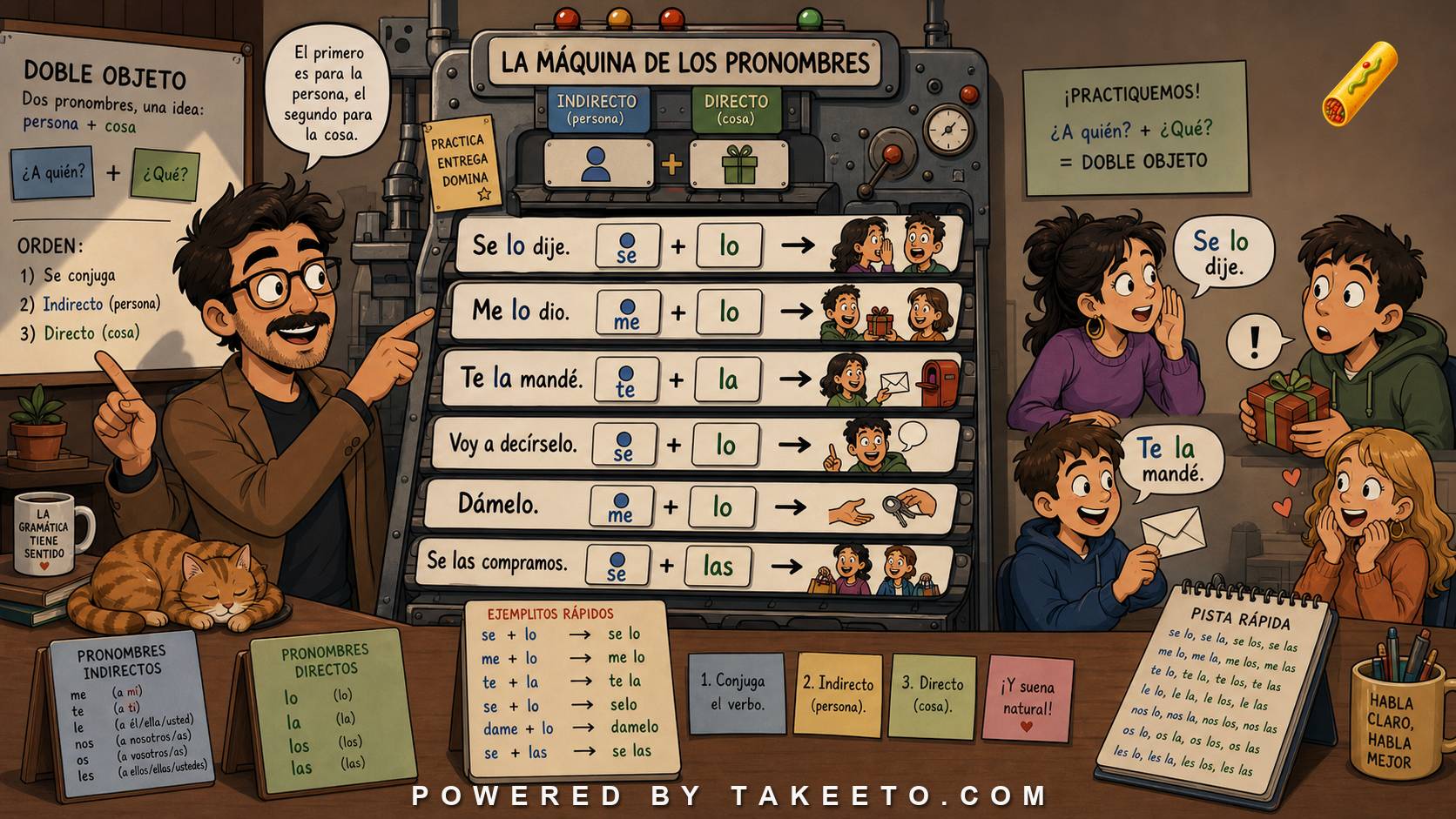
Double pronouns are strict, not random
Spanish lets two object pronouns appear together:
Me lo dio.
He/she gave it to me.
Te la mandé.
I sent it to you.
Se lo dije.
I told it to him/her/them/you.
For learners, these clusters feel dense because English often separates the pieces: “gave it to me,” “sent it to you,” “told it to them.” Spanish compresses the reference into a short sequence before or attached to the verb.
The order is not optional. The rule is:
Indirect object pronoun comes before direct object pronoun.
That is why Spanish says me lo, te la, nos los, se las, not lo me, la te, los nos, las se.
The basic order
The indirect object pronoun identifies the recipient, beneficiary, experiencer, or affected participant. The direct object pronoun identifies the thing affected or transferred.
| Indirect + direct | Meaning |
|---|---|
| me lo | it/him to me |
| te la | it/her to you |
| nos los | them to us |
| os las | them to you plural familiar |
| se lo | it/him to him/her/them/you |
| se las | them to him/her/them/you |
Examples:
Me dio el libro. + Lo dio. → Me lo dio.
He/she gave it to me.
Te mandé la foto. + La mandé. → Te la mandé.
I sent it to you.
Nos compraron los billetes. + Los compraron. → Nos los compraron.
They bought them for us.
The recipient comes first. The thing comes second.
Why le and les become se
Spanish does not say le lo, le la, les los, or les las. When le or les would appear before lo/la/los/las, it changes to se.
| Underlying roles | Actual form |
|---|---|
| le + lo | se lo |
| le + la | se la |
| le + los | se los |
| le + las | se las |
| les + lo | se lo |
| les + la | se la |
| les + los | se los |
| les + las | se las |
Examples:
Le dije la verdad a Ana.
Se la dije.
I told it to her.
Les mandé los documentos a mis padres.
Se los mandé.
I sent them to them.
Le compré una camisa.
Se la compré.
I bought it for him/her.
This se is purely a pronoun-form change. It is not reflexive se, passive se, impersonal se, or accidental se.
Se lo is ambiguous by design
Because both le and les become se, the sequence se lo does not tell you who the recipient is.
Se lo dije.
Possible meanings include:
- I told it to him.
- I told it to her.
- I told it to them.
- I told it to you formal.
- I told it to you all formal/plural.
Context often resolves the ambiguity. If not, Spanish adds an a phrase:
Se lo dije a Ana.
I told it to Ana.
Se lo dije a mis padres.
I told it to my parents.
The a phrase clarifies the indirect object. It does not replace the se in ordinary Spanish.
Direct object agreement still follows the thing
In se lo dije, lo refers to the thing said. If the thing is feminine, plural, or feminine plural, the direct object pronoun changes.
| Full sentence | Double-pronoun version |
|---|---|
| Le dije el secreto. | Se lo dije. |
| Le dije la verdad. | Se la dije. |
| Le dije los detalles. | Se los dije. |
| Le dije las razones. | Se las dije. |
The se does not show whether the recipient is singular or plural. The lo/la/los/las shows the direct object.
This creates a common issue. If you mean “I told it to them,” and it is singular, careful Spanish is:
Se lo dije a ellos.
I told it to them.
Not:
Se los dije a ellos if los does not refer to plural things.
In several varieties, speakers use se los to mark plural recipients even when the direct object is singular. That pattern is widespread enough that it should not be dismissed as random speech. For transparent cross-regional writing, though, keep lo/la/los/las agreeing with the thing, and add a ellos, a ustedes, or another clarifying phrase when the recipient needs to be explicit.
Placement with finite verbs
With a finite verb, the double pronoun cluster goes before the verb.
Me lo dio.
He/she gave it to me.
No te la mandé.
I did not send it to you.
Ya se los compramos.
We already bought them for him/her/them/you.
The two pronouns stay together. Do not split them around the verb.
Placement with infinitives and gerunds
With infinitives, Spanish often gives two placement options:
Voy a decírselo.
Se lo voy a decir.
I am going to tell it to him/her/them.
Quiero mandártela.
Te la quiero mandar.
I want to send it to you.
With gerunds:
Estoy explicándoselo.
Se lo estoy explicando.
I am explaining it to him/her/them.
Seguimos preparándosela.
Se la seguimos preparando.
We are still preparing it for him/her/them.
When pronouns attach, accent marks may be needed:
- decir → decírselo
- explicar → explicárselo
- dando → dándomelo
- preparando → preparándosela
The accent preserves the original stress pattern after pronouns are attached.
Placement with commands
With affirmative commands, double pronouns attach:
Dámelo.
Give it to me.
Díselo.
Tell it to him/her/them.
Mándamela.
Send it to me.
With negative commands, they go before the verb:
No me lo des.
Do not give it to me.
No se lo digas.
Do not tell it to him/her/them.
No me la mandes.
Do not send it to me.
Command forms are where spelling pressure becomes obvious. Da + me + lo becomes dámelo with an accent. Di + se + lo becomes díselo.
Double pronouns with reflexives
Reflexive or pronominal pronouns can also combine with direct object pronouns:
Me lo puse.
I put it on.
Se la quitó.
He/she took it off.
Nos los llevamos.
We took them with us.
Here the first pronoun is not always a recipient in the simple “to” sense. It may mark self-involvement, clothing, possession-like affectedness, or pronominal verb structure. The order still holds: the non-direct clitic comes before the direct object clitic.
Common learner errors
Error 1: Reversing pronoun order
Lo me dio.
Better:
Me lo dio.
Error 2: Saying le lo or les la
Le lo dije.
Better:
Se lo dije.
Error 3: Letting se los hide what the direct object is
In conservative cross-regional editing, lo/la/los/las should agree with the thing said, sent, or given:
Se lo dije a ellos.
I told it to them.
Se los dije a ellos.
I told them, where los refers to plural things such as los detalles.
In several American varieties, se los dije can also be used for “I told it to them,” with los reflecting the plural recipient. Learners should recognize that regional pattern, but they should also know the transparent agreement logic behind the conservative form.
Error 4: Splitting the cluster
Lo quiero se decir.
Better:
Quiero decírselo.
Se lo quiero decir.
Error 5: Forgetting accents in attached forms
Damelo in careful writing should be:
Dámelo.
Parsing dense clitic clusters in the wild
Double pronouns become easier when you stop reading them as a single mysterious block. Break the cluster into two jobs: affected participant first, direct object second.
Take:
Se las mandamos ayer.
Do not begin with “se = reflexive.” Instead, ask:
- What is the final pronoun? las.
- What can las refer to? A feminine plural direct object: cartas, fotos, instrucciones, llaves.
- What is se before las likely to be? A converted le/les, meaning “to him/her/them/you.”
- What is missing from context? The recipient.
A natural interpretation is:
We sent them to him/her/them yesterday.
If context does not identify the recipient, add it:
Se las mandamos a la directora ayer.
We sent them to the director yesterday.
The second pronoun carries object agreement
This is the most important diagnostic. In se lo, lo is the direct object. In se la, la is the direct object. In se los, los is the direct object. In se las, las is the direct object.
The recipient is hidden in se and may need clarification.
Se lo di a mis padres.
I gave it to my parents.
The thing given is singular masculine or neuter lo. The recipients are plural, but se does not show plural. That is why a mis padres is helpful.
Attached clusters must preserve order
When attached to infinitives, gerunds, or affirmative commands, the order does not change:
se + lo + decir → decírselo
me + la + mandar → mandármela
te + los + dar → dártelos
The cluster attaches as a unit, and written accents preserve stress.
Translate after parsing, not before
A phrase like dímelo should be decomposed before translation:
- di = tell
- me = to me
- lo = it
Result:
Tell it to me.
This method also prevents false se readings. In se lo dije, se is not reflexive, not passive, and not accidental. It is the third-person indirect object shape required before lo.
Clarifying se lo in conversation
Because se lo hides the number and gender of the recipient, natural Spanish often adds clarification when context is not enough.
Se lo dije a Laura.
I told it to Laura.
Se lo dije a mis hermanos.
I told it to my siblings.
Se lo dije a usted.
I told it to you.
The a phrase is not a mistake or unnecessary repetition. It is how Spanish restores information lost when le and les both become se.
This becomes important in narratives:
Vi a Laura y a sus padres, pero solo se lo dije a Laura.
Without a Laura, se lo dije could refer to Laura, her parents, or another previously mentioned person. The clarifying phrase anchors the recipient.
The same applies to plural direct objects:
Se las mandé a mis estudiantes.
I sent them to my students.
Las tells us the sent things are feminine plural. A mis estudiantes tells us who received them. The two pieces answer different questions.
A strong production habit is to add the a phrase whenever se lo/se la/se los/se las could be misunderstood. Spanish permits compactness, but it also gives you tools for clarity.
Diagnostic refinement: se lo is small because Spanish hides recipient number there
The cluster se lo compresses two pieces of information, but it also hides one. Se tells you there is a third-person or formal indirect object, but it does not reveal number or gender.
Se lo dije.
This can mean “I told it to him,” “to her,” “to them,” “to usted,” or “to ustedes.” The direct object lo tells you about the thing said. The recipient must come from context or from a clarifying phrase:
Se lo dije a Laura.
Se lo dije a mis padres.
Se lo dije a ustedes.
This explains a widespread regional pressure. Many speakers want the cluster to show the plural recipient, so they say:
Se los dije a ellos.
In many areas, that is a normal regional way to express “I told it to them.” The conservative cross-regional analysis, however, keeps lo tied to the singular thing said:
Se lo dije a ellos.
Both facts matter for learners. Receptively, do not misread every se los dije as “I told them plural things.” In actual speech, it may mean “I told it to them.” Productively, if you want the most transparent written form, make lo/la/los/las agree with the direct object and add the recipient phrase:
| Meaning | Transparent form |
|---|---|
| I told it to Ana. | Se lo dije a Ana. |
| I told it to them. | Se lo dije a ellos. |
| I told the details to them. | Se los dije a ellos. |
| I sent the photos to her. | Se las mandé a ella. |
The deeper rule is that Spanish clitic clusters are ordered by person and function, not by English word order. Me lo dio, te la mandé, se los expliqué, and nos lo compraron are compact, but each pronoun still has a role. Parse from left to right: affected/receiving participant first, direct object second.
Suggested interactive module: double-pronoun builder
A useful tool for this article would convert full noun phrases into double pronoun clusters.
Suggested functions:
- Role input: user selects recipient and thing.
- Order generator: produces me lo, te la, se los, nos las.
- Le/les conversion: explains why le lo → se lo.
- Placement options: finite, infinitive, gerund, affirmative command, negative command.
- Ambiguity warning: adds a Ana, a ellos, a usted where se is unclear.
- Accent recalculation: produces dámelo, díselo, explícaselo, mandándosela.
Example input:
decir + la verdad + a mis padres
Possible output:
- Direct object: la verdad → la.
- Indirect object: a mis padres → les → se before la.
- Result: Se la dije a mis padres.
Final rule
Spanish double object pronouns follow a strict order: indirect or affected participant first, direct object second. Me lo dio, te la mandé, nos los compraron. When le or les comes before lo/la/los/las, it becomes se: se lo dije.
The sequence is compact, but it is not chaotic. Identify the recipient, identify the thing, make le/les become se when necessary, and keep lo/la/los/las agreeing with the thing being referred to.