
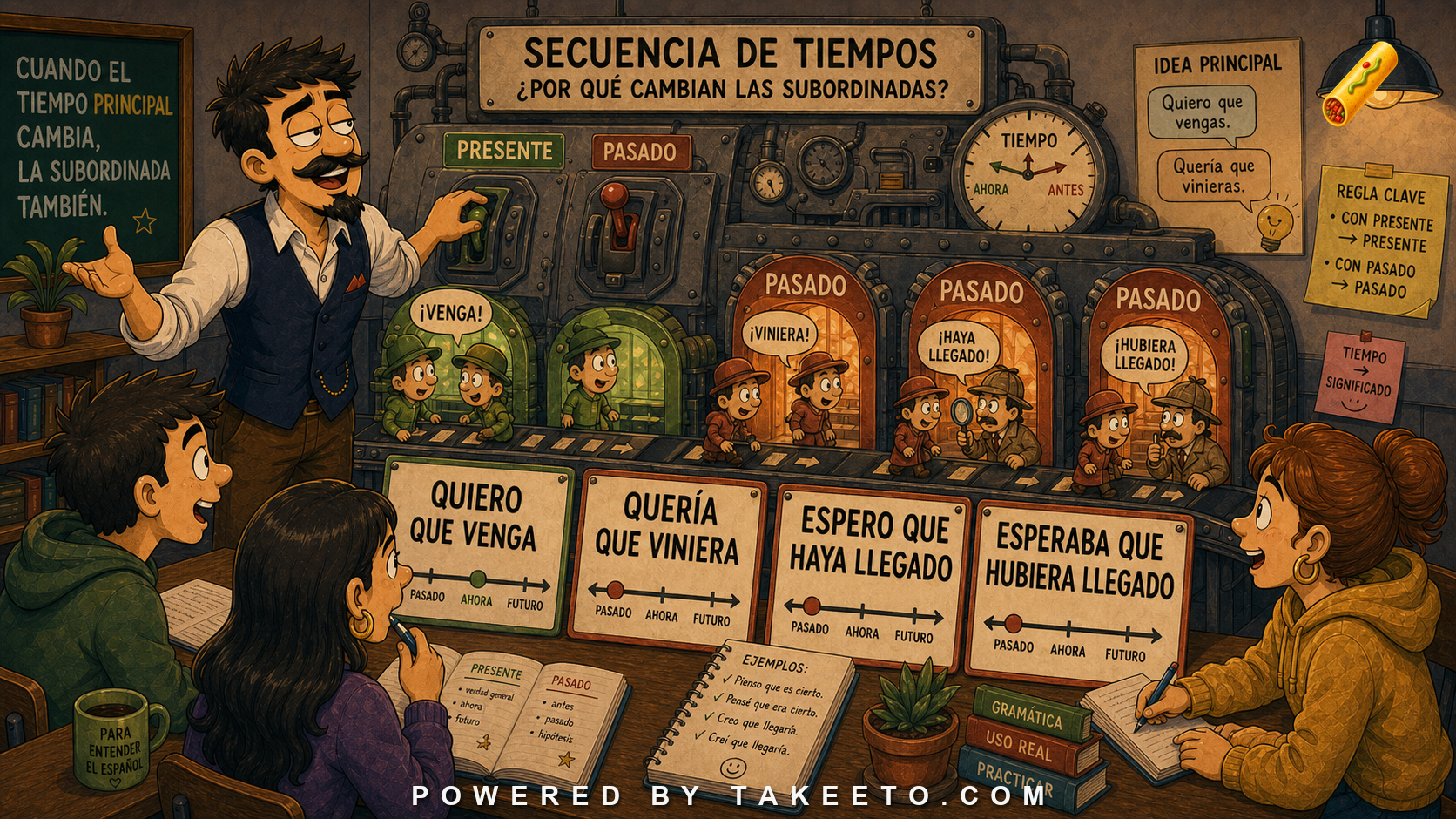
Subordinate clauses live on a timeline
Spanish learners often study the subjunctive as if mood were the whole issue. But mood is only half the problem. Once a sentence has a main clause and a subordinate clause, the verb in the subordinate clause must also fit the timeline created by the main verb.
Compare:
Quiero que venga.
I want him to come.
Quería que viniera.
I wanted him to come.
The desire changes from present to past, and the subordinate verb shifts with it.
Now compare:
Espero que haya llegado.
I hope he has arrived.
Esperaba que hubiera llegado.
I hoped he had arrived.
The subordinate event is prior to the main reference point. Spanish marks that relationship carefully.
The key principle is:
Spanish sequence of tenses anchors the subordinate clause to the time and viewpoint of the main clause.
This is not mechanical backshifting. It is timeline management.
Present main clause: present or perfect subjunctive
When the main clause is present, future, present perfect, or otherwise anchored in the present, the subordinate subjunctive commonly uses present or perfect subjunctive.
Quiero que vengas.
I want you to come.
Es importante que estudies.
It is important that you study.
Me alegra que estés aquí.
I am glad you are here.
Use the present subjunctive when the subordinate event is simultaneous, future, or not completed relative to the present viewpoint.
Use the perfect subjunctive when the subordinate event is prior to the present viewpoint.
Espero que haya llegado.
I hope he has arrived.
Me alegra que hayas terminado.
I am glad you have finished.
Dudo que lo hayan entendido.
I doubt they have understood it.
The perfect subjunctive is formed with:
haya + participle
Past main clause: imperfect or pluperfect subjunctive
When the main clause is in the past, conditional, or otherwise viewed from a past/hypothetical point, the subordinate subjunctive commonly shifts to imperfect or pluperfect subjunctive.
Quería que vinieras.
I wanted you to come.
Era importante que estudiaras.
It was important that you study / studied.
Me alegró que estuvieras allí.
I was glad you were there.
Use the imperfect subjunctive when the subordinate event is simultaneous, future relative to the past, or not completed at that past viewpoint.
Use the pluperfect subjunctive when the subordinate event is prior to that past viewpoint.
Esperaba que hubieras llegado.
I hoped you had arrived.
Me sorprendió que no hubieran llamado.
I was surprised they had not called.
Dudaba que lo hubiesen entendido.
I doubted they had understood it.
The pluperfect subjunctive is formed with:
hubiera / hubiese + participle
Sequence is about viewpoint, not only time
The main clause creates a viewpoint. From that viewpoint, the subordinate event can be:
- same time or later;
- earlier;
- still pending;
- already completed;
- hypothetical.
Compare:
Espero que llegue.
I hope he arrives.
The arrival is pending from now.
Esperaba que llegara.
I hoped he would arrive.
The arrival was pending from a past viewpoint.
Espero que haya llegado.
I hope he has arrived.
The arrival is prior to now.
Esperaba que hubiera llegado.
I hoped he had arrived.
The arrival was prior to that past hope.
This is the heart of sequence of tenses.
Conditional main clauses also shift
A conditional main verb can trigger the same kind of past/hypothetical sequence.
Me gustaría que vinieras.
I would like you to come.
Sería mejor que esperáramos.
It would be better if we waited.
Habría preferido que hubieras llamado.
I would have preferred you to have called.
The conditional creates distance. Spanish often aligns the subordinate verb with that distance.
Indicative subordinate clauses also sequence
Sequence of tenses is not only a subjunctive issue. Indicative subordinate clauses also shift depending on reporting and viewpoint.
Dice que está cansado.
He says he is tired.
Dijo que estaba cansado.
He said he was tired.
Dice que llegó ayer.
He says he arrived yesterday.
Dijo que había llegado el día anterior.
He said he had arrived the day before.
Reported speech makes the timeline especially visible.
Exceptions and present relevance
Spanish does not blindly backshift every subordinate verb. If a statement remains true, current, or intentionally anchored in the present, the present can remain.
Dijo que Madrid es la capital de España.
He said that Madrid is the capital of Spain.
Me explicó que el agua hierve a cien grados.
He explained that water boils at one hundred degrees.
A speaker can choose a present tense when the content is treated as generally valid or still current.
This is why sequence of tenses is not a robot rule. It is a system for managing reference time.
Learner error: mixing present main with past sequence
A common error is to use the imperfect subjunctive after a present main clause without a reason.
Quiero que vinieras.
This can be possible in special contexts, but it does not simply mean “I want you to come.” The default is:
Quiero que vengas.
Likewise:
Quería que vengas.
This breaks the expected sequence in standard Spanish unless there is a specific present-reference reason. The default is:
Quería que vinieras.
A compact four-cell map
A useful remediation is to reduce sequence of tenses to a four-cell map before handling exceptions.
Present viewpoint, subordinate event same time or later:
Quiero que venga.
I want him/her to come.
Present viewpoint, subordinate event earlier:
Espero que haya llegado.
I hope he/she has arrived.
Past or conditional viewpoint, subordinate event same time or later:
Quería que viniera.
I wanted him/her to come.
Past or conditional viewpoint, subordinate event earlier:
Esperaba que hubiera llegado.
I hoped he/she had arrived.
This map prevents a common mistake: choosing the subordinate form from English tense alone. Spanish asks where the main viewpoint sits, then asks whether the subordinate event is earlier or not.
Present preservation is a meaning choice
When Spanish preserves a present tense after a past main verb, that is usually not laziness. It can signal that the content remains current or is being presented as generally true.
Me dijo que vive en Bogotá.
He told me he lives in Bogotá.
This can imply that the speaker treats the residence as current.
Me dijo que vivía en Bogotá.
He told me he lived in Bogotá.
This may simply report from the past viewpoint, or it may leave current status open.
With general truths, present preservation is especially natural:
La profesora explicó que la Tierra gira alrededor del Sol.
The teacher explained that the Earth revolves around the sun.
The past reporting verb does not force the subordinate truth into the past. Sequence of tenses is a discipline of viewpoint, not a command to erase present relevance.
Example bank walkthrough
quiero que venga
Present desire, subordinate event pending or present.
Learner action: present main clause usually pairs with present subjunctive.
quería que viniera
Past desire, subordinate event pending from that past viewpoint.
Learner action: past main clause commonly pairs with imperfect subjunctive.
espero que haya llegado
Present hope about prior completion.
Learner action: use perfect subjunctive for “has/have” subordinate meaning.
esperaba que hubiera llegado
Past hope about prior completion.
Learner action: use pluperfect subjunctive for “had” subordinate meaning.
Sequence routine
To choose the subordinate form, ask:
- What is the main verb tense?
- Does the main clause view the situation from present, past, or hypothetical distance?
- Is the subordinate event simultaneous/later or prior?
- Is the subordinate clause indicative or subjunctive?
- Is there a reason to preserve present relevance?
Then choose:
- present viewpoint + same/later: present subjunctive;
- present viewpoint + earlier: perfect subjunctive;
- past/hypothetical viewpoint + same/later: imperfect subjunctive;
- past/hypothetical viewpoint + earlier: pluperfect subjunctive.
Suggested interactive module: main-clause tense selector
A strong tool for this article would let the learner set the main verb and subordinate event timing.
Suggested functions:
- Main tense selector: present, past, conditional, perfect.
- Subordinate timing: same/later vs earlier.
- Mood selector: indicative/subjunctive.
- Output generator: quiero que venga, quería que viniera.
- Timeline view: reference point and subordinate event.
- Exception note: general truths and present relevance.
- Reported-speech mode: dice/dijo que.
Final rule
Spanish subordinate clauses are anchored to a viewpoint.
Present main clauses usually take present or perfect subjunctive. Past or conditional main clauses often take imperfect or pluperfect subjunctive. The choice depends on whether the subordinate event is simultaneous, future, or prior.
Sequence of tenses is not memorized shifting. It is timeline discipline.