
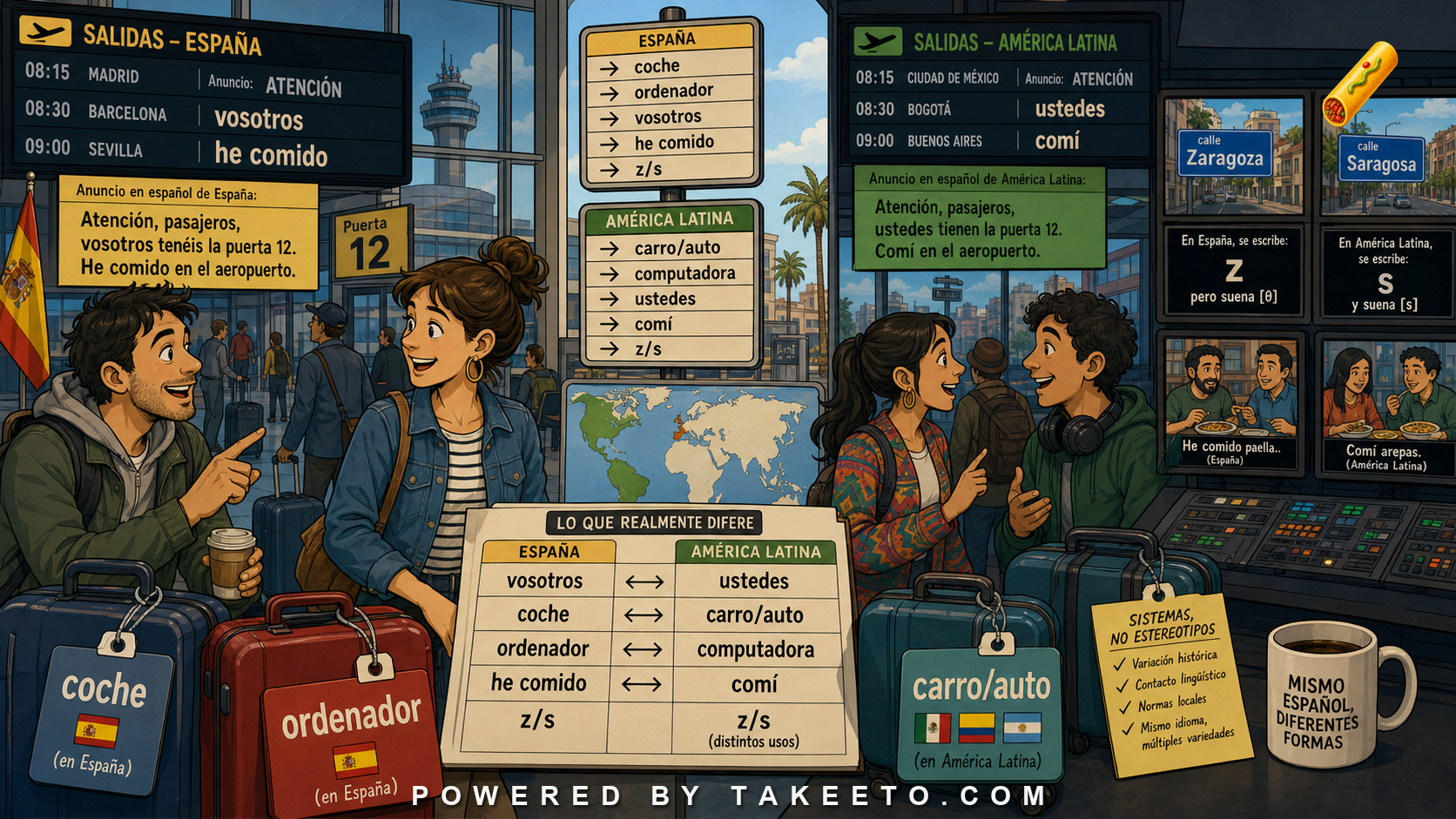
The first correction: there are not two Spanishes
Learners often speak as if Spanish were divided into two clean blocks: “Spain Spanish” and “Latin American Spanish.” That division is useful only as a first map. It becomes misleading very quickly.
Spain contains multiple varieties: northern Castilian, Andalusian, Canarian, Murcian, Extremaduran, bilingual-contact areas, and more. Latin America contains Mexican, Caribbean, Andean, Central American, Rioplatense, Chilean, Colombian, Paraguayan, and many other regional systems. A speaker from Seville, Madrid, Mexico City, Havana, Bogotá, Buenos Aires, and Santiago may all speak mutually intelligible Spanish, but the differences do not line up as one country against one continent.
The key principle is:
The Spain-versus-America contrast is a useful entry point, but real Spanish variation is regional, social, historical, and contextual.
The serious learner does not ask, “Which Spanish is correct?” The better question is: “Which features belong to which region, register, and interaction?”
Pronunciation: z/s is only one difference
The most famous Spain-versus-America pronunciation contrast involves c, z, and s.
In much of central and northern Spain, z and c before e/i are pronounced differently from s:
caza / casa
hunting / house
These are distinct for many Peninsular speakers. This is often called distinción.
In almost all of the Americas, z, c before e/i, and s are pronounced the same. This is seseo:
caza = casa
That does not mean Latin American Spanish is “simplified” or “incorrect.” Seseo is a major standard feature across the Americas and also exists in parts of Spain, including the Canary Islands and areas of Andalusia.
But pronunciation variation goes far beyond z/s. Spanish varieties differ in:
- how syllable-final s is pronounced,
- whether y and ll merge or separate,
- how strongly final d is pronounced,
- how r and rr sound,
- intonation,
- rhythm,
- speed of connected speech,
- vowel clarity in reduction-heavy contexts.
A learner who thinks the whole difference is “Spain uses th” has not learned dialectology. That is one feature among many.
Pronouns: vosotros and ustedes
The most visible grammar difference is the second-person plural.
In most of Spain:
vosotros habláis
you all speak, informal plural
ustedes hablan
you all speak, formal plural in traditional descriptions, though real use varies
In the Americas and the Canary Islands, ustedes is the normal plural “you” for both formal and informal contexts:
ustedes hablan
you all speak
This matters for recognition. If you consume Spanish media from Spain, you will hear:
¿Vosotros qué queréis?
What do you all want?
If you consume most Latin American media, you will hear:
¿Ustedes qué quieren?
Learner production strategy: even if you do not use vosotros, learn to recognize it. It appears in literature, dubbed media, exams, subtitles, grammar explanations, and Peninsular speech.
Singular address: tú, vos, usted
The singular “you” system is not simply Spain uses tú and Latin America uses usted. The real system is richer.
Across the Spanish-speaking world, speakers may use:
tú sabes
you know
vos sabés
you know
usted sabe
you know
Tú is widespread in Spain, Mexico, the Caribbean, and many other regions. Vos is strong in Argentina, Uruguay, Paraguay, much of Central America, parts of Colombia, parts of Bolivia, parts of Chile in particular registers, and elsewhere. Usted can mark respect, distance, tenderness, regional habit, family intimacy, or institutional politeness depending on place.
The learner error is assuming that pronouns carry one universal social meaning. They do not; their value is negotiated by region, relationship, age, formality, and moment in the interaction. A Colombian speaker using usted with a friend is not necessarily being cold. A Costa Rican speaker using usted in close interaction may be doing exactly what local norms expect. A Rioplatense speaker using vos is not being archaic or theatrical; that is ordinary speech in much of the region.
Verb forms: the pronoun changes the morphology
Pronoun choice affects verb forms.
Compare:
tú hablas
vos hablás
usted habla
vosotros habláis
ustedes hablan
The differences are not decorative. A learner who recognizes only tú hablas and usted habla will miss a large amount of real Spanish. A learner does not need to produce every system immediately, but recognition should come early.
Past-tense preferences: he comido and comí
Another common contrast involves the present perfect and preterite.
In much of Spain, especially in central Peninsular usage, speakers often use the present perfect for events in a time frame connected to the present:
Hoy he comido tarde.
I ate late today.
Many American varieties more often use the preterite in the same situation:
Hoy comí tarde.
This is a tendency, not an absolute border. Present perfect and preterite usage varies by region, register, discourse context, and speaker. Latin American Spanish does not lack the present perfect; Peninsular Spanish does not lack the preterite. The difference is distribution.
Learner rule:
Learn both forms. Then learn what your target variety does with “today,” “this week,” recent news, life experience, and completed past events.
Vocabulary: visible, memorable, and easy to exaggerate
Vocabulary differences are the easiest to notice.
coche / carro / auto
car
ordenador / computadora / computador
computer
móvil / celular
cell phone
piso / departamento / apartamento
apartment, depending on region
zumo / jugo
juice
These differences are real, but learners often exaggerate their danger. Most educated speakers understand many regional alternatives from media, travel, and context. The bigger danger is not being misunderstood; it is sounding unexpectedly regional, too formal, too slangy, or out of register.
A neutral international approach often chooses widely intelligible forms:
computadora
teléfono móvil / celular, depending on audience
automóvil / coche / carro, depending on region
But “neutral” is not the same as “cultureless.” Every word still lands somewhere.
Register and pragmatics differ too
Some differences are not in sounds or dictionary entries but in interaction.
A request that feels direct in one region may feel normal in another. A form of address that sounds warm in one place may sound distant elsewhere. Service encounters, email formulas, greetings, apologies, and complaint styles all vary.
Compare:
¿Me regalas una bolsa?
Could you give me a bag? / Would you give me a bag?
In some Colombian service contexts, regalar can be a polite service verb. In other regions, a learner may hear it literally as “give as a gift” and be confused.
This kind of difference is not a grammar table. It is pragmatic literacy.
Stereotypes are bad analysis
The worst learner habit is replacing analysis with stereotypes:
- “Spain Spanish is proper.”
- “Latin American Spanish is easier.”
- “Caribbean Spanish is just fast.”
- “Mexican Spanish is neutral.”
- “Argentine Spanish is Italian Spanish.”
- “Chilean Spanish is impossible.”
Every one of these statements hides more than it explains. Dialects are systems, not defects. Learners should evaluate features, not rank people.
Example bank walkthrough
vosotros
Second-person plural familiar form used in most of Spain.
Learner action: recognize habláis, coméis, vivís, tenéis, sois, vais even if you do not produce them.
ustedes
Plural “you” used across the Americas and the Canary Islands for both informal and formal plural address.
Learner action: do not assume ustedes is always formal in American Spanish.
coche / carro / auto
Regional vocabulary for car.
Learner action: learn the local word for your target community, but recognize the others.
ordenador / computadora
Common Spain/Americas technology contrast, though distribution is not perfectly binary.
Learner action: use computadora for broad American Spanish; recognize ordenador in Spain.
he comido / comí
Present perfect versus preterite distribution.
Learner action: connect tense choice to region, time frame, and discourse.
z/s
Distinción versus seseo.
Learner action: choose one pronunciation target and understand the other.
Learner production strategy
A good learner policy has three layers:
- Choose a production target.
For example: educated Mexican Spanish, central Colombian Spanish, Spain Spanish, Rioplatense Spanish, or international classroom Spanish.
- Build recognition broadly.
Understand vosotros, vos, ustedes, seseo, distinción, regional vocabulary, and common reductions.
- Adapt politely.
When entering a local context, observe how people address each other, what words they use, and how direct they are.
You do not need to sound like every region. You do need to stop being surprised that regions exist.
Remediation notes: feature maps, not national rankings
The biggest remediation for this article is to make the learner's mental map more feature-based. "Spain" and "Latin America" are not linguistic features; they are broad geographic labels. A useful learner question is not "Is this Spain Spanish or Latin American Spanish?" but:
Which feature am I hearing: distinción, seseo, vosotros, ustedes, vos, present-perfect preference, final-consonant weakening, local vocabulary, or pragmatic formula?
This protects the learner from false binaries. Seseo, for example, is not simply "Latin American pronunciation" because it is also part of Canary Island and many Andalusian varieties. Vosotros is strongly associated with Spain, but not every Peninsular interaction uses it in the same way, and some Spanish regional systems use ustedes in ways that differ from the classroom table. Voseo is associated with many American regions, but it is not present in the same social position everywhere.
A stronger production policy is:
Choose one speech target for active output, but build a wide passive map of features.
For example, a learner targeting educated Mexican Spanish can use ustedes, seseo, and Mexican vocabulary as production norms while still recognizing vosotros habláis, vos tenés, ordenador, he comido, le vi, and ¿me regalas...? in other varieties. The goal is not to sound like everywhere at once. That creates a mixed accent with unstable social signals. The goal is to stop being helpless when real Spanish comes from outside the classroom default.
There is also a register repair to make. Dialect features do not automatically mean informal speech. A Spanish judge, Colombian professor, Mexican doctor, Argentine journalist, or Chilean engineer may speak with regional phonology and local address norms while using a highly formal register. Conversely, a speaker can use an internationally recognizable accent and still speak very informally. Dialect and register intersect, but they are not the same thing.
A useful diagnostic table:
Dialect feature: vos hablás, vosotros habláis, seseo, distinción, coche/carro/auto.
Register feature: Le agradecería que..., ¿me ayudas?, che, güey, atentamente, queda prohibido.
Pragmatic feature: how direct a request sounds, how warm usted feels, whether regalar works in a service request.
Learners should also avoid treating vocabulary lists as the whole dialect. Word differences are easy to memorize, but the more durable differences are structural: address systems, tense distribution, sound patterns, discourse markers, and what counts as polite or natural. A learner who knows coche/carro/auto but cannot interpret vos, ustedes, os, or le vi still has a shallow dialect map.
Final repair rule for this article:
Do not rank varieties. Describe features, assign them to regions and registers, and decide what you will produce versus what you only need to recognize.
Suggested interactive module: dialect difference matrix
A strong tool for this article would compare regional features without ranking them.
Suggested functions:
- Feature rows: pronunciation, pronouns, verb forms, vocabulary, register, pragmatics.
- Region columns: Spain, Mexico, Caribbean, Andes, Rioplatense, Chile, Central America, Colombia.
- Example toggle: Show local examples with audio.
- Production target selector: User chooses a target variety.
- Recognition mode: Quiz forms from outside the target.
- Vocabulary swap: coche/carro/auto, ordenador/computadora.
- Tense preference display: he comido/comí by context.
- Stereotype warning: Replace vague labels with actual features.
Final rule
Spanish is not split into one correct Spain version and one Latin American version. It is a large language with regional systems.
Learn a production target. Build broad recognition. Treat every variety as structured. Dialect awareness is not trivia; it is real Spanish literacy.