Clothing Spanish is practical, visual, and commercial
Fashion and clothing Spanish appears in online stores, labels, return policies, size guides, social media posts, product reviews, and personal descriptions. It includes concrete nouns, material phrases, fit adjectives, care instructions, stock status, and sales language.
A product page may say:
Camisa de algodón, corte regular, manga larga, cuello clásico. Disponible en varias tallas. Lavado a máquina.
This is compact but highly structured.
The key principle is:
Clothing descriptions combine item, material, fit, feature, size, care, and purchase status.
Garments and categories
Common item terms:
camisa
camiseta
playera / remera / polera
pantalón
vaqueros / jeans / mezclilla
falda
vestido
chaqueta / chamarra / campera
abrigo
sudadera
jersey / suéter
zapatos
zapatillas / tenis
Regional variation is strong. Camiseta, playera, remera, and polera may refer to a T-shirt depending on country. Chaqueta, chamarra, and campera vary. Zapatillas can mean sneakers, slippers, or other footwear depending on region.
Do not assume one clothing dictionary entry solves all contexts.
Size and fit
Important terms:
talla
tamaño
ajuste
corte
horma
entallado
holgado
regular
oversize
slim
queda grande / queda pequeño
Talla is size for clothing and shoes. Ajuste or corte refers to fit/cut. Horma is especially used for shoes or the shape/fit of footwear.
Esta prenda tiene corte entallado.
The item is fitted. It may not suit someone expecting a loose cut.
Fabrics and material phrases
Materials are often introduced with de:
de algodón
de lana
de lino
de cuero
de seda
de poliéster
mezcla de algodón
tejido elástico
Algodón is cotton. Lana is wool. Lino is linen. Cuero is leather. Piel may also mean leather in some product contexts but can be sensitive because it also means skin.
Vestido de lino con forro interior.
This means a linen dress with lining.
Clothing parts
Product pages use detail vocabulary:
manga
cuello
cintura
tiro
bolsillo
cierre
cremallera / zipper
botón
dobladillo
forro
capucha
Manga is sleeve, not only mango in another context. Cuello is collar or neck. Tiro in pants refers to rise. Cierre may mean zipper, closure, or fastening depending on region.
Pantalón de tiro alto.
High-rise pants.
Color and adjective order
Colors and style adjectives usually follow the noun:
camisa blanca
pantalón negro
vestido largo
chaqueta ligera
falda plisada
But commercial style may stack adjectives:
elegante vestido negro de manga larga
The phrase structure is: elegant black dress with long sleeves. Learners must separate evaluation (elegante), color (negro), item (vestido), and feature (de manga larga).
Care instructions
Common label language:
lavado a máquina
lavar a mano
no usar blanqueador / lejía
no secar en secadora
planchar a baja temperatura
lavar con colores similares
limpieza en seco
Instructions may use infinitives:
Lavar del revés.
No planchar el estampado.
This is normal label style.
Availability and returns
Online store language includes:
disponible
agotado
pocas unidades
añadir al carrito
envío
devolución
cambio
reembolso
plazo de devolución
gastos de envío
Agotado means sold out. Devolución is return. Cambio is exchange. Gastos de envío are shipping costs.
Devolución gratuita dentro de los 30 días.
Return policy language matters as much as product vocabulary.
Example bank walkthrough
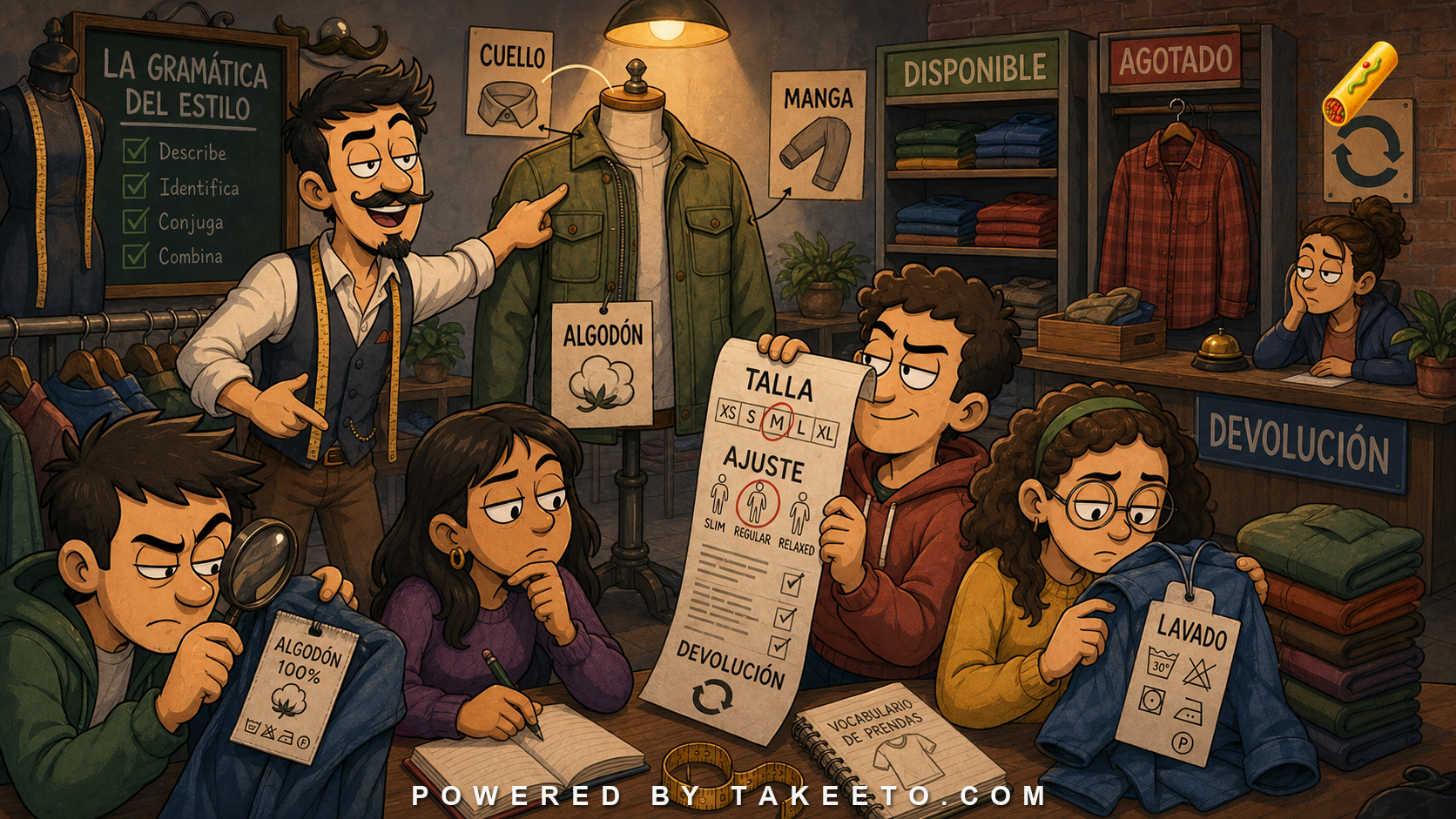
Talla: size. Ask country/system.
Ajuste: fit.
Algodón: cotton.
Manga: sleeve.
Cuello: collar/neck.
Lavado: washing/care.
Devolución: return.
Disponible: available.
Agotado: sold out.
Clothing product-page reading workflow
- Identify the garment type.
- Identify regional term variants.
- Identify material with de phrases.
- Identify fit: corte, ajuste, talla.
- Identify features: sleeve, collar, pockets, closure.
- Read care instructions separately.
- Check stock status.
- Read shipping, return, and exchange language.
- Watch gendered product categories, but do not overinterpret wearer identity.
- Compare size guide rather than translating size labels mechanically.
Before/after revision drill
Weak reading:
Cotton shirt, normal style.
Source Spanish:
Camisa de algodón orgánico, corte regular, cuello clásico, manga corta, no secar en secadora.
Better reading:
Organic-cotton shirt with regular fit, classic collar, short sleeves; do not tumble dry.
The better version separates material, fit, features, and care. A shopper who ignores care instructions may understand the product but damage it later.
Remediation: product-page Spanish is layered information
Fashion and clothing descriptions are not just vocabulary for garments. A product page usually layers item type, silhouette, fit, fabric, care, stock, size, color, price, shipping, and return conditions.
Example:
Camisa de lino de corte relajado, manga larga, cuello clásico, disponible en tallas S a XL. Lavar a mano. Cambios y devoluciones dentro de los 30 días.
Layered reading:
camisa = garment.
de lino = material.
corte relajado = fit/silhouette.
manga larga and cuello clásico = design features.
disponible en tallas S a XL = availability.
lavar a mano = care instruction.
cambios y devoluciones = return policy.
A learner who learns only camisa, manga, and talla may miss the purchasing conditions.
Fit words: ajuste, corte, tiro, horma
Clothing Spanish often uses fit terms that do not translate cleanly:
ajuste = fit, how close or loose the item sits.
corte = cut or silhouette.
entallado = fitted/tailored close to body.
holgado = loose.
recto = straight cut.
tiro alto/medio/bajo = rise for pants.
horma = last/shape/fit, especially footwear.
calce = fit in some regions.
A product that says corte amplio is not simply “big.” It may be intentionally oversized. A shoe with horma estrecha may be narrow even if the nominal size is correct.
Mini-workshop: parse a clothing description
Product copy:
Pantalón de mezclilla de tiro alto y pierna recta, con cinco bolsillos y cierre de botón. La modelo mide 1,75 m y usa talla 38.
Annotation:
pantalón de mezclilla = jeans/denim pants, regionally also vaquero.
tiro alto = high rise.
pierna recta = straight leg.
cinco bolsillos = design detail.
cierre de botón = button closure.
la modelo mide... = fit reference; not a guarantee.
Plain purchasing note:
High-rise straight-leg jeans with button closure. Check size chart because model size is only a reference.
Material phrases with de
De often marks material:
vestido de algodón
suéter de lana
chaqueta de cuero
blusa de seda
But product copy also uses blends:
70% algodón, 30% poliéster
mezcla de lana
tejido elástico
forro de poliéster
A chaqueta de cuero sintético is not leather. Efecto cuero means leather look, not leather. Acabado satinado means satin-like finish, not necessarily satin fabric. These distinctions matter for price, care, ethics, and expectations.
Before/after: avoiding false precision
Weak translation:
This is a normal shirt with good fabric.
Better:
This is a relaxed-fit linen shirt with long sleeves and a classic collar.
Weak Spanish production:
La ropa es cómoda y bonita.
Better:
La prenda tiene un corte holgado y tejido suave, por lo que resulta cómoda para uso diario.
Fashion Spanish improves when the writer names the garment feature and the effect.
Care and returns
Care instructions use infinitives, imperatives, and prohibitions:
lavar a mano
no usar blanqueador
secar a la sombra
planchar a baja temperatura
limpieza en seco
no retorcer
Return-policy language includes:
cambios, devoluciones, reembolso, garantía, producto agotado, disponible, últimas unidades, envío, retiro en tienda.
These terms are consumer Spanish, not merely fashion vocabulary. A learner buying clothing in Spanish should read care and return language before focusing on style.
Product-page checklist
Mark:
- garment type; 2. material; 3. fit/cut; 4. size system; 5. color; 6. stock status; 7. care instructions; 8. shipping/return policy; 9. regional vocabulary; 10. whether the description is factual or promotional.
This turns fashion Spanish into practical literacy.
Additional remediation drill: slow the document down
If this article still feels like vocabulary, turn one authentic-looking sentence into a four-line analysis before translating it. Write the original sentence. Then list the actor, the action, the object, and the condition or consequence. Only after that, produce a plain-language paraphrase.
This drill matters because domain Spanish often compresses too much into noun phrases. The learner sees familiar words and moves too quickly. Slowing the sentence down reveals whether the reader understands the document logic or only recognizes terms. For article 270, the safest practice is to treat each key term as a field in a larger system: who is acting, what status is changing, what evidence or condition controls the action, and what the reader should do with the information.
A useful production rule is: do not write a polished sentence until you can write a plain one. Plain Spanish is not inferior; it is the diagnostic layer that proves comprehension.
Suggested interactive module: clothing product-page annotator
A useful tool would tag product descriptions.
Suggested functions:
- Garment term regional notes.
- Fit classifier: entallado, holgado, regular, oversize.
- Material parser: de algodón, mezcla, forro.
- Care-instruction decoder.
- Return-policy highlighter: devolución, cambio, reembolso.
Mini-workshop: reading a product description by layers
Product line:
Pantalón de lino, tiro alto, corte recto, bolsillos laterales. Lavar a mano. Disponible en tallas S-XL.
Layer it:
- item: pantalón
- material: de lino
- fit/shape: tiro alto, corte recto
- features: bolsillos laterales
- care: lavar a mano
- availability: tallas S-XL
This layered reading prevents a common mistake: understanding the attractive description but missing the care or fit information.
Common learner mistakes
A frequent mistake is translating manga as mango because the learner sees food vocabulary first. In clothing, manga is sleeve. Another is confusing cierre as abstract closure when the product means zipper or fastening.
Regional vocabulary also matters. Camiseta, playera, remera, and polera may name similar garments. Zapatillas may mean sneakers in one country and slippers in another. For shopping, regional context is not decorative. It determines what you are buying.
Applied reading drill: decode a product page before buying
A clothing product page may say:
Camisa de lino, corte regular, manga larga, lavado a mano. Disponible en tallas M y L. Devolución gratuita dentro de 14 días.
Read it as a decision checklist. Camisa de lino tells you item and material. Corte regular tells you fit. Manga larga describes construction. Lavado a mano affects maintenance. Disponible en tallas M y L limits size options. Devolución gratuita dentro de 14 días sets return conditions.
The learner mistake is to stop at “linen shirt.” The practical reader asks: will it fit, how do I care for it, is my size available, and what happens if it does not work?
Also notice that product pages often separate garment measurements from body measurements. Medidas de la prenda means the item lying flat or measured directly. Guía de tallas may refer to body ranges. Mixing those up causes bad purchases.
Clothing Spanish is a place where grammar directly affects real decisions.
Final rule
Clothing Spanish is a product language. Read the item, material, fit, feature, care, and purchase terms as separate layers. A pretty adjective will not tell you whether it fits or whether you can return it.