
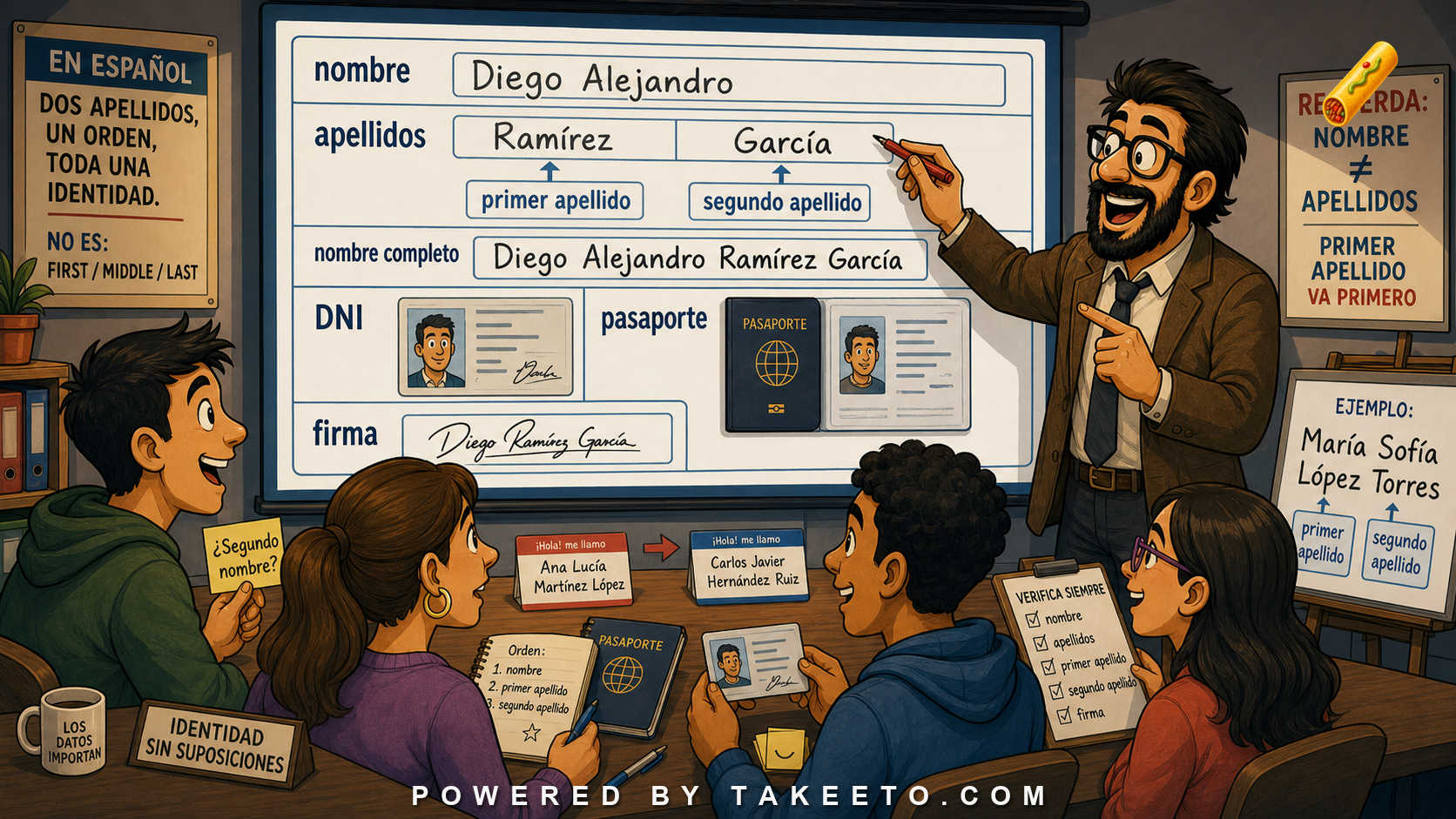
Spanish name fields do not map cleanly onto English forms
A learner opens a Spanish form and sees nombre, apellidos, primer apellido, segundo apellido, nombre completo, and firma. The English-speaking instinct is to translate these into “first name,” “middle name,” “last name,” and “signature.” That works only partly.
The key principle is:
Do not force Spanish identity fields into first/middle/last-name logic. Read the labels as Spanish categories.
This matters in passports, visas, bank accounts, school records, plane tickets, medical files, certificates, and immigration forms. A name that is parsed incorrectly can stop matching across systems.
Nombre means given name field
In a form, nombre usually means given name, not the whole name.
Nombre: Ana María
Apellidos: García López
A person may have one given name or a compound given name:
José Luis
María Fernanda
Juan Carlos
María del Carmen
These are not always “first name plus middle name” in the English sense. José Luis may function as a single social given-name unit. María del Carmen contains del, but it is still a given-name expression in that example.
Apellidos means surnames
Apellido means surname or family name. Apellidos is plural because many Spanish-speaking naming systems use two surname positions.
Primer apellido
first surname
Segundo apellido
second surname
A common structure is:
given name(s) + first surname + second surname
For example:
Laura Patricia Gómez Salazar
Here Laura Patricia is the given-name portion, Gómez is the first surname, and Salazar is the second surname.
Do not assume the final word is the only surname. Do not assume the second surname is a middle name. Do not drop it because an English form has only one “last name” box.
Primer apellido and segundo apellido
The two surname positions can be legally and socially meaningful. The exact rules vary by country, jurisdiction, and document system. Some traditions historically used a paternal-maternal order; some systems allow different orders; some families and countries follow their own legal rules.
Learner rule:
Copy the name exactly as it appears on the official document. Do not reorder, translate, simplify, or guess.
In everyday reference, a person may be addressed by the first surname, by both surnames, by a public professional name, or by a preferred name. Official records require exactness.
Segundo nombre is not always a U.S.-style middle name
Segundo nombre can mean second given name. It does not automatically mean an optional middle initial.
Primer nombre: Ana
Segundo nombre: Sofía
Together, Ana Sofía may be the person’s given name as used in speech and documents. Reducing Sofía to an initial may be inappropriate in some contexts.
Bilingual forms can create confusion. A Spanish segundo nombre field and an English middle name field may be close enough for some administrative purposes, but they are not conceptually identical.
Nombre completo
Nombre completo means full name.
Nombre completo: Carlos Alberto Ruiz Mendoza
This field usually expects all given names and surnames as they should appear in full. If the document must match a passport or national ID, use the exact spelling, accent marks, and order.
DNI, pasaporte, and document labels
Forms often ask for identity-document information:
DNI
documento nacional de identidad in some systems
pasaporte
passport
documento de identidad
identity document
número de documento
document number
Do not assume DNI is universal across the Spanish-speaking world. Many countries use other terms or document systems. The larger skill is recognizing document fields and copying the identifying information precisely.
Firma means signature
In forms, firma usually means signature.
Firma del solicitante
applicant’s signature
Firma y fecha
signature and date
The verb is firmar, to sign.
A printed-name field may say nombre y apellidos, nombre completo, or sometimes aclaración de firma depending on the form and country. Do not fill a signature field with typed name unless the form explicitly asks for it.
Polite naming and address
Broad patterns:
Sr. García
Sra. López
Dra. Hernández
don Carlos
doña Marta
Señor/señora often combines with surname. Don/doña often combines with given name in respectful address. But conventions vary by region, age, institution, and relationship. Do not infer too much from one country or one classroom model.
Common administrative problems
Common errors include:
- Treating the second surname as a middle name.
- Dropping the second surname from travel or bank records.
- Splitting a compound given name incorrectly.
- Removing particles such as de, del, or de la.
- Removing accents inconsistently.
- Reordering names to fit English forms.
For identity data, exactness beats convenience.
Remediation notes: identity fields are not cultural trivia
Name fields are one of the places where language mistakes become data mistakes. A learner may understand every word on a form and still enter the name incorrectly because the fields do not match English assumptions.
Nombre is usually the given-name field, and it may include more than one word:
José Luis
María del Carmen
Ana María
These are not automatically first name plus middle name in the U.S. sense. They may function as compound given names. A form that asks for nombre(s) may expect all given-name material.
Apellidos refers to surname material. Many Spanish-speaking systems use two surname fields:
primer apellido
segundo apellido
The traditional explanation “father’s surname plus mother’s surname” is useful as background, but it is not a universal legal rule across every country, family situation, adoption, nationality case, or modern reform. In Spain, for example, the order can be determined by parental agreement under contemporary civil-registry practice, and other countries have their own rules. For learners, the safe rule is not “guess the parents.” The safe rule is: copy the official document.
A major database problem occurs when an English-style form has only one field for “last name.” A person with two surnames may be forced to compress, hyphenate, drop, or reorder information. That can cause mismatches across passports, school records, bank accounts, airline tickets, and immigration files.
Other fields matter too:
nombre completo
full name
firma
signature
nombre y apellidos
given name(s) and surname(s)
tal como aparece en el pasaporte
as it appears in the passport
The phrase segundo nombre is especially risky. In some contexts it may correspond to a second given name; in bilingual contexts it may be a calque for “middle name”; in official forms it may not be the right category at all. Do not assume that segundo nombre means segundo apellido. They are different fields.
The remediation rule is administrative, not romantic: preserve order, accents, particles, spaces, and all surname material unless the form explicitly requires a different format. Names are personal identity, legal data, and social respect at the same time.
Example bank walkthrough
nombre
Given-name field.
Learner action: do not confuse with nombre completo.
apellidos
Surname field, often plural.
Learner action: expect more than one surname in many contexts.
primer apellido
First surname.
Learner action: often central for filing and address.
segundo apellido
Second surname.
Learner action: do not treat as optional decoration.
nombre completo
Full name.
Learner action: copy all parts in official order.
DNI / pasaporte
Identity-document labels.
Learner action: check country-specific document type.
firma
Signature.
Learner action: distinguish from printed name.
Suggested interactive module: name-field parser
A strong tool for this article would compare Spanish-style and U.S.-style forms.
Suggested functions:
- Field splitter: nombre(s), primer apellido, segundo apellido.
- Full-name builder: reconstruct nombre completo.
- Compound given-name warning: José Luis, María del Carmen.
- Two-surname warning: do not drop the second surname.
- Document matching mode: passport, DNI, school record, bank account.
- Particle mode: de, del, de la.
- Signature mode: firma vs printed name.
- Database-risk alerts: missing accents, reordered names, one last-name box.
Final rule
Spanish name fields are identity structures, not translation exercises.
Nombre is the given-name field. Apellidos are surnames. Primer apellido and segundo apellido can both matter. Nombre completo requires the full form.
When names touch documents, copy exactly.