
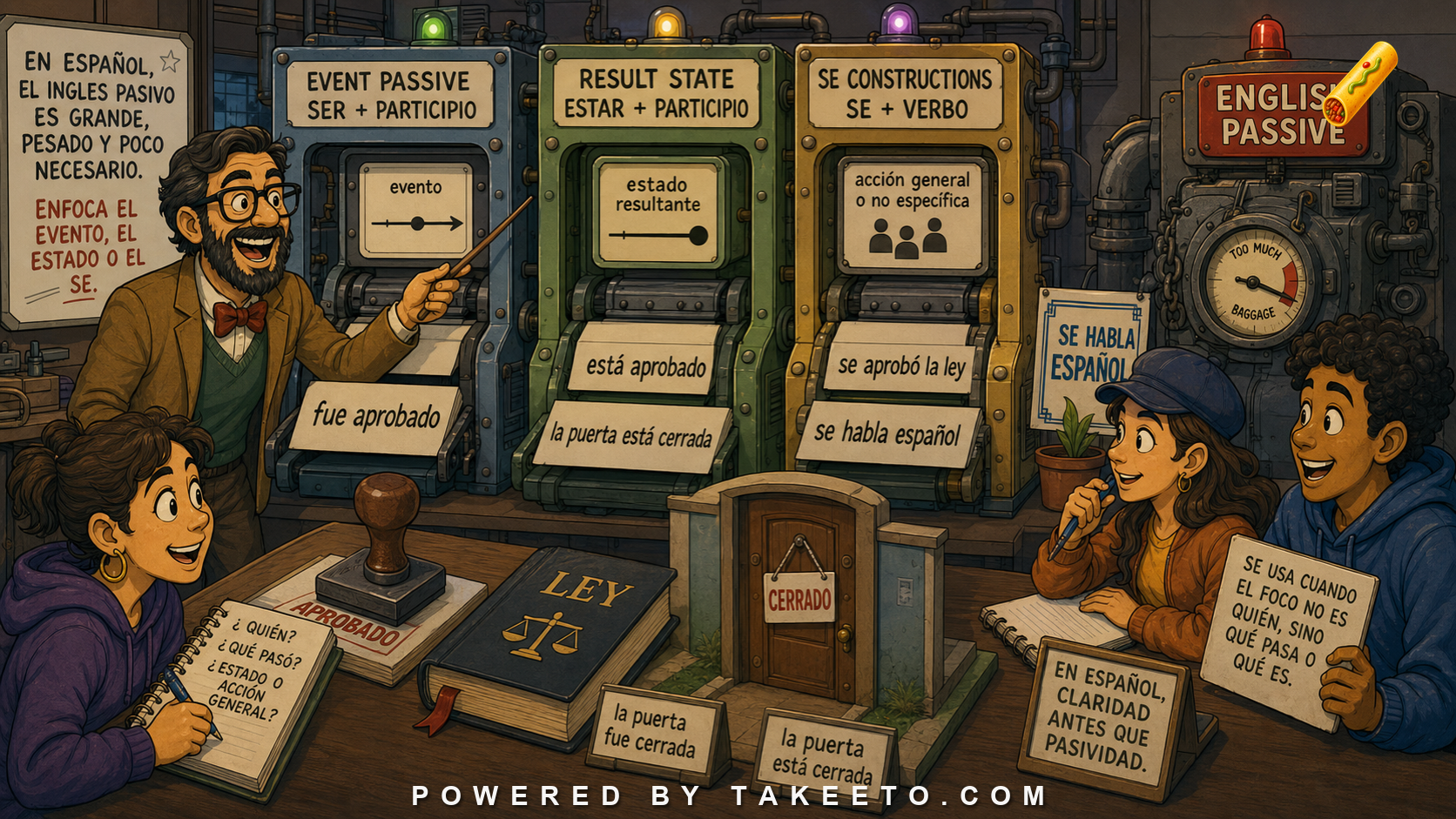
English passives do not map onto one Spanish construction
English uses be + past participle for many jobs:
The law was approved.
The door is closed.
Spanish is spoken here.
The documents were lost.
The report was written by Ana.
A learner may expect Spanish to use one equivalent construction everywhere. It does not.
Spanish divides these meanings among several patterns:
- ser + participle for event passives;
- estar + participle for states and results;
- passive se for patient-centered events without a named agent;
- impersonal se for subjectless general statements;
- active clauses when Spanish simply prefers to name the doer.
The central question is not “How do I translate the English passive?” It is:
Am I describing an event, a result, a general practice, or an unnamed human action?
Ser + participle: the event passive
The construction ser + participle presents an event from the perspective of the patient, the thing affected by the action.
La ley fue aprobada ayer.
The law was approved yesterday.
El informe será publicado en junio.
The report will be published in June.
Los resultados fueron revisados por el comité.
The results were reviewed by the committee.
The participle agrees with the subject:
| Subject | Passive construction |
|---|---|
| el documento | fue aprobado |
| la ley | fue aprobada |
| los documentos | fueron aprobados |
| las leyes | fueron aprobadas |
A por phrase can name the agent:
El libro fue escrito por una historiadora chilena.
The book was written by a Chilean historian.
This construction is common in formal, legal, historical, administrative, and academic writing. It is also natural when the agent matters but the patient is the topic.
Still, Spanish uses it less casually than English. A sentence like:
The package was delivered yesterday.
may be better as:
Entregaron el paquete ayer.
They delivered the package yesterday.
or:
Se entregó el paquete ayer.
The package was delivered yesterday.
The passive is available. It is not always the most idiomatic default.
Estar + participle: resultative state
Estar + participle describes the state that results from an action.
La puerta está cerrada.
The door is closed.
El contrato está firmado.
The contract is signed.
Las luces están apagadas.
The lights are off.
This construction does not primarily report the closing, signing, or turning off as an event. It tells you the current condition.
Compare:
| Event passive | Resultative state |
|---|---|
| La puerta fue cerrada a las ocho. | La puerta está cerrada. |
| El contrato fue firmado por las partes. | El contrato está firmado. |
| Las luces fueron apagadas antes de salir. | Las luces están apagadas. |
English is/was closed can correspond to either side depending on context. Spanish usually makes the contrast explicit.
If you say:
La puerta fue cerrada.
you are reporting that a closing event occurred. If you say:
La puerta estaba cerrada.
you are describing the door’s condition at some reference time.
Passive se: the Spanish workhorse for many English passives
Spanish often uses se + verb when the agent is not named and the patient is the grammatical subject.
Se aprobó la ley.
The law was passed.
Se vendieron todas las entradas.
All the tickets were sold.
Se publicaron los resultados.
The results were published.
This is often called pasiva refleja, or passive se. The key evidence is agreement: the verb agrees with the patient subject.
| Singular patient | Plural patient |
|---|---|
| Se aprobó la ley. | Se aprobaron las leyes. |
| Se vende casa. | Se venden casas. |
| Se alquila habitación. | Se alquilan habitaciones. |
The noun after the verb is not a direct object in the usual active sense. It is the patient subject. That is why plural agreement appears.
Passive se is common in signs, announcements, journalism, academic prose, and general information:
Se prohíbe fumar.
Smoking is prohibited.
Se aceptan tarjetas.
Cards are accepted.
Se necesitan voluntarios.
Volunteers are needed.
It often sounds more natural than a heavy ser + participle passive.
Impersonal se: no subject, singular verb
Another se construction does not have a patient subject. It makes a general statement without naming an agent.
Se vive bien aquí.
One lives well here. / People live well here.
Se trabaja mucho en esta empresa.
People work a lot in this company.
Se habla español.
Spanish is spoken.
The verb is third-person singular because there is no plural subject controlling agreement.
This becomes especially important with specific human direct objects marked by personal a:
Se busca a los responsables.
They are looking for those responsible.
The verb stays singular: se busca, not se buscan, because a los responsables is not the subject. It is a marked direct object.
Compare:
| Construction | Agreement | Meaning |
|---|---|---|
| Se buscan actores. | plural | Actors are being sought. |
| Se busca a los actores. | singular | They are looking for the actors. |
| Se venden casas. | plural | Houses are sold / for sale. |
| Se vive bien. | singular | People live well. |
This distinction becomes central in articles 046 and 047. For now, the important point is that Spanish se can produce passive-like English translations without always being the same Spanish construction.
Active Spanish where English uses passive
English often uses passive voice to avoid a subject:
I was told that the meeting changed.
We were given the wrong address.
The documents were sent yesterday.
Spanish frequently chooses a subjectless active third-person plural:
Me dijeron que cambió la reunión.
They told me that the meeting changed.
Nos dieron la dirección equivocada.
They gave us the wrong address.
Enviaron los documentos ayer.
They sent the documents yesterday.
The Spanish third-person plural does not necessarily identify a specific group. It can function as an unnamed-agent strategy. This is often more conversational than a formal passive.
So a learner should not try to make every English passive into ser + participle. Spanish has several ways to background the agent.
The event-state test
Use this test when choosing between ser and estar with a participle.
Ask: does the sentence answer what happened? or what condition is true?
| Question | Spanish pattern | Example |
|---|---|---|
| What happened? | ser + participle | La puerta fue cerrada a las ocho. |
| What condition is true? | estar + participle | La puerta está cerrada. |
| What happened without naming the agent? | passive se | Se cerró la puerta. |
| What do people generally do/say here? | impersonal se | Se habla español aquí. |
Consider:
El documento está aprobado.
This means the document is in an approved state. It may be useful when checking status.
El documento fue aprobado ayer.
This reports the approval event and locates it in time.
Se aprobó el documento ayer.
This also reports the approval event, but without naming the approver.
Each sentence is grammatical. They do different discourse work.
Why passive choice affects tone
The ser + participle passive can sound formal or institutional:
La solicitud será evaluada por el comité.
The application will be evaluated by the committee.
That may be exactly right in an official notice.
But in ordinary speech, a more direct structure may sound better:
El comité va a evaluar la solicitud.
The committee is going to evaluate the application.
or:
Van a evaluar la solicitud.
They are going to evaluate the application.
Passive se can sound neutral, practical, and sign-like:
Se aceptan devoluciones.
Returns are accepted.
Se entregan pedidos a domicilio.
Home delivery orders are delivered.
Impersonal se can sound general, instructional, or public:
No se puede entrar sin autorización.
You cannot enter without authorization.
Good Spanish style depends on choosing the construction that fits the genre.
Common learner errors
Error 1: Using ser for every English “is/was + participle”
La puerta es cerrada.
This is usually not the sentence you want for “the door is closed.” The natural state description is:
La puerta está cerrada.
Error 2: Forgetting agreement in passives
La ley fue aprobado.
Because ley is feminine singular:
La ley fue aprobada.
Error 3: Using passive se without agreement
Se vende casas.
If casas is the patient subject:
Se venden casas.
Error 4: Making impersonal se agree with a personal a object
Se buscan a los culpables.
In standard usage, with personal a:
Se busca a los culpables.
Error 5: Overusing passive because English does
Fui dado un libro.
Spanish normally says:
Me dieron un libro.
A passive-choice diagnostic for real prose
When translating an English passive, do not begin by reaching for ser + participle. That construction is available, but it is only one member of a larger system. Use a diagnostic sequence instead.
1. Is the sentence mainly reporting an event?
If the sentence reports an event and the patient is the topic, ser + participle is possible.
El acuerdo fue firmado el martes.
The agreement was signed on Tuesday.
This is especially natural when a time phrase, agent phrase, or institutional context makes the event important.
But if the agent is obvious or irrelevant, passive se may be more idiomatic:
Se firmó el acuerdo el martes.
Both sentences report an event. The ser passive sounds more formal and patient-focused; the se version is compact and common.
2. Is the sentence mainly checking status?
If the sentence asks or states whether something is already in a resulting condition, use estar + participle.
¿Está firmado el acuerdo?
Is the agreement signed?
This does not ask who signed it. It asks whether the agreement has the relevant status. In administrative Spanish, this contrast is crucial:
La solicitud fue aprobada ayer.
The application was approved yesterday. Event.
La solicitud está aprobada.
The application is approved. Status.
3. Is the agent unnamed but human and general?
If the meaning is “people/they/one do something,” impersonal se may be the natural choice.
Se trabaja mucho en esta oficina.
People work a lot in this office.
No se puede entrar.
One cannot enter / entry is not allowed.
There is no patient subject controlling agreement.
4. Is there a patient noun that can agree?
If there is a thing acted on and the verb can agree with it, passive se is likely.
Se publicaron los resultados.
The results were published.
Se aprobaron nuevas reglas.
New rules were approved.
This is often the most natural Spanish equivalent of an English passive, especially in announcements and reports.
The best passive translation is therefore not the one that looks most like English. It is the one that matches event, state, agent visibility, and register.
Diagnostic refinement: a passive can be grammatical and still be the wrong choice
A useful remediation point is that Spanish passive selection is partly grammatical and partly stylistic. A sentence may be technically possible and still sound unlike the Spanish a skilled writer would choose.
Take:
La puerta es cerrada.
This is not impossible in every imaginable context. It can work if the sentence reports a repeated event or procedure:
La puerta es cerrada por el guardia cada noche a las diez.
The door is closed by the guard every night at ten.
But if the intended meaning is simply “the door is closed” as a current condition, Spanish wants:
La puerta está cerrada.
And if the intended meaning is “the door was closed yesterday,” Spanish may choose:
La puerta fue cerrada ayer.
Se cerró la puerta ayer.
Cerraron la puerta ayer.
These are not interchangeable in tone. Fue cerrada keeps the patient as topic and allows an agent phrase. Se cerró backgrounds the agent and sounds compact. Cerraron uses an unnamed plural subject, roughly “they closed,” often natural in speech.
Use this selection test:
| Question | Likely Spanish choice |
|---|---|
| Do I care who did it, or might I name the agent? | ser + participle |
| Am I describing the resulting condition? | estar + participle |
| Is the agent irrelevant, institutional, or obvious? | passive se or active plural |
| Is this a public rule or general instruction? | impersonal se |
| Does English use a passive only because English avoids unnamed agents? | active Spanish may be better |
This explains why a sentence like “Applications will be accepted until Friday” often becomes:
Se aceptarán solicitudes hasta el viernes.
The ser passive Las solicitudes serán aceptadas hasta el viernes is grammatical, but it can sound heavier unless the text needs that formal patient-centered tone.
The final editing question should not be “How do I translate the English passive?” It should be “What does this Spanish sentence need to foreground: event, state, patient, agent, rule, or procedure?”
Suggested interactive module: passive construction selector
A useful tool for this article would ask the user a series of questions and produce a construction recommendation.
Suggested functions:
- Event vs state toggle: chooses between ser + participle and estar + participle.
- Agent visibility toggle: shows active, ser passive, and se versions.
- Agreement checker: flags fue aprobado/aprobada and se vende/se venden errors.
- Human object warning: detects personal a and explains why se busca a los responsables stays singular.
- Register label: marks a sentence as conversational, official, journalistic, sign-like, or heavy.
Example input:
The law was passed yesterday.
Possible outputs:
- Se aprobó la ley ayer. Neutral, common, agent omitted.
- La ley fue aprobada ayer. Formal event passive.
- El Congreso aprobó la ley ayer. Active, agent explicit.
Final rule
Spanish passive meaning is distributed across several constructions. Ser + participle reports an event from the patient’s perspective. Estar + participle describes a state or result. Passive se often handles patient-centered events without a named agent. Impersonal se makes general subjectless statements. Active clauses often sound better than a direct English-style passive.
Do not translate the English passive mechanically. Identify the event, state, agent, patient, and register. Spanish will usually tell you which construction belongs there.