
Food reviews are evidence plus appetite
Spanish restaurant reviews range from quick platform comments to serious food criticism. A user review may say:
Muy recomendable. Buen servicio y excelente relación calidad-precio.
A professional review may say:
La carta apuesta por producto local, técnicas precisas y una lectura contemporánea de la cocina tradicional.
Both are reviews, but they operate at different levels. One summarizes satisfaction. The other interprets culinary choices.
The key principle is:
Restaurant Spanish should be read by review type: recommendation, complaint, consumer evidence, or critical analysis.
Servicio and atención
Two central service words are servicio and atención.
Servicio can refer to the act of serving, the quality of service, or the service charge in some contexts.
El servicio fue rápido.
El servicio resultó lento y desorganizado.
Atención refers to treatment by staff, attentiveness, or customer care.
La atención fue amable.
Mala atención al cliente.
In reviews, servicio may focus on timing and organization; atención may focus on courtesy and interpersonal treatment. They overlap, but the distinction helps.
Ambiente and setting
Ambiente means atmosphere or ambience.
ambiente familiar
family-friendly atmosphere
ambiente acogedor
cozy/welcoming atmosphere
ambiente ruidoso
noisy atmosphere
terraza agradable
pleasant terrace
decoración cuidada
carefully designed decor
Restaurant reviews often evaluate the whole experience, not only food. Noise, lighting, music, seating, cleanliness, and pacing can shape the review.
Carta, menú, plato
Carta is the menu as a list of dishes. Menú can be a menu, set meal, or tasting menu depending on context.
la carta es breve pero bien pensada
the menu is short but well thought out
menú del día
daily set menu / lunch menu in many places
menú degustación
tasting menu
plato principal
main dish
entrada / entrante
starter, with regional variation
Do not assume menú always means the physical menu. In many contexts, it means a fixed meal offering.
Calidad-precio
Relación calidad-precio is a key review phrase: value for money.
Buena relación calidad-precio.
La relación calidad-precio no convence.
This evaluates whether the experience is worth the cost. It does not necessarily mean cheap. An expensive restaurant can have good calidad-precio if the quality justifies the price.
Sensory vocabulary
Food criticism uses sensory words:
sabor
flavor
textura
texture
aroma
aroma
punto de cocción
degree of cooking / doneness
crujiente
crispy/crunchy
cremoso
creamy
equilibrado
balanced
intenso
intense
fresco
fresh
pesado
heavy
A serious review does not only say rico or delicioso. It explains flavor, technique, ingredient quality, and balance.
Recomendable and review strength
Recomendable means recommendable or worth recommending.
Muy recomendable.
Recomendable para una cena informal.
No es recomendable si buscas un lugar tranquilo.
It can be broad or qualified. The best reviews tell you for whom and for what occasion the restaurant works.
Other stance phrases:
volvería
I would return
no volveré
I will not return
cumple
it does the job / meets expectations
decepciona
disappoints
sorprende
surprises
queda corto
falls short
Platform reviews versus professional criticism
Platform reviews often focus on:
- waiting time,
- reservation problems,
- portion size,
- price,
- friendliness,
- delivery issues,
- one bad or good experience.
Professional criticism may focus on:
- culinary concept,
- technique,
- ingredient sourcing,
- menu structure,
- tradition and innovation,
- wine pairing,
- consistency,
- service choreography.
Both can be useful. But a one-star platform review after a delivery mistake should not be read like a full critique of the kitchen.
Credibility markers
Credible reviews often include concrete evidence:
Pedimos tres platos: la sopa estaba tibia, el pescado llegó en su punto y el postre fue demasiado dulce.
Less useful reviews rely only on emotion:
Horrible. Nunca más.
The emotional reaction may be real, but the reader has less evidence.
Look for specifics: dish names, dates, wait time, staff response, price, context, and comparison.
Example bank walkthrough
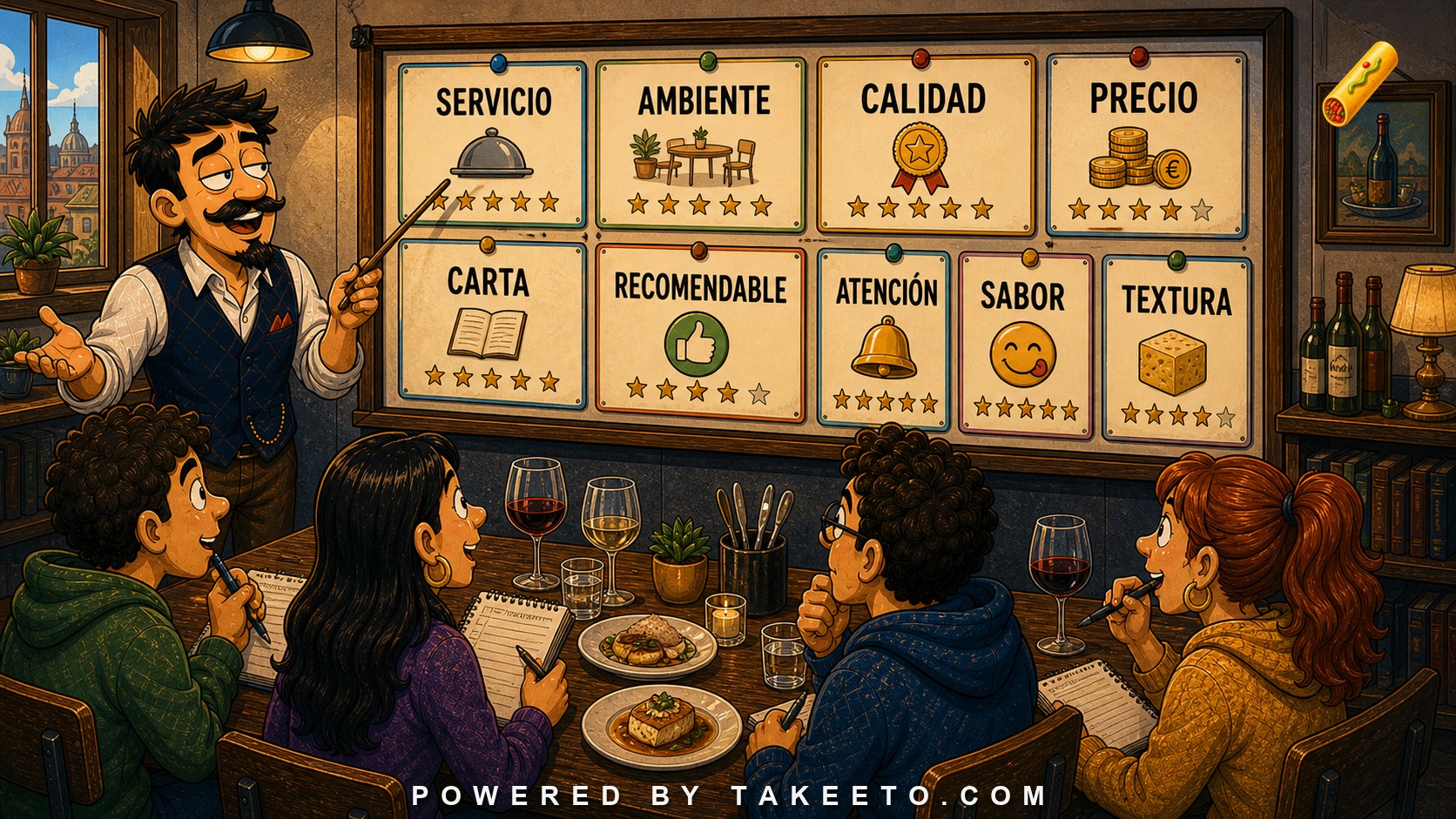
Servicio evaluates speed, organization, and hospitality.
Ambiente evaluates the setting and mood.
Calidad should be tied to ingredients, preparation, consistency, or experience.
Precio matters through value, not only amount.
Carta is the list of dishes; menú may be a set meal.
Recomendable marks positive stance, often needing a context.
Atención focuses on how staff treated customers.
Sabor and textura give sensory evidence.
Restaurant review reading workflow
- Identify review type: quick rating, complaint, recommendation, professional critique.
- Separate food, service, atmosphere, price, and logistics.
- Look for specific dishes.
- Mark sensory adjectives.
- Identify evidence versus emotion.
- Notice whether the reviewer had realistic expectations.
- Check whether criticism is about restaurant, delivery, reservation, or platform.
- Interpret calidad-precio carefully.
- Translate stance phrases naturally.
- Decide whether the review helps your own decision.
Mini-workshop: evidence-check a review
Choose a five-star or one-star review and underline only evidence: dish names, wait times, prices, staff actions, reservation problems, temperature, texture, flavor, portion size. Then circle pure stance words: excelente, horrible, decepcionante, recomendable. A review with strong stance but little evidence may still reflect a real experience, but it is less useful for decision-making. This drill trains the reader to separate appetite, anger, and information.
Review credibility matrix
For restaurant Spanish, use a credibility matrix with five rows: food, service, timing, price/value, atmosphere. A review that fills only the emotion column is weak. A review that gives details across several rows is more useful even if the writer's taste differs from yours.
Example:
El ambiente es agradable y la atención fue correcta, pero el arroz llegó pasado y el vino estaba demasiado frío para el tipo de plato.
Food: rice overcooked. Service: correct. Atmosphere: pleasant. Drink/service detail: wine temperature. Stance: mixed, credible.
This also helps production. Instead of writing muy rico, produce one sensory detail: la salsa tenía buena acidez, la carne estaba seca, el pan llegó caliente, la textura era demasiado densa. Spanish food criticism becomes stronger when adjectives are tied to observable features.
Remediation drill: rate review credibility
Build a credibility scale for Spanish restaurant reviews. Low credibility: only emotion, no evidence. Medium credibility: evidence about one area, such as food or service. High credibility: specific details across food, service, timing, price, atmosphere, and problem handling.
Review A:
Todo horrible. No vuelvo.
Low credibility. Strong emotion, no evidence.
Review B:
La pasta llegó fría y tardaron diez minutos en traer los cubiertos.
Higher credibility. It names specific events.
Review C:
El menú del día cuesta 14 euros e incluye entrada, plato principal y postre. La sopa estaba bien sazonada, pero el pollo llegó seco. El personal corrigió el error con rapidez.
High credibility. It includes price, structure, sensory detail, flaw, and service recovery.
Now classify vocabulary. Atención belongs to service. Ambiente belongs to setting. Textura, sabor, punto de cocción, and temperatura belong to food evidence. Relación calidad-precio evaluates value. Carta and menú need regional caution.
For writing practice, turn a vague review into a useful review without changing the opinion. If the opinion is negative, support it with specific observations. If positive, do the same. A serious critic is not less opinionated. The opinion is simply anchored in evidence.
Editorial remediation note
This article should keep the distinction between preference and evidence visible. Food criticism is allowed to be subjective, but good review language gives the reader sensory and situational evidence. The remediation target is the lazy adjective. Excelente and horrible are not banned; they are incomplete. Strong Spanish food writing names texture, temperature, timing, service, value, and expectation.
Suggested interactive module: restaurant review evidence map
A strong tool would classify review content and credibility.
Suggested functions:
- Aspect labels: food, service, atmosphere, price, reservation, delivery.
- Evidence detector: dish names, wait times, prices, staff actions.
- Sensory vocabulary map: flavor, texture, aroma, temperature, balance.
- Stance scale: complaint, mixed, recommendation, criticism, praise.
- Review-type tag: platform user, critic, blog, guide, social post.
- Value analysis: price versus quality language.
- Decision summary: best for whom and when.
Applied reading drill: upgrade a weak review
Weak review:
Todo estuvo excelente. Muy recomendable.
Stronger review:
El servicio fue atento, los platos llegaron a buen ritmo y el pescado estaba jugoso, con piel crujiente. El precio es alto, pero la calidad de los ingredientes lo justifica.
The stronger version names service, timing, dish, texture, price, and value. This is the difference between enthusiasm and evidence. When reading Spanish reviews, look for the same movement: from excelente or decepcionante to specific details that let you judge credibility.
Remediation focus: distinguishing complaint, recommendation, platform review, and professional criticism
Restaurant Spanish looks like everyday opinion, but it has several registers. A platform review may say muy rico, fatal, no vuelvo, calidad-precio excelente, tardaron muchísimo. A professional critic may discuss punto de cocción, equilibrio, textura, servicio de sala, bodega, propuesta, and ejecución. A complaint may focus on hygiene, billing, delay, or treatment. These texts should not be read as the same genre.
The remediation task is to classify the review’s purpose before judging vocabulary. Is the writer recommending, warning, venting, analyzing, comparing, or documenting a problem? Spanish uses sensory adjectives and intensifiers heavily in food discourse, but credibility comes from evidence: what dish, what price, what service moment, what expectation, what comparison.
Common failure modes to repair
- Treating intensity as evidence: Buenísimo, horrible, espectacular, and decepcionante express stance. They do not prove the claim.
- Missing value language: Calidad-precio, porción, menú del día, cubierto, suplemento, and precio shape the judgment.
- Confusing taste and execution: A reviewer may dislike an ingredient but still recognize technique, or enjoy flavor while criticizing service.
- Ignoring platform norms: Short star-review Spanish is compressed and emotional; professional criticism is slower and more comparative.
Before/after: turn a vague review into useful evidence
Weak version:
El restaurante es caro y malo. No lo recomiendo.
Stronger version:
Pagamos 42 euros por persona sin vino; el pescado llegó tibio, el arroz estaba pasado y el servicio tardó treinta minutos en retirar los platos. Por ese precio, la experiencia no justificó la visita.
The stronger review names price, dishes, defects, timing, and basis for recommendation. It is still negative, but now it is usable.
Upgrade workshop: review evidence map
- Separate food, service, atmosphere, price, cleanliness, reservation, and billing.
- Underline sensory adjectives and connect each one to a specific dish or moment.
- Mark whether the reviewer gives evidence or only emotion.
- Identify comparison: previous visits, competing restaurants, price level, advertised promise, cultural expectation.
- Rewrite one sentence to reduce exaggeration while preserving the judgment.
Quality-control checklist
- Does atención mean service quality, attention from staff, or care?
- Does carta mean menu, not letter?
- Does ambiente refer to decor, noise, crowd, lighting, or general feel?
- Is casero a meaningful description or a marketing adjective?
- Would a translation preserve register: casual review, formal complaint, or culinary criticism?
Applied remediation drill: separate taste, value, and service in a review
Use this source-style excerpt:
La comida estaba correcta, aunque las porciones fueron pequeñas para el precio. El servicio fue atento, pero la espera entre platos superó los cuarenta minutos.
A fast but weak reading might say:
The restaurant was okay but expensive and slow.
That reading is incomplete. A stronger reading says:
The reviewer gives a mixed assessment: acceptable food, small portions relative to price, attentive service, and excessive wait time between courses.
The repair comes from five checks:
- Correcta is restrained praise, not enthusiasm.
- Porciones pequeñas para el precio is a value judgment based on quantity and cost.
- Atento evaluates staff behavior positively.
- Pero shifts from service attitude to service timing.
- Superó los cuarenta minutos gives concrete evidence for the delay.
Turn the review into a balanced recommendation: Puede valer la pena si se prioriza la atención y no se tiene prisa, pero la relación cantidad-precio y los tiempos de espera reducen la recomendación. This kind of rewrite trains learners to preserve nuance. Not every negative review is a condemnation; not every positive adjective creates a recommendation.
Final rule
Restaurant Spanish is not just whether something is delicious.
Read servicio, ambiente, calidad, precio, carta, recomendable, atención, sabor, and textura as parts of an experience claim. The best review gives evidence for appetite.