
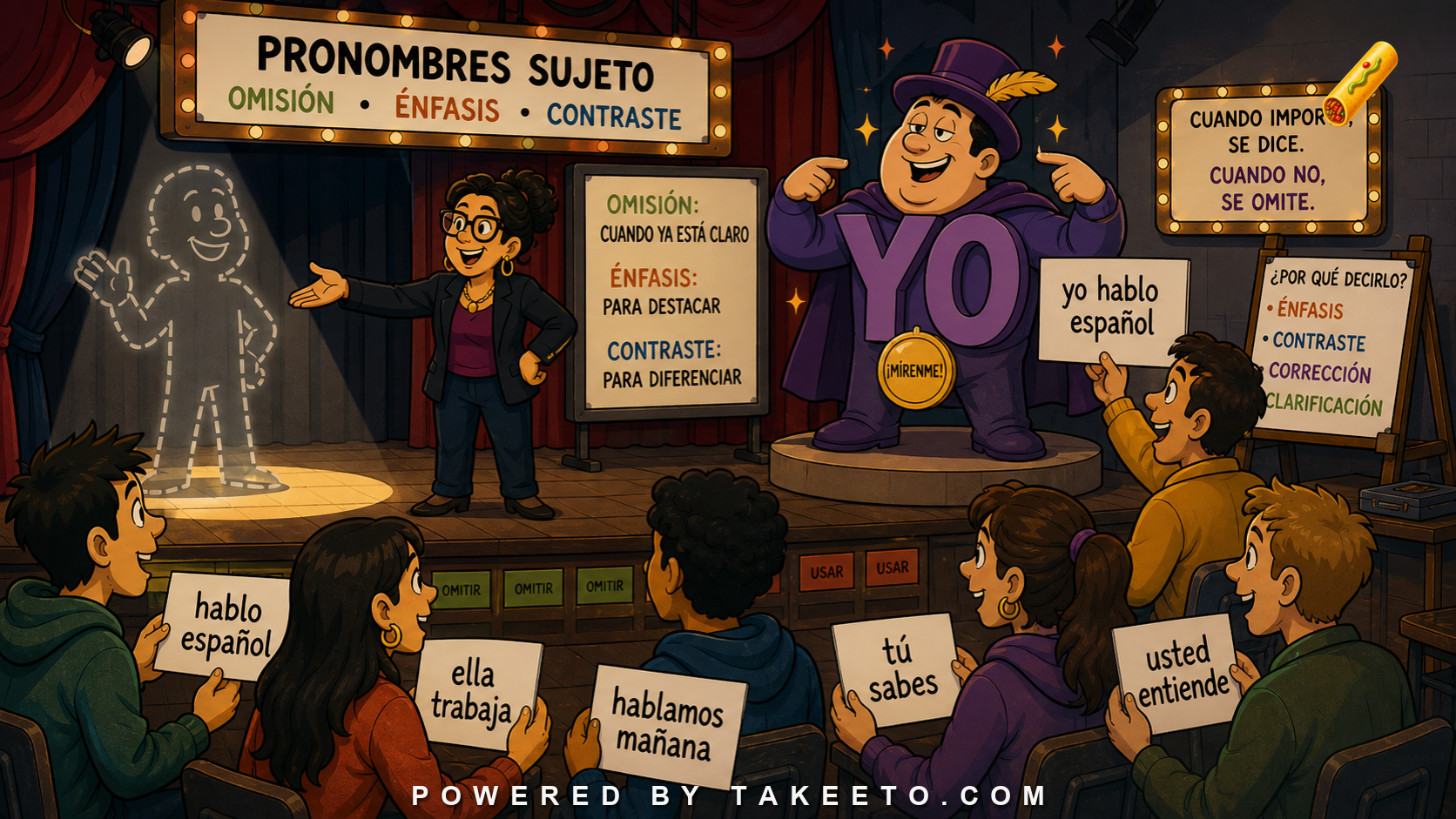
Spanish pronouns are not missing; they are often unnecessary
English normally requires subject pronouns:
I speak Spanish.
She works.
We are leaving tomorrow.
Do you understand?
Spanish often omits them:
Hablo español.
I speak Spanish.
Trabaja.
He/she/you-formal works.
Salimos mañana.
We are leaving tomorrow.
¿Entiende?
Do you understand? / Does he or she understand?
Beginners sometimes describe this as “Spanish drops pronouns.” That is true in a surface sense, but it can make the language sound as if it were deleting something required. A better description is:
Spanish verb morphology often carries enough person-and-number information that the subject pronoun is not needed.
The pronoun is not absent because Spanish is careless. It is absent because the verb ending, context, and discourse normally do the job.
Verb endings carry subject information
Compare the present-tense forms of hablar:
| Person | Verb | Pronoun usually unnecessary? |
|---|---|---|
| yo | hablo | yes, often clear |
| tú | hablas | yes, often clear |
| él/ella/usted | habla | sometimes ambiguous |
| nosotros/as | hablamos | yes, usually clear |
| vosotros/as | habláis | yes, where used |
| ellos/ellas/ustedes | hablan | sometimes ambiguous among plural subjects |
When you say hablo, the -o ending identifies first-person singular. You usually do not need yo.
Hablo español.
I speak Spanish.
Adding yo is grammatical, but it is not neutral in every context:
Yo hablo español.
I speak Spanish.
Depending on context, this can mean “I, for my part, speak Spanish,” “I do speak Spanish,” or “I’m the one who speaks Spanish.” The pronoun adds discourse weight.
Omission is the default, not a casual shortcut
Spanish subject-pronoun omission occurs in formal writing, ordinary conversation, academic prose, literature, and public speech. It is not merely casual or slangy.
Presentamos los resultados en la sección siguiente.
We present the results in the following section.
Solicito la revisión del expediente.
I request the review of the file.
Llegaron tarde por el tráfico.
They arrived late because of traffic.
No sabemos qué ocurrió.
We do not know what happened.
A learner who inserts pronouns everywhere may sound repetitive, English-shaped, or overly emphatic:
Yo estudio español y yo trabajo en una oficina. Yo vivo en Chicago y yo tengo dos perros.
A more natural version:
Estudio español y trabajo en una oficina. Vivo en Chicago y tengo dos perros.
This is not a matter of making Spanish shorter. It is a matter of using pronouns when they have a reason to be there.
Explicit pronouns create contrast
The most important reason to include a subject pronoun is contrast.
Yo hablo español, pero mi hermano habla francés.
I speak Spanish, but my brother speaks French.
Here yo contrasts with mi hermano.
Tú sabes la respuesta; yo no.
You know the answer; I do not.
Here tú and yo divide responsibility or knowledge.
Ella trabaja los sábados; él descansa.
She works on Saturdays; he rests.
The pronouns help manage two people.
Contrast can be explicit or implied:
Yo no dije eso.
I did not say that.
This often implies “someone else may have said it, but not me.”
Usted entiende mejor que nadie la situación.
You understand the situation better than anyone.
Here usted can be respectful, focused, or contrastive, depending on context.
Explicit pronouns mark topic shifts
Spanish may include a pronoun when the discourse shifts from one subject to another.
Ana llegó temprano. Ella preparó el café, y Carlos abrió la sala.
Ana arrived early. She made the coffee, and Carlos opened the room.
In many contexts, ella could be omitted:
Ana llegó temprano. Preparó el café, y Carlos abrió la sala.
But if several people are active in the paragraph, the pronoun can help orient the reader.
A subject pronoun is especially useful when the verb form alone is ambiguous:
Trabaja en una clínica.
He/she/you-formal works in a clinic.
If the previous context does not identify the subject, Spanish may need a noun or pronoun:
Ella trabaja en una clínica.
She works in a clinic.
Usted trabaja en una clínica, ¿verdad?
You work in a clinic, right?
Third-person forms are often ambiguous
The form habla can correspond to:
- él habla — he speaks;
- ella habla — she speaks;
- usted habla — you speak, formal singular;
- sometimes a named subject: Ana habla, el profesor habla.
The form hablan can correspond to:
- ellos hablan — they masculine or mixed group speak;
- ellas hablan — they feminine group speak;
- ustedes hablan — you plural speak.
Because of this, Spanish often omits pronouns when context is clear but supplies them when needed.
¿Dónde trabaja Ana?
Trabaja en una clínica.
No pronoun is necessary because the question established Ana.
¿Dónde trabaja?
Without context, this could mean “Where does he/she/you-formal work?”
A learner should not overstate pro-drop. Spanish omits pronouns when recoverable. It does not require the listener to guess blindly.
Yo is not rude, but it is not invisible
Some learners hear that Spanish omits yo and conclude that using yo is rude or egotistical. That is too strong.
Yo is perfectly normal when it has discourse value:
Yo creo que no es así.
I think it is not like that.
Yo prefiero esperar.
I prefer to wait.
Yo puedo ayudarte.
I can help you.
It can sound self-focused if repeated unnecessarily, but it is not inherently rude. The real issue is weight. Yo makes the subject explicit. It can mark opinion, contrast, responsibility, or emphasis.
Compare:
Creo que es mejor esperar.
I think it is better to wait.
Yo creo que es mejor esperar.
I think it is better to wait. / My view is that it is better to wait.
The second version slightly foregrounds the speaker’s stance. That may be exactly what you want.
Tú and usted can also carry social meaning
Because second-person verb forms already identify the addressee in many cases, explicit tú and usted often add social or discourse weight.
¿Tú sabes algo?
Do you know anything?
This may be neutral in some contexts, but it can also mean “you specifically, do you know anything?”
Usted entiende la situación.
You understand the situation.
This may be polite, formal, contrastive, or calming, depending on tone and context.
In commands, explicit subject pronouns can sound contrastive:
Siéntate.
Sit down.
Siéntate tú.
You sit down, as opposed to someone else.
Do not mechanically add tú to every command or question. Use it when it helps manage contrast, attention, or relationship.
Regional pronoun systems matter
Spanish subject pronouns are not the same everywhere. The major second-person systems include:
| Pronoun | Broad use | Verb example |
|---|---|---|
| tú | familiar singular in many regions | tú hablas |
| usted | formal, respectful, distant, or regionally ordinary singular | usted habla |
| vos | familiar singular in many parts of Latin America | vos hablás, vos hablás/comes/vivís in common voseo patterns |
| vosotros/as | familiar plural, mainly Spain | vosotros habláis |
| ustedes | plural “you” in the Americas and also used in parts of Spain | ustedes hablan |
Because pronouns interact with verb endings, omission works differently depending on the system. Hablás strongly points to vos in voseo regions. Habláis points to vosotros. Hablan may mean ellos, ellas, or ustedes.
Learners should not treat one textbook variety as the whole language. A course may teach tú and vosotros, or tú and ustedes, or include vos from the beginning. The important thing is to connect the pronoun system to real regional use.
Pronoun omission and politeness are separate issues
Omitting a subject pronoun does not make a sentence informal, and including one does not automatically make it polite.
¿Puede ayudarme?
Can you help me? / Can he or she help me?
¿Usted puede ayudarme?
Can you help me? with explicit formal addressee.
The second version can clarify that the question is addressed to usted. It may sound respectful, but it can also sound insistent or contrastive depending on tone.
Similarly:
¿Quieres café?
Do you want coffee?
¿Tú quieres café?
Do you want coffee? / Do you, specifically, want coffee?
The pronoun does not supply politeness by itself. Address form, verb form, tone, context, and relationship all matter.
English interference: translating every subject
A common English-shaped paragraph looks like this:
Yo me llamo Laura. Yo vivo en Madrid. Yo estudio medicina. Yo tengo veintidós años. Yo quiero trabajar en un hospital.
A more natural version:
Me llamo Laura. Vivo en Madrid. Estudio medicina. Tengo veintidós años. Quiero trabajar en un hospital.
If contrast appears, the pronoun becomes useful:
Mi hermana estudia derecho, pero yo estudio medicina.
My sister studies law, but I study medicine.
The practical rule is not “never use pronouns.” It is “do not use them just because English does.”
Pronouns after prepositions are different
This article focuses on subject pronouns, but learners should notice that Spanish has different forms after prepositions:
| Subject | After preposition |
|---|---|
| yo | mí |
| tú | ti |
| él | él |
| ella | ella |
| nosotros/as | nosotros/as |
| vosotros/as | vosotros/as |
| ustedes | ustedes |
Examples:
Yo hablo.
I speak.
Hablan de mí.
They are talking about me.
Tú sabes.
You know.
Es para ti.
It is for you.
The special forms conmigo and contigo are also important:
Ven conmigo.
Come with me.
Quiero hablar contigo.
I want to talk with you.
Do not confuse subject-pronoun omission with prepositional-pronoun choice. They are separate parts of the pronoun system.
Pronoun omission across coordinated verbs
Spanish often lets one subject govern several verbs without repeating a pronoun:
Trabajo, estudio y cuido a mis hijos.
I work, study, and take care of my children.
English repeats the subject only once too, but Spanish goes further because the verb endings keep the subject alive across clauses:
Llegamos tarde, dejamos las maletas y salimos a cenar.
We arrived late, left the bags, and went out to eat.
If the subject changes, Spanish signals the change with a noun, pronoun, or clear context:
Llegamos tarde. Ana dejó las maletas y yo salí a comprar agua.
We arrived late. Ana left the bags, and I went out to buy water.
This is why explicit pronouns often appear at switch points. A paragraph with no pronouns is not automatically elegant; a paragraph with too many pronouns is not automatically clear. Good Spanish uses just enough subject marking to keep the discourse trackable.
A practical editing test is to underline every subject pronoun you wrote. For each one, ask: contrast, ambiguity, topic shift, emphasis, or social stance? If the answer is “none,” try removing it. If the sentence becomes unclear, restore it. This is how you move from textbook correctness to natural discourse control.
Diagnostic refinement: omission has conditions
Subject pronoun omission is normal in Spanish, but it is not magic. A pronoun can be omitted when the subject is recoverable from verb morphology, context, discourse, or shared knowledge. When those clues are weak, Spanish uses a noun, a pronoun, or a different structure.
Compare:
| Context | Sentence | Why it works or fails |
|---|---|---|
| speaker is obvious | Hablo español. | -o identifies first-person singular |
| group is obvious | Vamos mañana. | -mos identifies first-person plural |
| third person not established | Trabaja en Lima. | possible, but he/she/you formal may be unclear |
| topic shift | Ella trabaja en Lima; él estudia en Quito. | pronouns mark contrast |
| ambiguous address | ¿Trabaja aquí? | could be usted, él, or ella without context |
The weakest area is often third person and formal address. Habla may mean “he speaks,” “she speaks,” or “you speak” in the usted system. Hablan may mean “they speak” or “you all speak” with ustedes. In conversation, context usually solves this. In writing, especially when several people are mentioned, explicit subjects are often necessary.
Regional speech also matters. Some varieties use overt subject pronouns more frequently than others, especially in contexts where final consonants are weakened or where discourse habits favor explicit subjects. That does not erase Spanish pro-drop grammar. It means that pronoun frequency is partly grammatical and partly regional, phonetic, and pragmatic.
A useful editing routine is:
- Remove English-default pronouns first: yo trabajo, yo estudio, yo vivo should not become repetitive just because English repeats “I.”
- Put pronouns back when they do work: contrast, topic shift, emphasis, ambiguity repair, or social stance.
- Check address forms: usted, ustedes, vos, vosotros/as, and tú affect both verb morphology and how much subject information the listener already has.
Do not ask “Can Spanish omit this pronoun?” Ask “Will the listener know the subject, and does an explicit pronoun add a meaning I actually want?”
Suggested interactive module: pronoun weight annotator
A useful tool for this article would take a sentence with a subject pronoun and label why the pronoun is there.
Input:
Yo hablo español, pero Ana habla francés.
Output:
- Yo: contrastive subject; contrasts with Ana.
- Pronoun useful: yes.
Input:
Yo vivo en Bogotá. Yo trabajo en una escuela. Yo tengo dos hijos.
Output:
- Repeated yo: probably unnecessary after the first sentence unless contrast is intended.
- Suggested rewrite: Vivo en Bogotá. Trabajo en una escuela. Tengo dos hijos.
Input:
Ella trabaja en una clínica.
Output:
- Ella may clarify third-person ambiguity or mark topic shift.
- Pronoun useful if previous context has multiple possible subjects.
The tool should also let users toggle regional pronoun systems: tú/usted/ustedes, tú/vosotros/ustedes, or vos/usted/ustedes.
Final rule
Spanish subject pronouns are often omitted because the verb ending and context identify the subject. Omission is not laziness, informality, or missing grammar. It is normal Spanish.
Use explicit subject pronouns when they do work: contrast, emphasis, topic shift, ambiguity resolution, social stance, or regional address.
Do not translate every English “I,” “you,” “he,” “she,” “we,” and “they.” Ask what the pronoun contributes. If it contributes nothing, Spanish will often leave it out. If it contributes contrast or clarity, Spanish will use it with purpose.