
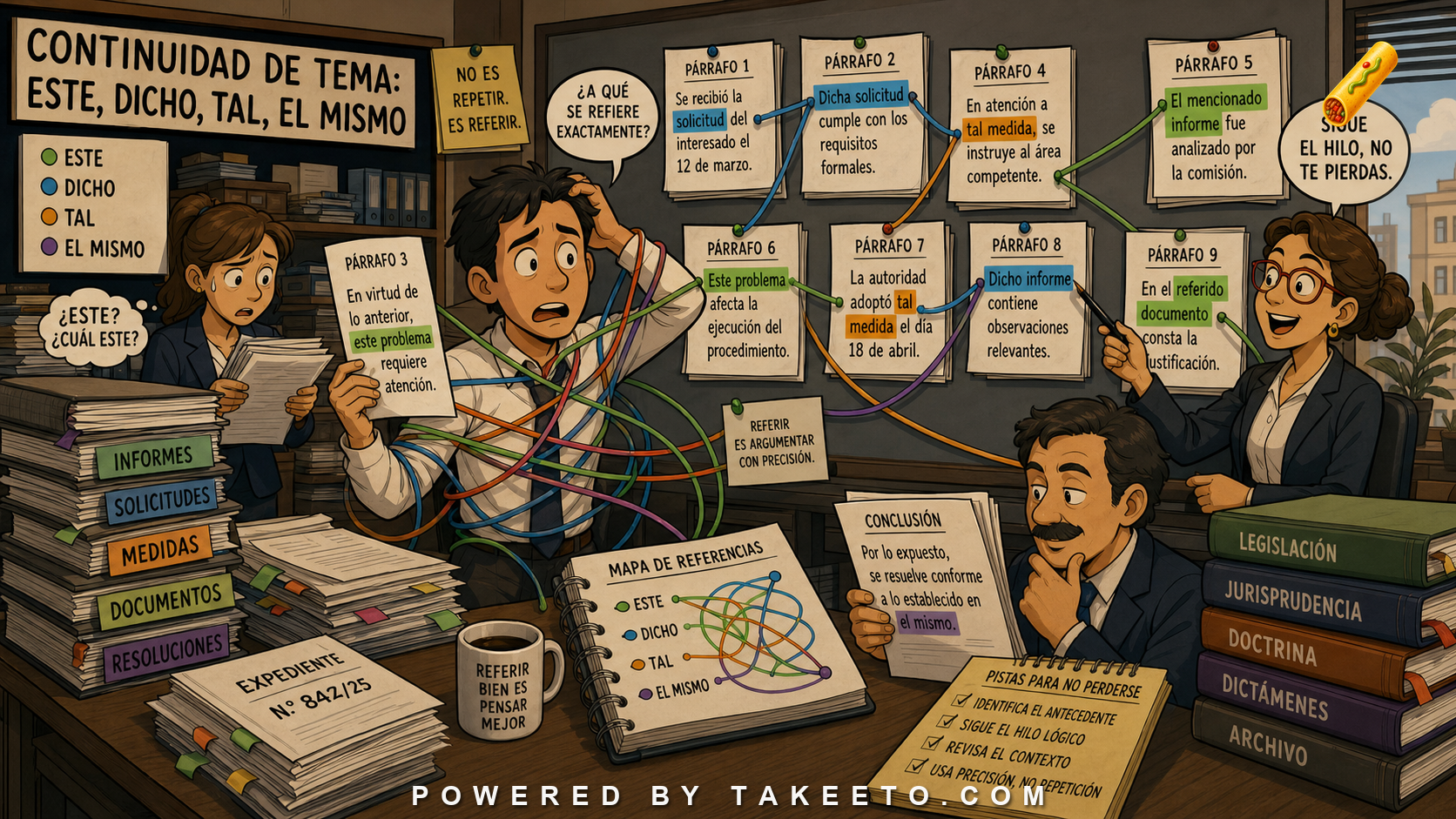
Formal Spanish often points backward
In formal Spanish, a paragraph may introduce a noun and then keep referring to it with compact reference words:
El solicitante presentó una reclamación el 3 de mayo. Dicha solicitud fue revisada por la comisión. Este órgano concluyó que tal medida no procedía.
To an advanced learner, the vocabulary may be familiar, but the reference chain can still be difficult. What does dicha solicitud refer to? What is este órgano? What is tal medida?
The key principle is:
Formal reference words preserve topic continuity by pointing back to already introduced information.
If you cannot track these links, you cannot follow legal, administrative, academic, or bureaucratic Spanish reliably.
Este and esta: this, but also the latter topic
Demonstratives such as este, esta, estos, estas can point to something near the speaker, but in writing they often point back to a recently mentioned idea.
El informe identifica varios errores. Estos afectan principalmente a la sección final.
Estos refers to errores.
La comisión revisó la propuesta. Esta fue aprobada por unanimidad.
Esta refers to la propuesta, not la comisión, because of gender agreement and likely meaning.
But ambiguity is possible:
La directora habló con la coordinadora. Esta presentó el informe.
Esta likely refers to la coordinadora if we follow “the latter” interpretation, but context is necessary. Formal writing should avoid ambiguity when two feminine nouns compete.
Learner action:
Track gender and number, but do not rely on them alone. Check meaning and distance.
Dicho: the aforementioned
dicho / dicha / dichos / dichas
Dicho literally relates to “said,” but in formal writing it often means “aforementioned” or “the said.”
El interesado presentó una solicitud. Dicha solicitud fue admitida a trámite.
This means:
The interested party submitted an application. That application / the aforementioned application was accepted for processing.
Dicho is common in legal and administrative prose. It is clear, but overuse can make writing stiff.
Less formal alternative:
La solicitud fue admitida a trámite.
Often the noun alone is enough.
Tal: such, that kind of, the aforementioned type
tal
Tal can refer back to a previously described measure, condition, or situation.
La norma exige autorización previa. Tal requisito no se aplica a los menores de seis años.
Tal requisito means “that requirement” or “such a requirement.”
Tal can also sound formal or emphatic:
No existe tal obligación.
No such obligation exists.
Learner action:
Read tal as a backward-pointing adjective when it appears before a noun: tal medida, tal requisito, tal circunstancia.
Mencionado and referido
mencionado / mencionada
referido / referida
These explicitly signal previous mention.
El mencionado informe será publicado mañana.
The aforementioned report will be published tomorrow.
El referido documento deberá adjuntarse a la solicitud.
The referenced document must be attached to the application.
Referido is especially common in bureaucratic and legal language. In ordinary writing, it can feel heavy.
Alternative:
Ese documento deberá adjuntarse a la solicitud.
Or simply:
El documento deberá adjuntarse a la solicitud.
El mismo: useful, but often overused
el mismo / la misma / los mismos / las mismas
El mismo can mean the same one:
Compré el mismo libro.
I bought the same book.
In bureaucratic writing, it is often used to refer back to a noun:
Se presentó el informe y se procedió a la revisión del mismo.
This means:
The report was submitted and its review proceeded.
But this use can sound heavy or awkward. Many editors prefer a possessive, pronoun, repeated noun, or restructuring:
Se presentó el informe y se procedió a revisarlo.
Se presentó el informe y comenzó su revisión.
Se presentó el informe, que fue revisado posteriormente.
Learner action:
Understand el mismo in formal texts, but do not imitate bureaucratic overuse.
Legal and administrative overuse
Legal and administrative Spanish often values explicitness, traceability, and avoidance of ambiguity. That encourages phrases like:
dicha solicitud
el referido documento
la mencionada resolución
tal circunstancia
el mismo
These forms can be useful when many documents, parties, deadlines, and clauses appear in one text. But they can also create dense prose.
Plain-language revision often replaces them with clearer noun repetition or shorter clauses.
Bureaucratic:
El interesado deberá presentar la documentación requerida; la falta de la misma dará lugar al archivo de la solicitud.
Clearer:
El interesado deberá presentar la documentación requerida. Si no la presenta, se archivará la solicitud.
Reference-chain annotation
Consider:
La empresa presentó una propuesta de modificación del contrato. Dicha propuesta fue analizada por el comité técnico, el cual emitió un informe desfavorable. Este informe señala que tal modificación afectaría al calendario de entrega.
Reference chain:
- una propuesta de modificación del contrato → dicha propuesta → tal modificación
- el comité técnico → el cual
- un informe desfavorable → este informe
If you miss the chain, you may think new objects are being introduced when the text is actually referring back.
Example bank walkthrough
dicha solicitud
The aforementioned application/request.
Learner action: find the earlier solicitud and link them.
tal medida
Such measure / that measure.
Learner action: identify what measure was previously described.
el mencionado informe
The aforementioned report.
Learner action: expect a formal backward reference.
este problema
This problem.
Learner action: usually points to the problem just described, but confirm by context.
el mismo
The same one / bureaucratic reference to a previous noun.
Learner action: understand it, but prefer clearer alternatives in your own writing when possible.
referido documento
Referenced/aforementioned document.
Learner action: common in legal and administrative texts.
Reference-chain reading routine
When reading formal Spanish:
- Underline reference words. este, dicho, tal, mencionado, referido, mismo.
- Circle the noun they modify. dicha solicitud, tal medida.
- Find the antecedent. What earlier noun is being referenced?
- Check agreement. Gender and number narrow options.
- Check meaning. Agreement alone may not solve ambiguity.
- Draw chains. solicitud → dicha solicitud → la misma.
- Watch overuse. Dense reference chains may need plain-language rewriting.
- Translate according to register. aforementioned may fit legal English; “that” may fit ordinary English.
Reference chains create cohesion and risk
Formal Spanish often avoids repeating the same noun by using demonstratives and anaphoric adjectives:
La solicitud fue presentada el 3 de abril. Dicha solicitud incluía dos documentos. Estos documentos fueron revisados por la comisión. Tal revisión no produjo observaciones.
This creates cohesion, but it also creates risk. If several nouns are possible antecedents, the reader may not know what dicha, estos, or tal refers to.
Weak:
La empresa envió el contrato al proveedor después de revisar el informe. Dicho documento contenía errores.
Which document contained errors: the contract or the report? The sentence may be clear in context, but the reference is potentially ambiguous.
Better:
La empresa envió el contrato al proveedor después de revisar el informe. El contrato contenía errores.
Repetition is not always bad. Sometimes it is the clearest solution.
Dicho and mencionado are not neutral decoration
Dicho and mencionado sound formal, legal, or administrative. They are useful when the text needs precise backward reference:
El solicitante deberá presentar copia del pasaporte. Dicho documento debe estar vigente.
But overuse becomes heavy:
El estudiante leyó el artículo. Dicho estudiante comentó dicho artículo en dicha clase.
Natural prose would repeat selectively or use pronouns/demonstratives:
El estudiante leyó el artículo y lo comentó en clase.
The goal is not to avoid dicho. The goal is to use it where formal precision is worth the weight.
El mismo: useful, but dangerous
El mismo, la misma, los mismos, and las mismas can refer back to a noun, especially in formal writing. But they are often overused in bureaucratic Spanish and in translations from English.
Heavy:
Recibimos su solicitud y procederemos a la revisión de la misma.
Cleaner:
Recibimos su solicitud y procederemos a revisarla.
Or:
Recibimos su solicitud y la revisaremos.
In many cases, a pronoun, possessive, repeated noun, or verb rewrite is better than el mismo.
Use el mismo when it truly adds contrast or precision:
Los dos formularios parecen iguales, pero no son el mismo.
Here it means “the same one,” not merely “it.”
Este, ese, aquel in discourse
Demonstratives can point physically, but in written discourse they also point textually.
El informe analiza la traducción automática. Este problema afecta especialmente a textos legales.
Here este problema packages the previously mentioned issue. But if the previous sentence has several possible problems, este may not be enough.
A strong writer alternates:
- repeat the noun when clarity matters;
- use este/esta for nearby topics;
- use dicho/mencionado in formal reference;
- avoid el mismo as a default pronoun;
- annotate long chains when reading.
Reference-chain annotation method
When a paragraph feels dense, draw arrows:
La autoridad notificó a la empresa la apertura del expediente. Dicha notificación indicaba que la empresa disponía de diez días para responder. Este plazo comenzaba a contar desde el día siguiente a la recepción de la comunicación.
Arrows:
- dicha notificación → la notificación de apertura del expediente;
- la empresa → same company;
- este plazo → diez días;
- la comunicación → the notification.
This method turns bureaucratic prose into a map. Without reference tracking, formal Spanish can feel harder than it really is.
Sometimes repetition is the elegant choice
Learners are often told not to repeat words. In formal Spanish, that advice can backfire. When precision matters, repeating the noun may be clearer than using a vague reference.
Ambiguous:
La empresa entregó el informe al auditor después de revisar el contrato. Este contenía errores.
Clear:
La empresa entregó el informe al auditor después de revisar el contrato. El contrato contenía errores.
Or:
La empresa entregó el informe al auditor después de revisar el contrato. El informe contenía errores.
The repeated noun resolves the ambiguity immediately.
The better rule is:
Avoid needless repetition, but repeat the noun when reference clarity is at risk.
This is especially important in legal, administrative, and academic Spanish, where a wrong antecedent changes the meaning of the whole paragraph.
Suggested interactive module: reference-chain highlighter
A strong tool for this article would trace anaphoric references across paragraphs.
Suggested functions:
- Text input: legal or administrative paragraph.
- Reference detection: dicho, tal, referido, el mismo.
- Antecedent candidates: based on gender, number, and distance.
- Chain visualization: solicitud → dicha solicitud → la misma.
- Ambiguity warning: multiple feminine nouns nearby.
- Plain-language rewrite: reduce bureaucratic reference.
- Translation mode: formal legal vs plain English.
Final rule
Formal Spanish keeps topics alive through reference chains.
Este, dicho, tal, mencionado, referido, and el mismo help link sentences, but they can also make prose dense. Track the antecedent, check agreement, and rewrite overused bureaucratic forms when clarity matters.
To understand the paragraph, follow what each word points back to.