
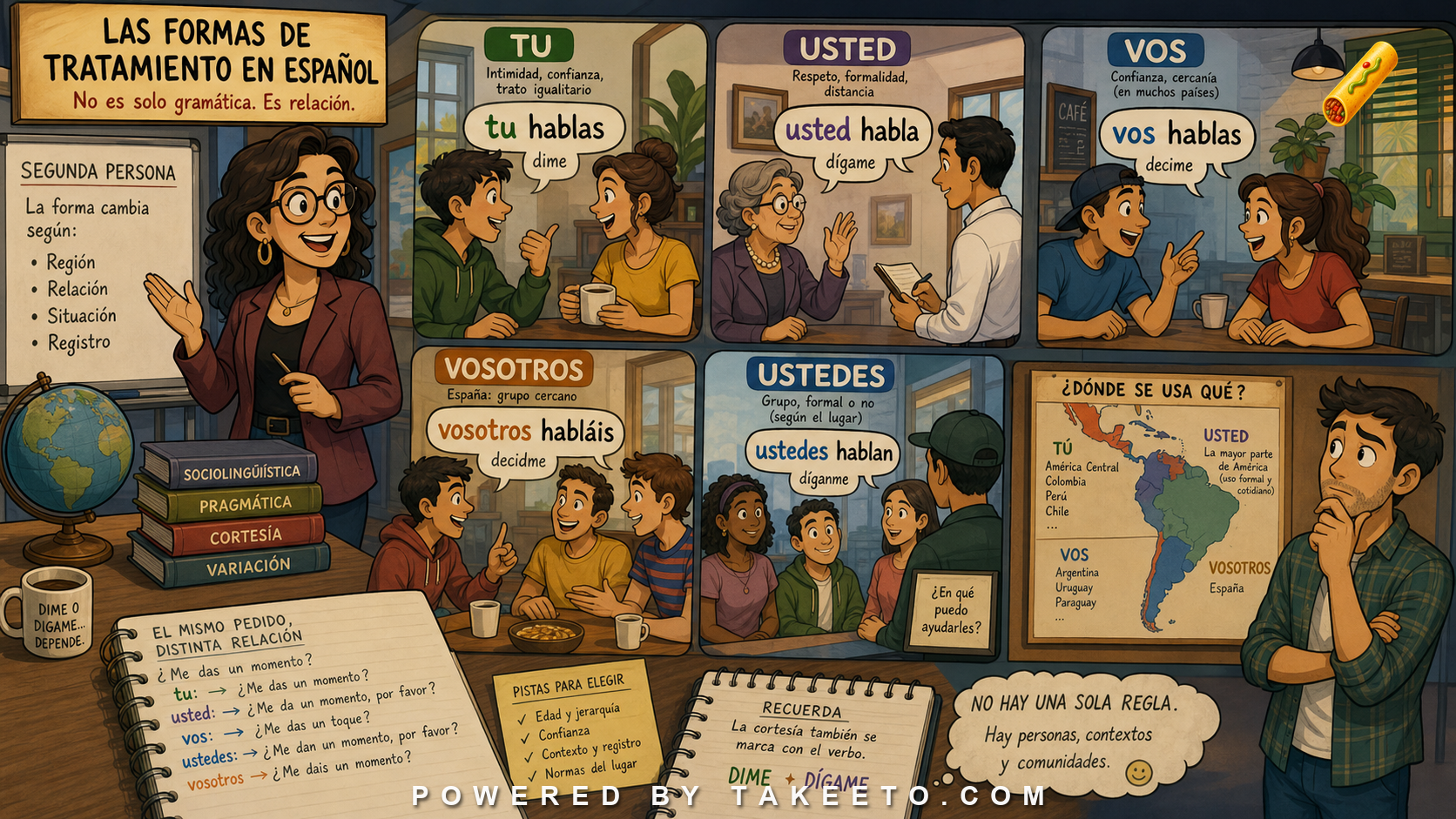
“You” is not one thing in Spanish
English has a deceptively simple second person: you.
Spanish has a system:
tú hablas
usted habla
vos hablás
vosotros habláis
ustedes hablan
A beginner may be told that tú is informal and usted is formal. That is a useful first approximation, but it is too thin for real Spanish. Spanish address is not only grammar. It is relationship, region, age, workplace culture, family habit, institutional setting, politeness, distance, solidarity, affection, authority, and sometimes conflict.
The pronoun you choose affects verb forms, commands, object pronouns, possessives, and tone. Address is not a vocabulary choice placed on top of grammar. It is grammar carrying social information.
The main second-person options
Here is the broad map:
| Form | Number | Broad social value | Broad geography | Verb example |
|---|---|---|---|---|
| tú | singular | familiar, ordinary, intimate, peer-to-peer | widespread | tú hablas |
| usted | singular | formal, respectful, distant, or regionally ordinary | widespread, values vary | usted habla |
| vos | singular | familiar in voseo regions | much of Latin America, with strong regional patterns | vos hablás |
| vosotros/as | plural | familiar plural | mainly Spain | vosotros habláis |
| ustedes | plural | plural you; formal or neutral depending on region | all Americas; also parts of Spain | ustedes hablan |
The table is only a map. Real usage depends on place and situation. In some communities, usted can be intimate or affectionate. In others, using usted with a peer may create distance. In some countries, vos is the default familiar singular. In others, it is regional, stigmatized, literary, rural, urban, prestigious, or mixed depending on local norms.
A serious learner should avoid moralizing these systems. Vos is not “incorrect.” Ustedes as the ordinary plural is not a degraded form of vosotros. These are living grammatical systems.
Tú: familiar singular, but not automatically casual
Tú is the familiar singular pronoun in many Spanish varieties.
Tú hablas muy rápido.
You speak very fast.
¿Tú quieres café?
Do you want coffee?
The present-tense forms are the textbook second-person singular forms:
| Verb | tú form |
|---|---|
| hablar | hablas |
| comer | comes |
| vivir | vives |
| tener | tienes |
| poder | puedes |
| ser | eres |
| estar | estás |
But because Spanish often omits subject pronouns, the verb form is usually enough:
Hablas muy rápido.
You speak very fast.
¿Quieres café?
Do you want coffee?
Using tú explicitly can add contrast or focus:
Tú sabes la respuesta.
You know the answer.
It may imply “you, unlike someone else,” or it may simply focus attention on the addressee. Tone matters.
Usted: respect, distance, institution, or local intimacy
Usted uses third-person singular verb forms:
Usted habla.
You speak.
Usted tiene razón.
You are right.
¿Usted entiende?
Do you understand?
The grammar is third-person, but the discourse role is second-person: the speaker is addressing someone.
In many teaching contexts, usted is explained as “formal you.” That is often useful, especially for service encounters, institutions, strangers, elders, official communication, and respectful address. But usted is not simply a switch labeled “formal.” In parts of the Spanish-speaking world, usted may appear among family members, romantic partners, parents and children, or close friends with values ranging from respect to tenderness to local habit.
Compare:
¿Cómo está usted?
How are you? formal or respectful.
¿Cómo estás?
How are you? familiar.
But in some communities, a child may use usted with a parent, or adults may use usted affectionately. Learners should observe local patterns rather than assuming one universal etiquette rule.
Vos: a standard familiar form in many regions
Vos is a second-person singular form used in many parts of Latin America. It is especially associated with Argentina, Uruguay, Paraguay, much of Central America, and regions of other countries, but its exact status and forms vary.
A common present-tense voseo pattern is:
| Infinitive | tú | vos |
|---|---|---|
| hablar | hablas | hablás |
| comer | comes | comés |
| vivir | vives | vivís |
| tener | tienes | tenés |
| poder | puedes | podés |
| ser | eres | sos |
| estar | estás | estás |
Examples:
Vos hablás muy claro.
You speak very clearly.
¿Vos tenés tiempo?
Do you have time?
Sos muy amable.
You are very kind.
In voseo regions, vos is not a quirky alternative to tú. It may be the ordinary familiar address. A learner going to Buenos Aires, Montevideo, San José, Managua, Tegucigalpa, or many other places will hear voseo regularly, though the exact forms differ.
There are several voseo systems. Some use vos pronouns with tú verb forms in some contexts; others use voseo verb forms robustly; some vary by tense or social setting. Do not reduce all voseo to one chart. But do not call it incorrect either.
Vosotros and vosotras: familiar plural in much of Spain
Vosotros and vosotras are familiar plural forms used mainly in Spain.
Vosotros habláis.
You all speak.
Vosotras tenéis razón.
You all are right.
Common present forms:
| Verb | vosotros/as form |
|---|---|
| hablar | habláis |
| comer | coméis |
| vivir | vivís |
| tener | tenéis |
| ser | sois |
| estar | estáis |
In Spain, a teacher speaking to a group of students may use:
¿Vosotros entendéis?
Do you all understand?
In most of Latin America, learners will instead hear:
¿Ustedes entienden?
Vosotros is not needed for many learners whose target variety is Latin American Spanish. But it is essential for reading, travel, media, literature, and interaction with many speakers from Spain.
Ustedes: plural you across the Spanish-speaking world
Ustedes uses third-person plural verb forms:
Ustedes hablan.
You all speak.
Ustedes tienen razón.
You all are right.
In the Americas, ustedes is the normal plural “you” for both familiar and formal situations. It covers what English speakers often mean by “you all,” “you guys,” or “y’all,” without necessarily being informal.
In much of Spain, ustedes is formal plural, contrasting with familiar vosotros/as. But in some parts of Spain, especially in areas with different local systems, ustedes is also used more broadly.
The key grammar point is that ustedes takes third-person plural verb forms:
Ustedes viven aquí.
You all live here.
not:
Ustedes vivís aquí.
The form vivís does not belong with ustedes. It may be vosotros/as plural in Spain, or vos singular in many voseo systems. The address system tells you which one.
Commands show the system clearly
Commands make the address system visible:
| Address | Command from decir | Example |
|---|---|---|
| tú | di | Dime la verdad. |
| usted | diga | Dígame la verdad. |
| vos | decí | Decime la verdad. |
| vosotros/as | decid | Decidme la verdad. |
| ustedes | digan | Díganme la verdad. |
The familiar/formal contrast is not just pronoun vocabulary. It changes verb morphology and pronoun attachment.
Compare:
Dime.
Tell me. familiar singular tú.
Dígame.
Tell me. usted.
Decime.
Tell me. vos, in voseo regions.
Decidme.
Tell me. vosotros.
Díganme.
Tell me. ustedes.
This is why learners need to choose a target address system early. You cannot master commands without knowing who you are addressing.
Possessives and object pronouns add complexity
Second-person address also affects possessives and object pronouns.
With tú:
¿Cómo se llama tu hermana?
What is your sister’s name?
Te llamo mañana.
I will call you tomorrow.
With usted:
¿Cómo se llama su hermana?
What is your sister’s name?
Lo/la llamo mañana, or le llamo mañana depending on region and construction.
I will call you tomorrow.
With vosotros/as:
¿Cómo se llama vuestra hermana?
What is your sister’s name?
Os llamo mañana.
I will call you all tomorrow.
With ustedes:
¿Cómo se llama su hermana?
What is your sister’s name? / What is their sister’s name? context needed.
Los/las llamo mañana, or les llamo in many regions.
I will call you all tomorrow.
The su system creates ambiguity because su can mean his, her, its, your formal singular, their, or your plural. Spanish often clarifies with de usted, de ustedes, de él, de ella, or a name.
Social meaning is negotiated
Address is not only a rule; it is negotiated. Speakers may switch from usted to tú after permission, familiarity, or a change in setting. A workplace may use tú internally but usted with clients. A family may use usted with grandparents but tú among siblings. A teacher may use tú, usted, or vos depending on country, school culture, and relationship.
Common Spanish metalinguistic expressions include:
¿Nos tuteamos?
Shall we use tú with each other?
Me puedes tutear.
You can use tú with me.
In voseo regions, the equivalent social negotiation may involve vos rather than tú, even if the verb tutear remains part of the broader vocabulary.
Learners should be careful but not paralyzed. Start with the local default for your context. If you are unsure in a service, professional, or formal situation, usted is often safer, but local norms may prefer warmth or directness. Listen, adapt, and follow the other speaker’s lead.
Common learner errors
Error 1: Mixing pronoun and verb system
Usted hablas.
Tú habla.
Vosotros hablan.
Use:
Usted habla.
Tú hablas.
Vosotros habláis.
Ustedes hablan.
Error 2: Treating vos as slang or incorrect
Vos is standard and ordinary in many regions. Learn its local forms if your target variety uses it.
Error 3: Thinking usted always means cold distance
Usted can express respect, distance, hierarchy, formality, affection, or local habit. Its social value is regional.
Error 4: Ignoring plural address
English “you” hides singular and plural. Spanish often forces the distinction:
¿Vienes?
Are you coming? singular familiar.
¿Vienen?
Are you all coming? ustedes, or are they coming? context.
¿Venís?
Are you all coming? vosotros, in Spain.
Error 5: Learning only pronouns, not commands
Address forms affect imperatives:
Ven. / Venga. / Vení. / Venid. / Vengan.
A pronoun chart without command forms is incomplete.
Diagnostic refinement: choose a production system, but read several
A learner needs two skills that are easy to confuse. For production, you should choose a target address system and become consistent. For comprehension, you should recognize several systems without judging them.
A learner aiming at Mexico City might build around tú / usted / ustedes. A learner aiming at Madrid needs tú / usted / vosotros/as / ustedes. A learner aiming at Buenos Aires or Montevideo needs robust vos. A learner working with Costa Rican, Colombian, Central American, Caribbean, or Andean speakers needs to observe local patterns because usted, tú, and vos may carry different social meanings from one community to another.
Do not treat verb forms in isolation. The same surface form can belong to different address systems:
| Form | Possible source | Not compatible with |
|---|---|---|
| hablas | tú | usted / ustedes |
| hablás | vos in many voseo systems | tú in non-voseo systems |
| habla | usted, él, ella | tú / vos familiar present in most systems |
| habláis | vosotros/as | ustedes |
| hablan | ustedes, ellos, ellas | vosotros/as |
| vivís | vosotros/as plural in Spain; vos singular in many voseo systems | ustedes |
This is why the corrected rule is not “vivís equals vosotros.” It is “vivís does not go with ustedes.” In Spain it may be second-person plural familiar. In many voseo systems it may be second-person singular familiar. Context and region decide.
Also watch the rest of the pronoun package. In many voseo regions, vos combines with familiar object and possessive forms such as te, tu, and tuyo/a:
Vos tenés tu libro.
Te llamo mañana.
Learners sometimes expect an entire historical vos package with os or vuestro, but that is not the normal modern pattern in many American voseo systems. The system is local, living, and internally consistent.
For writing or speaking, pick the address relationship first. Then choose the verb form, command, object pronoun, and possessive that fit that relationship.
Suggested interactive module: regional second-person map
A strong tool for this article would let users choose a region and see the address system in action.
Example settings:
- Mexico City: tú, usted, ustedes.
- Buenos Aires: vos, usted, ustedes.
- Madrid: tú, usted, vosotros/as, ustedes.
- San José: voseo and ustedeo patterns, depending on social context.
- Bogotá: tú, usted, and regional/social variation.
For each region, the tool should show:
- subject pronouns;
- present-tense forms;
- commands;
- object pronouns;
- possessives;
- social notes;
- common safe defaults for learners.
A dialogue mode could rewrite the same exchange in several systems:
Do you want to tell me the truth?
- tú: ¿Quieres decirme la verdad? / Dime la verdad.
- usted: ¿Quiere decirme la verdad? / Dígame la verdad.
- vos: ¿Querés decirme la verdad? / Decime la verdad.
- vosotros: ¿Queréis decirme la verdad? / Decidme la verdad.
- ustedes: ¿Quieren decirme la verdad? / Díganme la verdad.
Final rule
Spanish address is grammar plus relationship.
Tú is familiar singular in many regions. Usted is formal, respectful, distant, intimate, or locally ordinary depending on community. Vos is a standard familiar singular in many parts of Latin America. Vosotros/as is familiar plural mainly in Spain. Ustedes is plural “you” across the Americas and formal or broader plural in different parts of Spain.
Do not memorize these as mere translations of English “you.” They determine verb forms, commands, pronouns, possessives, and social stance. Choose them according to region, relationship, and situation, then make the grammar agree.