
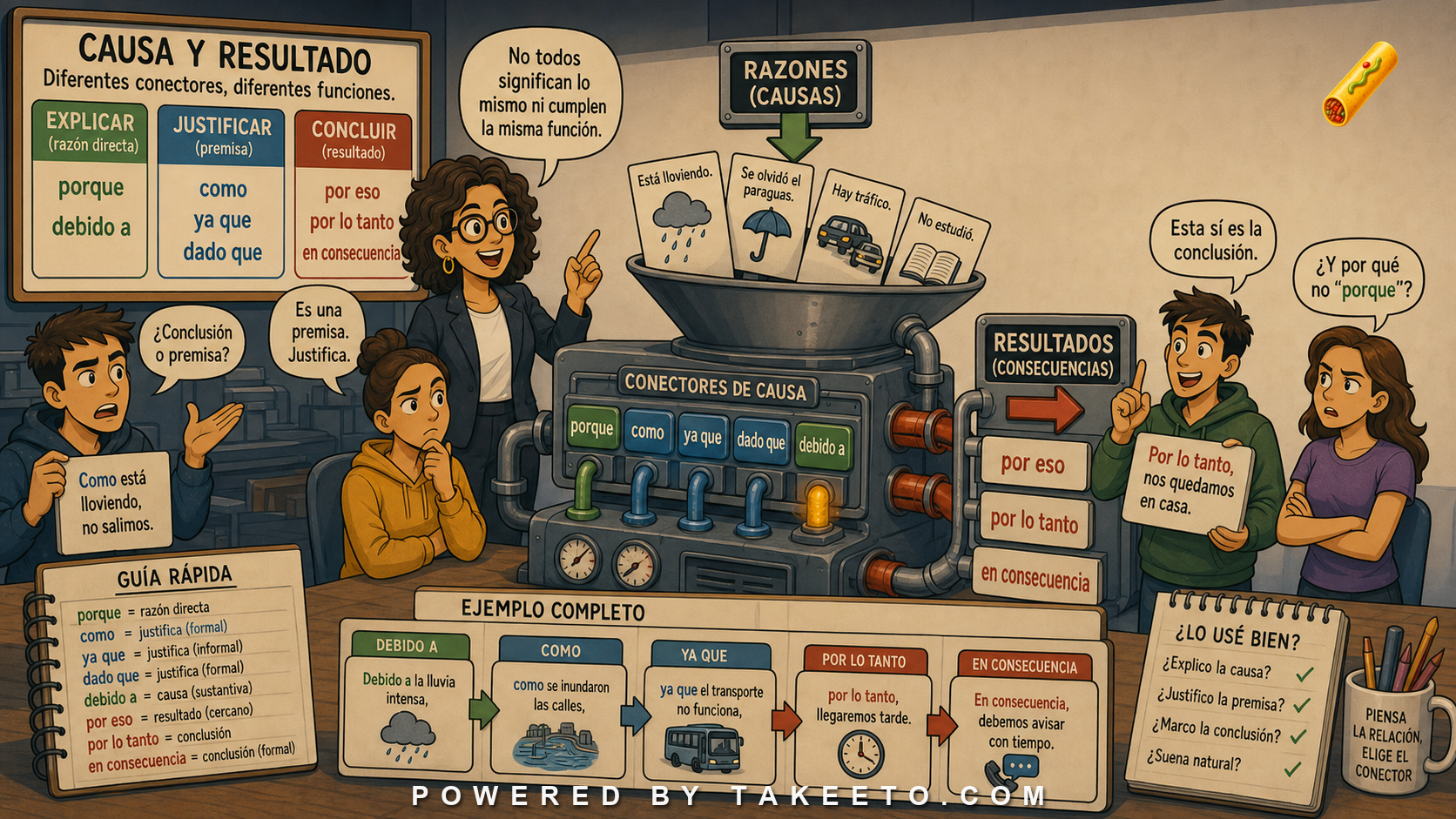
Cause is not one connector
Spanish learners often use porque for every causal relationship.
No fui porque estaba enfermo.
That sentence is fine. But Spanish has many ways to mark cause, reason, premise, consequence, and conclusion.
Compare:
No fui porque estaba enfermo.
Como estaba enfermo, no fui.
No fui, ya que estaba enfermo.
Debido a la enfermedad, no fui.
Estaba enfermo; por eso no fui.
Estaba enfermo; por lo tanto, no fui.
These are related, but they do not sound the same. They differ in order, register, logic, and emphasis.
The key principle is:
Cause connectors do not only connect facts. They tell the reader how to interpret the relationship.
Porque: direct reason
porque
Porque gives a reason or explanation.
Llegué tarde porque había mucho tráfico.
I arrived late because there was a lot of traffic.
It usually answers why.
Question:
¿Por qué llegaste tarde?
Answer:
Porque había mucho tráfico.
In writing, porque is clear and ordinary. It is not informal by itself, but in formal prose writers may choose ya que, dado que, puesto que, debido a, or causal noun phrases when the logic is more structured.
Como at the beginning: cause as background
como
When como begins a causal clause, it often presents the reason first as background information.
Como había mucho tráfico, llegué tarde.
Since there was a lot of traffic, I arrived late.
This is not the same como used for comparison:
Trabajo como profesor.
I work as a teacher.
Nor the question word cómo:
¿Cómo llegaste?
Causal como usually appears at the start of the sentence or clause:
Como no había datos suficientes, el análisis quedó incompleto.
Learner action:
At the beginning of a sentence, como + finite verb often means “since/because,” not “how.”
Ya que, dado que, puesto que
These connectors often sound more explanatory, formal, or argumentative than porque.
Ya que no hay consenso, conviene aplazar la votación.
Since there is no consensus, it is advisable to postpone the vote.
Dado que los resultados son preliminares, no se pueden sacar conclusiones definitivas.
Given that the results are preliminary, no definitive conclusions can be drawn.
Puesto que el plazo ha vencido, no se admitirán nuevas solicitudes.
Since the deadline has expired, no new applications will be accepted.
They are useful when the cause functions as a premise in an argument.
Debido a: noun-phrase cause
debido a
Debido a is followed by a noun phrase, not a full finite clause unless you use debido a que.
Debido a la lluvia, se canceló el evento.
Due to the rain, the event was canceled.
Debido a que llovía, se canceló el evento.
Because it was raining, the event was canceled.
Common error:
Debido a llovía, se canceló el evento.
Better:
Debido a la lluvia...
Debido a que llovía...
Related expressions:
a causa de
por motivo de
como consecuencia de
These are useful in administrative and formal writing.
Por eso, por lo tanto, en consecuencia
These mark result or conclusion.
Estaba enfermo; por eso no fui.
I was sick; that is why I did not go.
El plazo venció; por lo tanto, no se admitirán nuevas solicitudes.
The deadline expired; therefore, no new applications will be accepted.
La demanda aumentó. En consecuencia, se ampliará el servicio.
Demand increased. As a result, the service will be expanded.
Por eso is common and direct. Por lo tanto is more logical/formal. En consecuencia is common in formal prose and reports.
Cause versus conclusion
A common learner problem is confusing cause markers and result markers.
Cause:
No salí porque llovía.
Como llovía, no salí.
Debido a la lluvia, no salí.
Result:
Llovía; por eso no salí.
Llovía; por lo tanto, no salí.
Llovía. En consecuencia, no salí.
The facts are the same. The direction of the connector changes.
Punctuation
Formal connectors often need careful punctuation.
Como no había pruebas suficientes, el caso fue archivado.
Initial causal clause takes a comma.
El caso fue archivado porque no había pruebas suficientes.
No comma is usually needed before porque when the reason is integrated.
No había pruebas suficientes; por lo tanto, el caso fue archivado.
A semicolon or period before por lo tanto is often clearer than a comma splice in formal writing.
No había pruebas suficientes. En consecuencia, el caso fue archivado.
En consecuencia often begins a new sentence in formal prose.
Cause-result chain
Formal Spanish often builds chains:
Dado que la muestra es pequeña, los resultados deben interpretarse con cautela. Por lo tanto, no conviene generalizar las conclusiones a toda la población.
Structure:
- Dado que la muestra es pequeña = premise/cause.
- los resultados deben interpretarse con cautela = immediate conclusion.
- Por lo tanto = logical result.
- no conviene generalizar = recommendation.
A strong reader tracks these steps.
Example bank walkthrough
porque
Direct reason.
Learner action: use to answer why.
como
Causal when placed at the beginning before a finite verb.
Learner action: translate as since/because in sentences like como no había tiempo.
ya que
Explanatory cause or premise.
Learner action: useful in formal or reasoned prose.
dado que
Given that.
Learner action: use for explicit premises in arguments.
debido a
Due to + noun phrase.
Learner action: use debido a que before a full clause.
por eso
That is why / therefore in ordinary style.
Learner action: result marker, not cause marker.
por lo tanto
Therefore.
Learner action: use for logical conclusion.
en consecuencia
As a result/consequently.
Learner action: common in formal cause-result chains.
Cause-result argument mapper
When reading or writing a causal paragraph:
- Mark causes. porque, como, ya que, dado que, debido a.
- Mark results. por eso, por lo tanto, en consecuencia.
- Identify direction. Does the connector point backward to a cause or forward to a conclusion?
- Check register. conversational, academic, legal, administrative?
- Check grammar. debido a + noun; debido a que + clause.
- Check punctuation. initial clauses and formal connectors need structure.
- Avoid overconnecting. Not every sentence needs a connector.
- Make the reasoning explicit. Cause, evidence, consequence, recommendation.
Cause connectors have scope
A causal connector does not automatically explain the entire sentence. It has scope: the part of the argument it governs.
Compare:
No se aprobó la propuesta porque faltaban datos.
The reason for non-approval is missing data.
Now:
Porque faltaban datos, no se aprobó la propuesta.
The cause is placed first as background. The logic is similar, but the emphasis changes: the reader receives the reason before the result.
Now:
No se aprobó la propuesta, por lo tanto faltaban datos.
This is logically different and probably wrong unless the non-approval proves the missing data. Por lo tanto marks conclusion, not cause.
A common learner error is treating causal and result connectors as interchangeable. They are not.
Como at the beginning sets the reason as given
Como used causally usually appears at the beginning:
Como no había suficiente información, se aplazó la decisión.
This often presents the reason as background or already accepted. It is close to “since” or “because” at the beginning of an English sentence.
Putting causal como after the result is generally not the normal pattern:
Se aplazó la decisión como no había suficiente información.
Use porque in that position:
Se aplazó la decisión porque no había suficiente información.
This is a high-value distinction for learners because como is already overloaded: comparison, manner, approximation, and causal connector.
Multiple causes need hierarchy
Formal Spanish often stacks reasons:
Debido a la falta de datos, y dado que el plazo era insuficiente, el comité decidió aplazar la votación.
This is grammatical, but it may become heavy. A clearer version may separate the causes:
El comité decidió aplazar la votación por dos razones. Faltaban datos y el plazo era insuficiente.
Or:
Como faltaban datos y el plazo era insuficiente, el comité decidió aplazar la votación.
The revision depends on whether the prose needs legal density, academic explanation, or reader-friendly clarity.
Cause-result chains
A chain may contain several links:
La demanda aumentó. Por eso, subieron los precios. En consecuencia, muchas familias redujeron el consumo.
This is clear because each sentence marks a step. But a writer can overuse connectors:
La demanda aumentó, por eso, por lo tanto, en consecuencia, subieron los precios.
That is not stronger. It is cluttered.
Use one connector per logical link unless the genre requires extra explicitness.
Punctuation and connector weight
Light connectors often live inside clauses:
No fui porque estaba enfermo.
Heavier connectors often sit at sentence boundaries:
Estaba enfermo. Por eso, no fui.
Formal result connectors frequently need commas:
La información era insuficiente; por lo tanto, la decisión se aplazó.
La información era insuficiente. En consecuencia, la decisión se aplazó.
Punctuation helps readers see whether the text is giving a reason, drawing a conclusion, or adding a formal consequence.
Argument repair routine
When revising cause-result prose:
- Underline every causal connector.
- Label it as reason, background premise, result, or conclusion.
- Check whether the connector points in the right direction.
- Replace heavy connectors with simple ones when possible.
- Split long causal chains if the reader may lose the logic.
- Avoid stacking por eso, por lo tanto, and en consecuencia for the same relation.
- Make sure the evidence actually supports the conclusion.
Good Spanish argumentation is not connector decoration. It is logical architecture.
Translation trap: because, since, as
English “since” can mean time or cause. Spanish must choose.
Since 2020, the program has grown.
Spanish:
Desde 2020, el programa ha crecido.
But:
Since the program has grown, we need more staff.
Spanish:
Como el programa ha crecido, necesitamos más personal.
or:
Dado que el programa ha crecido, necesitamos más personal.
A learner who translates both as desde will produce a serious error. A learner who translates every causal “since” as porque may miss the backgrounding function of como or the formal tone of dado que.
The same caution applies in the other direction: como can mean “as,” “like,” “since,” or “I eat.” Translation begins with syntactic role.
Suggested interactive module: cause-result mapper
A strong tool for this article would visualize logic.
Suggested functions:
- Paragraph input: Dado que..., por lo tanto...
- Connector labels: cause, premise, result, conclusion.
- Direction arrows: reason → outcome.
- Grammar warnings: debido a + clause error.
- Register alternatives: porque → ya que → dado que.
- Punctuation suggestions: comma, semicolon, new sentence.
- Rewrite mode: conversational, academic, administrative.
Final rule
Spanish causal connectors do different jobs.
Porque gives a reason. Como backgrounds a cause. Ya que and dado que build premises. Debido a packages cause as a noun phrase. Por eso, por lo tanto, and en consecuencia move to result or conclusion.
Good Spanish argumentation is not just adding connectors. It is making the logic visible.