Gaming Spanish is multilingual by default
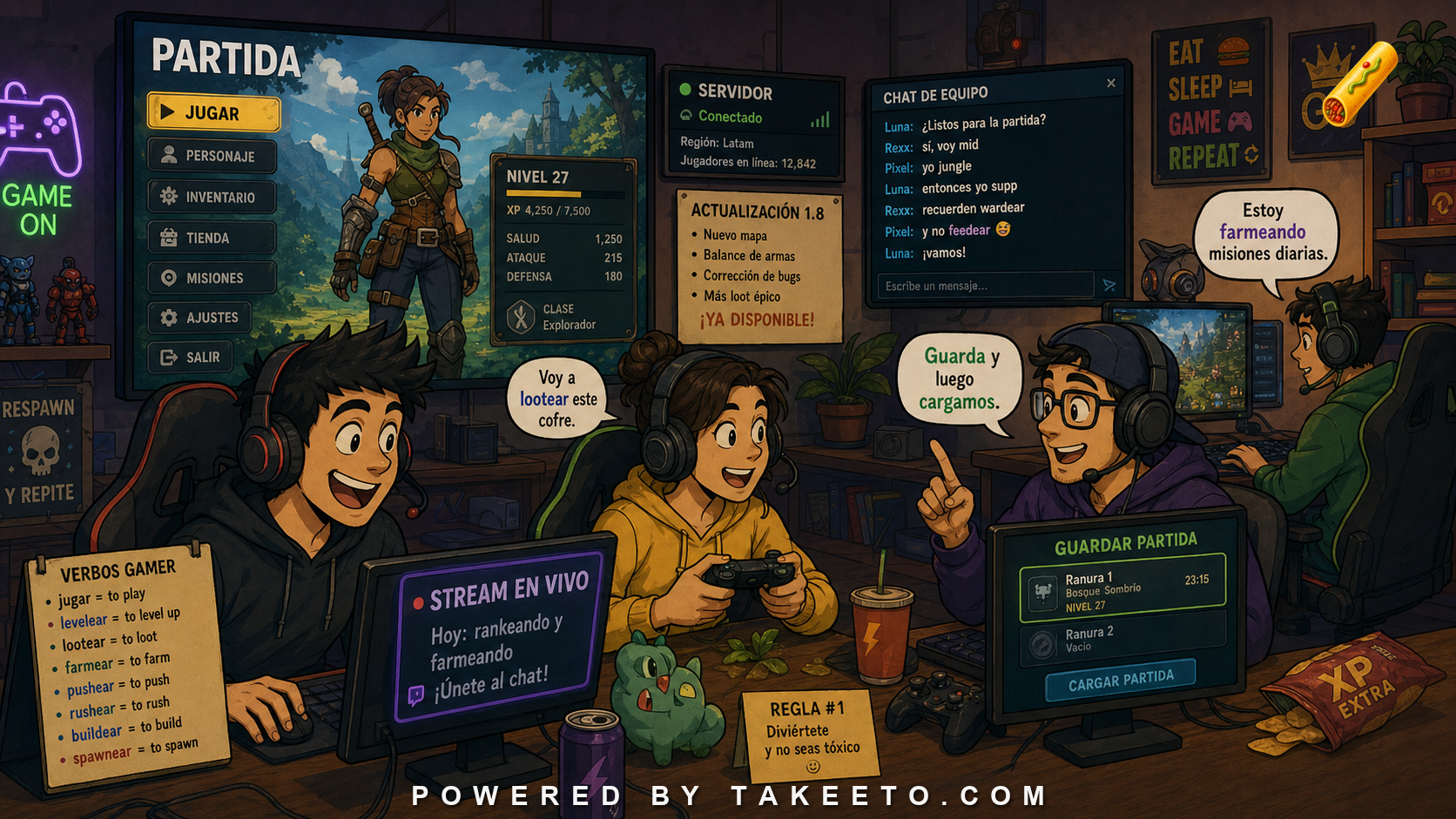
Spanish gaming language mixes localized interface Spanish, community slang, English borrowings, platform terminology, and genre-specific vocabulary. A game menu may say guardar partida, but players in chat may say farmear, lootear, rushear, or me banearon.
The key principle is:
Gaming Spanish has two layers: official localization and community speech. They overlap but are not the same.
Core gameplay terms
Basic vocabulary:
jugar
juego
partida
nivel
personaje
jugador
equipo
misión
mapa
enemigo
habilidad
objeto
Partida can mean match, game session, or saved game depending on context. Nivel can mean level of player, area, difficulty, or stage. Personaje is character. Habilidad is skill or ability.
Iniciar partida.
Start a game/match/session.
Interface verbs
Official Spanish localization uses verbs such as:
guardar
cargar
continuar
iniciar
salir
confirmar
cancelar
equipar
mejorar
desbloquear
actualizar
Guardar means save. Cargar can mean load, not only charge. Desbloquear means unlock. Actualizar means update.
Cargar partida guardada.
Load saved game.
Borrowed verbs with -ear
Community gaming Spanish frequently adapts English stems:
lootear
farmear
rushear
grindear
nerfear
bufear
banear
carrear
campear
These verbs conjugate as Spanish -ear verbs:
farmeo recursos
lo banearon
nos rushearon
están campeando
Some are accepted in communities but may be absent from formal localization. They belong to gamer speech.
Localization choices: Spain and Latin America
Games may have separate Spanish localizations or a more neutral Spanish. Differences can appear in:
- vosotros versus ustedes,
- item names,
- humor and idioms,
- swear words,
- voice acting accent,
- button labels,
- fantasy terminology.
A game localized for Spain may sound marked to Latin American players, and vice versa. A neutral localization may be clear but bland.
Servers, updates, and technical status
Common live-service terms:
servidor
conexión
latencia
ping
mantenimiento
actualización
parche
error
caída
cola
emparejamiento
Parche is patch/update. Mantenimiento means maintenance. Servidor caído means server down. Emparejamiento is matchmaking.
Los servidores estarán en mantenimiento.
Servers will be under maintenance.
Roles, builds, and community strategy
Common multiplayer terms:
tanque
sanador
soporte
daño
DPS
build
meta
rango
clasificatoria
casual
Some English terms remain unchanged: build, meta, DPS. Others are translated or adapted. Soporte can mean support role. Clasificatoria refers to ranked mode/match in many contexts.
Toxicity, moderation, and safety
Gaming communities also use moderation language:
reporte
denunciar
bloquear
silenciar
expulsar
banear
acoso
insultos
conducta inapropiada
Denunciar in platform context means report. It does not always mean file a legal complaint. Silenciar means mute. Bloquear means block.
Denunciar jugador.
Report player.
Volatile vocabulary strategy
Gaming vocabulary changes by title, genre, patch, streamer, and platform. Learners should prioritize stable interface Spanish first, then genre terms, then community slang.
Stable:
guardar, cargar, nivel, personaje, servidor, actualización.
Volatile/community:
lootear, farmear, nerfear, bufear, meta, tryhard.
Recognition should come before production.
Example bank walkthrough
Jugar: to play.
Partida: match/session/saved game depending on context.
Nivel: level.
Personaje: character.
Guardar: save.
Cargar: load.
Lootear: loot, community borrowing.
Farmear: farm/grind resources.
Actualización: update.
Servidor: server.
Gaming Spanish reading workflow
- Identify context: official UI, patch notes, chat, forum, stream.
- Separate localized Spanish from community slang.
- Identify genre: RPG, shooter, strategy, sports, mobile, MMO.
- Decode interface actions first.
- Watch borrowed -ear verbs.
- Identify technical status: server, update, maintenance, error.
- Note regional localization choices.
- Treat toxic language cautiously.
- Learn title-specific terms in context.
- Produce slang only after repeated exposure.
Before/after revision drill
Weak reading:
Save the game and charge the game.
Source Spanish:
Guarda la partida antes de cargar la actualización.
Better reading:
Save the game before loading/installing the update.
Gaming Spanish makes guardar and cargar central. Context decides whether cargar means load, charge, or carry. In a game interface, it usually means load.
Remediation: gaming Spanish has three layers that collide
Gaming Spanish is shaped by official localization, player communities, and English contact. These layers constantly collide.
Official UI: guardar, cargar, partida, ajustes, continuar, salir, servidor.
Patch-note/technical Spanish: se corrigió, se redujo, se aumentó, equilibrio, rendimiento, errores conocidos.
Community speech: lootear, farmear, rushear, nerfear, buffear, main, build, server, lag.
A learner who expects one clean vocabulary set will be frustrated. A game menu may use careful Spanish, while players in chat use English borrowings and local slang. Patch notes may sit in the middle: formal enough for documentation, but full of terms inherited from gaming communities.
Mini-workshop: one event in three registers
Game event: a weapon becomes weaker after an update.
Official patch note:
Se redujo el daño base del rifle de asalto para mejorar el equilibrio competitivo.
Community summary:
Nerfearon el rifle porque estaba rotísimo.
Support reply:
Entendemos sus comentarios sobre los cambios de balance y los compartiremos con el equipo correspondiente.
All three refer to the same event. The patch note uses se redujo, daño base, and equilibrio competitivo. The community uses nerfearon and rotísimo. Support uses institutional empathy and escalation language. A strong learner can move across layers without judging one as “real Spanish” and another as “wrong.”
Borrowed verbs obey Spanish grammar
Gaming verbs borrowed from English often take Spanish morphology:
farmear → farmeo, farmeas, farmeamos
lootear → looteé, lootearon, looteando
rushear → rusheamos, rushearon
nerfear → nerfeado, nerfearon
buffear → buffeado, buffearon
This makes them understandable even when they are informal. The grammar is Spanish; the root is borrowed. The question is register, not grammatical existence.
UI false friends
Gaming interfaces create false friends:
cargar partida = load game, not charge the match.
guardar = save, not guard physically.
salir = exit/quit.
ajustes/configuración = settings.
partida = match, session, or saved game depending on context.
personaje = character/avatar.
habilidad = ability/skill.
aspecto = skin/appearance in some UI contexts.
A player may say skin even when the official localization says aspecto. Both can be intelligible in different layers.
Before/after: localizing without sounding fake
Too literal from English:
El juego crasheó y necesito reclamar mi loot perdido.
More natural support Spanish:
El juego se cerró inesperadamente y perdí los objetos obtenidos durante la partida.
Community version:
Se me crasheó el juego y perdí el loot.
Neither version is universally better. The support version is clearer and more official. The community version sounds closer to player chat. The learner’s skill is choosing the right version.
Spain and Latin America localization choices
Game localization may differ by market:
ordenador / computadora / PC
mando / control
guardar / salvar, depending on product style
ajustes / configuración
partida / juego / match
doblaje / voces
subtítulos / textos
A neutral Spanish game may avoid regionally marked terms. A Spain-specific version may use mando and ordenador. A Latin American community may use control, compu, or English terms. Players often adapt official terms to local speech.
Gaming-reading workflow
When reading gaming Spanish, identify:
- Source: UI, patch note, support article, player chat, forum, stream.
- Layer: official localization, technical documentation, community slang.
- Action: save, load, equip, upgrade, attack, report, update.
- Object: item, weapon, character, ability, server, account.
- Status: blocked, banned, updated, fixed, nerfed, buffed, unavailable.
- Register safety: can you use this in support, or only in chat?
Gaming Spanish is useful because it shows Spanish absorbing English in real time. The goal is not purity. The goal is control.
Additional remediation drill: slow the document down
If this article still feels like vocabulary, turn one authentic-looking sentence into a four-line analysis before translating it. Write the original sentence. Then list the actor, the action, the object, and the condition or consequence. Only after that, produce a plain-language paraphrase.
This drill matters because domain Spanish often compresses too much into noun phrases. The learner sees familiar words and moves too quickly. Slowing the sentence down reveals whether the reader understands the document logic or only recognizes terms. For article 280, the safest practice is to treat each key term as a field in a larger system: who is acting, what status is changing, what evidence or condition controls the action, and what the reader should do with the information.
A useful production rule is: do not write a polished sentence until you can write a plain one. Plain Spanish is not inferior; it is the diagnostic layer that proves comprehension.
Suggested interactive module: gaming term adaptation map
A strong tool would show how terms move between English, localized Spanish, and community slang.
Suggested functions:
- Layer labels: UI, patch notes, chat, streamer speech.
- -ear verb conjugator: lootear, farmear, banear.
- Localization comparison: Spain, Latin America, neutral.
- Genre glossary: RPG, FPS, MMO, strategy.
- Volatility warning: stable term versus short-lived slang.
Mini-workshop: official UI versus player chat
Official UI:
Guardar partida.
Cargar partida.
Actualización disponible.
Servidores en mantenimiento.
Player chat:
Hay que farmear antes del boss.
Nos rushearon.
Ese personaje está nerfeado.
Me banearon la cuenta.
The first group is localization Spanish. The second group is community Spanish. A learner needs both for gaming, but they are not interchangeable. A polished game menu will usually not say everything the way players say it in chat.
Common learner mistakes
One mistake is translating cargar as charge when the game means load. Another is treating partida as one fixed thing. It can mean match, session, or saved game depending on genre and UI.
A third mistake is assuming all English-looking terms are sloppy. Borrowed verbs such as farmear and lootear often follow Spanish grammar cleanly. The issue is not whether they are “real”; the issue is whether they fit the context, community, and register.
Applied reading drill: compare UI, patch notes, and chat
The same game event can appear in three Spanish registers.
Interface:
Actualización disponible. Reinicie el juego para continuar.
Patch note:
Se redujo el daño del arma principal y se corrigieron errores de conexión.
Player chat:
Nerfearon el arma y el server sigue fatal.
The interface is direct and user-oriented. The patch note is technical and semi-formal. The chat message is community speech with nerfearon, server, and fatal. A learner who expects all three to use the same vocabulary will be confused.
Build your gaming vocabulary in layers. First learn stable UI actions: guardar, cargar, continuar, salir. Then learn patch-note verbs: reducir, corregir, mejorar, aumentar. Then learn community borrowings: nerfear, buffear, farmear, lootear. This order gives you both practical comprehension and social awareness.
Gaming Spanish is easiest when you stop asking which term is “the real Spanish” and start asking which layer you are reading.
Final rule
Gaming Spanish is not one register. Learn official interface Spanish for accuracy, community slang for comprehension, and borrowed verbs as Spanish grammar in motion. The best gamer Spanish is not the most English-heavy; it is the most context-aware.