Recipes are practical grammar lessons
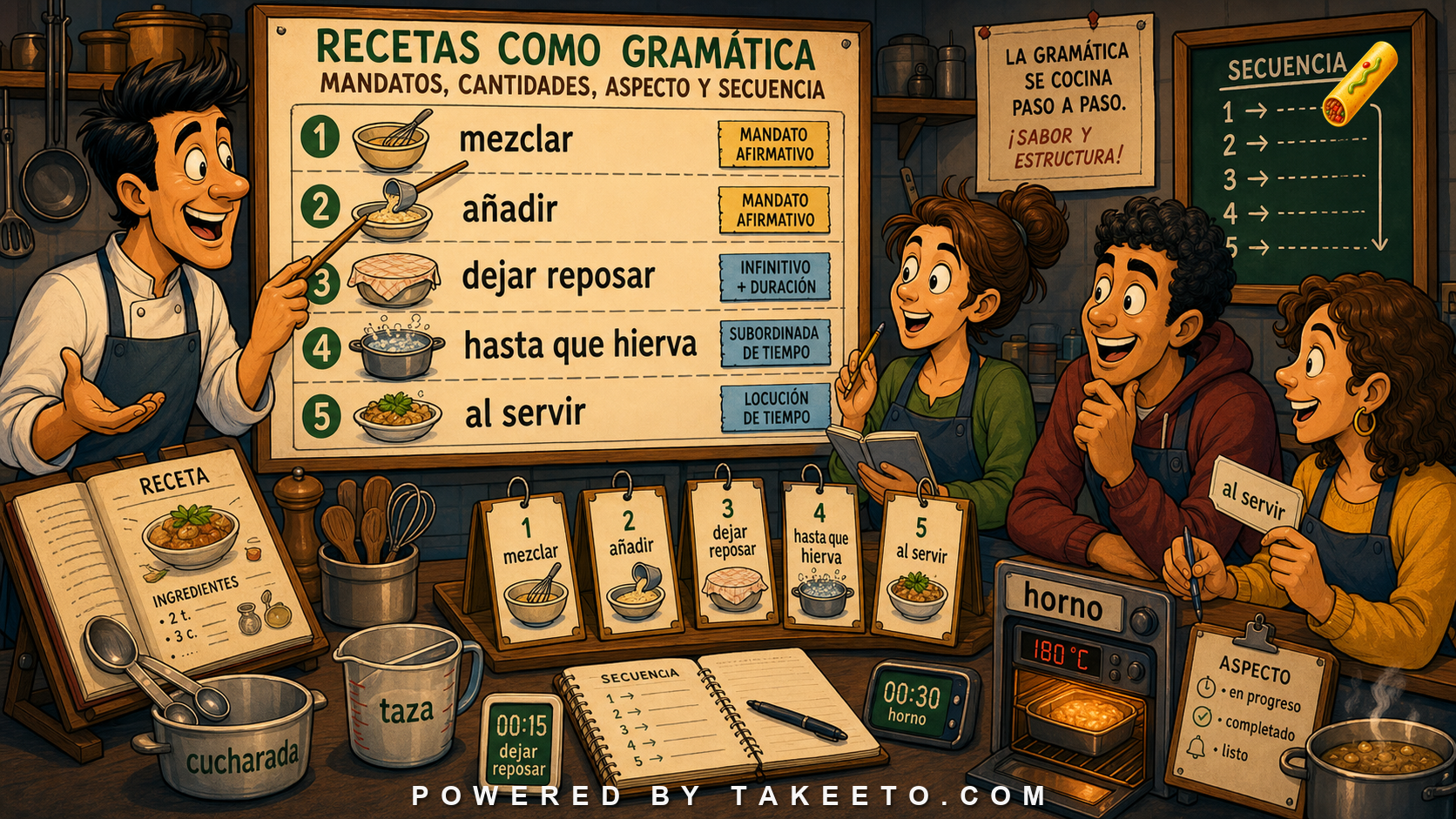
Recipes look simple because the context is concrete: ingredients, quantities, steps, heat, timing, and serving. But they are excellent grammar material. They use commands, infinitives, sequence markers, aspect, quantities, result clauses, and regional vocabulary.
Core expressions include:
mezclar
añadir
dejar reposar
hasta que hierva
al servir
cucharada
taza
horno
The key principle is:
Recipes teach how Spanish organizes actions toward a visible result.
A learner who studies recipes carefully gains more than food words. They see how Spanish gives instructions naturally.
Ingredient lists: nouns and quantities
Ingredient sections are compact noun phrases:
2 tazas de harina
2 cups of flour
1 cucharada de aceite
1 tablespoon of oil
1 cucharadita de sal
1 teaspoon of salt
3 dientes de ajo
3 cloves of garlic
500 g de tomate
500 g of tomato/tomatoes
al gusto
to taste
The structure is usually quantity + de + ingredient.
Learner action: notice measure words. A taza, cucharada, cucharadita, pizca, diente, rodaja, and manojo are not just vocabulary; they package food into usable units.
Infinitive recipe style
Many Spanish recipes use infinitives:
Mezclar la harina con la sal.
Mix the flour with the salt.
Añadir el agua poco a poco.
Add the water little by little.
Hornear durante 25 minutos.
Bake for 25 minutes.
This style is impersonal and efficient. It does not address the reader directly, but it functions as instruction.
Learners should not think every instruction requires an imperative form. Infinitive instructions are natural in recipes.
Imperative recipe style
Other recipes use commands:
Mezcla la harina con la sal.
Mix the flour with the salt. informal tú
Añada el agua poco a poco.
Add the water little by little. formal usted
Hornee durante 25 minutos.
Bake for 25 minutes. formal usted
Tú recipes can feel friendly and modern. Usted recipes can feel formal, traditional, or institutional. Infinitive recipes can feel neutral and compact.
Learner action: identify the style before copying phrases.
Sequence markers
Recipes are built from sequence:
primero
first
luego / después
then / afterward
a continuación
next
mientras tanto
meanwhile
finalmente
finally
antes de servir
before serving
Example:
Mientras tanto, calentar el aceite en una sartén.
Meanwhile, heat the oil in a pan.
Mientras tanto coordinates simultaneous work. Recipes teach time management through language.
Heat, equipment, and preparation verbs
Common verbs:
cortar
cut
picar
chop
pelar
peel
mezclar
mix
batir
beat/whisk
añadir / agregar
add
hervir
boil
freír
fry
hornear
bake
dejar reposar
let rest
Equipment:
horno
oven
sartén
frying pan
olla / cacerola
pot/saucepan
bol / tazón
bowl, depending on region
bandeja
tray
cuchillo
knife
Regional variation is common. A food term that is normal in Mexico may not be the default in Spain or Argentina.
Hasta que + subjunctive or indicative
Recipes often use hasta que:
Cocinar hasta que la salsa espese.
Cook until the sauce thickens.
Hervir hasta que el arroz esté tierno.
Boil until the rice is tender.
Why subjunctive? The thickening or tenderness is a future desired endpoint at the time of instruction. The cook has not reached it yet.
Compare a past narration:
Cociné la salsa hasta que espesó.
I cooked the sauce until it thickened.
In recipes, the goal is future relative to the instruction, so subjunctive is common.
Learner action: recipes make subjunctive practical. It marks the endpoint you are waiting for.
Al + infinitive
Al + infinitive means “upon/when doing.”
Examples:
Al servir, añadir cilantro fresco.
When serving, add fresh cilantro.
Al retirar del horno, dejar reposar diez minutos.
Upon removing from the oven, let rest ten minutes.
This structure is compact and common in instructions.
Dejar reposar and aspect
Dejar + infinitive is powerful in recipes:
dejar reposar
let rest
dejar enfriar
let cool
dejar hervir
let boil
dejar cocinar
let cook
It marks controlled waiting. The cook is still managing the process even while not actively stirring or cutting.
Example:
Dejar reposar la masa durante 30 minutos.
Let the dough rest for 30 minutes.
Regional ingredient names
Spanish food vocabulary varies widely:
maíz / elote / choclo
corn, depending on region/context
aguacate / palta
avocado
judías / frijoles / porotos / alubias
beans, depending on region
patata / papa
potato
calabacín / zucchini / zapallito
zucchini/squash, depending on region
Recipes are regional documents. They reveal food culture, not just grammar.
Example bank walkthrough
mezclar
Mix.
Learner action: note whether it appears as infinitive, tú command, or usted command.
añadir
Add.
Learner action: compare with agregar; both are common, with regional and stylistic variation.
dejar reposar
Let rest.
Learner action: recognize waiting as an instruction.
hasta que hierva
Until it boils.
Learner action: notice subjunctive for future endpoint.
al servir
When serving.
Learner action: learn al + infinitive as a compact time expression.
cucharada and taza
Tablespoon and cup.
Learner action: treat measurement words as grammar of quantity.
horno
Oven.
Learner action: connect with hornear and precalentar.
Recipe grammar annotation routine
- Identify instruction style: infinitive, tú, usted.
- Mark quantities and measure words.
- Circle sequence markers.
- Underline cooking verbs.
- Mark equipment vocabulary.
- Find hasta que clauses.
- Find al + infinitive phrases.
- Note regional ingredient names.
- Rewrite one recipe in another instruction style.
- Practice explaining the steps aloud.
Remediation: recipes are not just vocabulary lists
Recipes teach grammar because they organize action over time. The verbs are not random cooking words; they encode sequence, aspect, temperature, texture, and completion.
Important recipe verbs include:
mezclar
mix
añadir / agregar / incorporar
add/incorporate
batir
beat/whisk
hervir
boil
cocer / cocinar
cook, with regional variation
sofreír / saltear
sauté
hornear
bake
dejar reposar
let rest
colar
strain
sazonar
season
But the grammar around them matters just as much.
Hasta que: result-based timing
Recipes often use hasta que to mark a condition, not a clock time.
Cocine hasta que la salsa espese.
Cook until the sauce thickens.
Hornee hasta que la superficie esté dorada.
Bake until the surface is golden.
Bata hasta que la mezcla quede homogénea.
Beat until the mixture becomes smooth/uniform.
The subjunctive is common when the desired result is not yet achieved at the time of instruction. The learner should understand the practical function: continue the action until the named condition appears.
A recipe may also give both time and condition:
Hornee durante 25 minutos o hasta que al insertar un palillo este salga limpio.
The condition may matter more than the approximate time because ovens, altitude, pan size, and ingredient temperature vary.
Al + infinitive: action timing
Al + infinitive means “upon/when doing.”
Al servir, añada cilantro fresco.
When serving, add fresh cilantro.
Al retirar del horno, deje reposar diez minutos.
After removing from the oven, let it rest for ten minutes.
This structure is useful because recipes often compress timing relationships without full subordinate clauses.
Mini-workshop: annotate recipe grammar
Sentence:
Añada el caldo poco a poco, sin dejar de mezclar, hasta que el arroz absorba el líquido.
Main action:
añada el caldo
Manner:
poco a poco
Simultaneous action:
sin dejar de mezclar
Endpoint condition:
hasta que el arroz absorba el líquido
Plain reading:
Add the broth gradually, while continuing to stir, until the rice absorbs the liquid.
A learner who translates word-by-word may miss the simultaneity of sin dejar de mezclar.
Regional ingredient and measurement cautions
Recipe Spanish varies heavily:
frijoles / alubias / judías / porotos
beans
elote / maíz / choclo
corn, with regional distinctions
calabacín / zucchini / zapallito
zucchini/courgette
papa / patata
potato
ají / chile / guindilla
chili pepper, depending on region
Measurements also vary:
cucharada
tablespoon
cucharadita
teaspoon
taza
cup, but exact size may vary
pizca
pinch
For cooking, approximation may be acceptable. For baking, precision matters more. The remediation rule is to treat recipes as regional documents, not universal Spanish.
Mood practice with hasta que
Recipes give learners a practical way to notice mood without abstract fear. Compare:
Cocine la salsa hasta que espese.
Cook the sauce until it thickens.
The thickening is an expected future endpoint at the moment of instruction, so the subjunctive espese is natural.
Now compare a descriptive sentence:
Cociné la salsa hasta que espesó.
I cooked the sauce until it thickened.
Here the action already happened, so indicative espesó is natural. The recipe form tells someone what to do; the narrative form reports what happened.
Learners can practice with pairs:
Hornear hasta que esté dorado. / Horneé hasta que estuvo dorado.
Batir hasta que la mezcla quede suave. / Batí hasta que la mezcla quedó suave.
The goal is not to memorize a slogan. The goal is to connect grammar to time and viewpoint.
Doneness words are cultural and sensory
Recipes often rely on sensory judgment:
dorado, tierno, crujiente, jugoso, espeso, homogéneo, al dente
These words are not exact measurements, but they are not vague either. They name a target state. A learner should connect each adjective to a visible or tactile condition. Dorado refers to color; tierno to texture; homogéneo to uniform mixture; al dente to resistance when bitten.
This is why recipe Spanish is excellent for building grounded vocabulary: verbs, quantities, time, heat, texture, and result all appear together.
Additional remediation: doneness and texture vocabulary
Recipes often rely on result adjectives that do not translate neatly word by word:
dorado — golden/browned
tierno — tender
crujiente — crispy/crunchy
jugoso — juicy
espeso — thick
homogéneo — smooth/uniform
grumos — lumps
al dente — firm to the bite
These words tell the cook when the process has succeeded. They are grammar targets because they appear after hasta que, quedar, estar, dejar, and ponerse.
Examples:
Cocine hasta que las verduras estén tiernas.
Mezcle hasta obtener una masa homogénea.
Hornee hasta que la superficie quede dorada.
Aspect: dejar, volver, and seguir
Cooking Spanish uses aspectual verbs constantly:
dejar reposar — let rest
volver a calentar — reheat
seguir batiendo — keep beating/whisking
terminar de cocer — finish cooking
These verbs describe process management rather than ingredients. A learner who studies only nouns misses much of recipe comprehension.
Order matters
Añadir, incorporar, verter, and mezclar can imply different handling. Incorporar often suggests adding gently or integrating into a mixture, while verter means pour. A good recipe reader tracks not only what is added, but how.
Quantities, containers, and texture targets
Recipe Spanish often uses container and portion words that are only approximate unless the recipe defines them:
una taza de harina
a cup of flour
una cucharada de aceite
a tablespoon of oil
un diente de ajo
a clove of garlic
una pizca de sal
a pinch of salt
un chorrito de vinagre
a small splash of vinegar
The grammar is usually quantity + de + ingredient. Texture targets are often adjectives or participles:
hasta obtener una masa suave
until you get a smooth dough
hasta que esté dorado
until it is golden
hasta que quede cremoso
until it becomes creamy
These phrases teach more than cooking vocabulary. They train result-based reading. The recipe does not merely say “cook for X minutes.” It says what the food should become.
Imperative choice and audience
A recipe blog may use tú:
Mezcla los ingredientes.
A formal cookbook may use usted or infinitive:
Mezcle los ingredientes.
Mezclar los ingredientes.
A brand package may prefer concise infinitives because they save space:
Añadir agua. Mezclar. Hornear.
The learner should notice the chosen voice and not randomly switch halfway through a recipe adaptation.
Suggested interactive module: recipe grammar annotator
A strong tool for this article would turn recipes into grammar practice.
Suggested functions:
- Verb-style tagger: infinitive, tú command, usted command.
- Quantity parser: taza, cucharada, pizca, gramos.
- Sequence mapper: first, meanwhile, finally.
- Subjunctive detector: hasta que hierva, hasta que esté.
- Regional glossary: ingredient variants by country.
- Style converter: infinitive recipe → tú/usted commands.
- Timeline visualizer: prep, cook, rest, serve.
Final rule
Recipes are excellent Spanish grammar because every structure has a visible purpose.
They teach commands, infinitives, quantities, sequence, endpoints, waiting, and regional vocabulary. Study them not only to cook, but to see Spanish organizing action.
A recipe is grammar you can taste.