
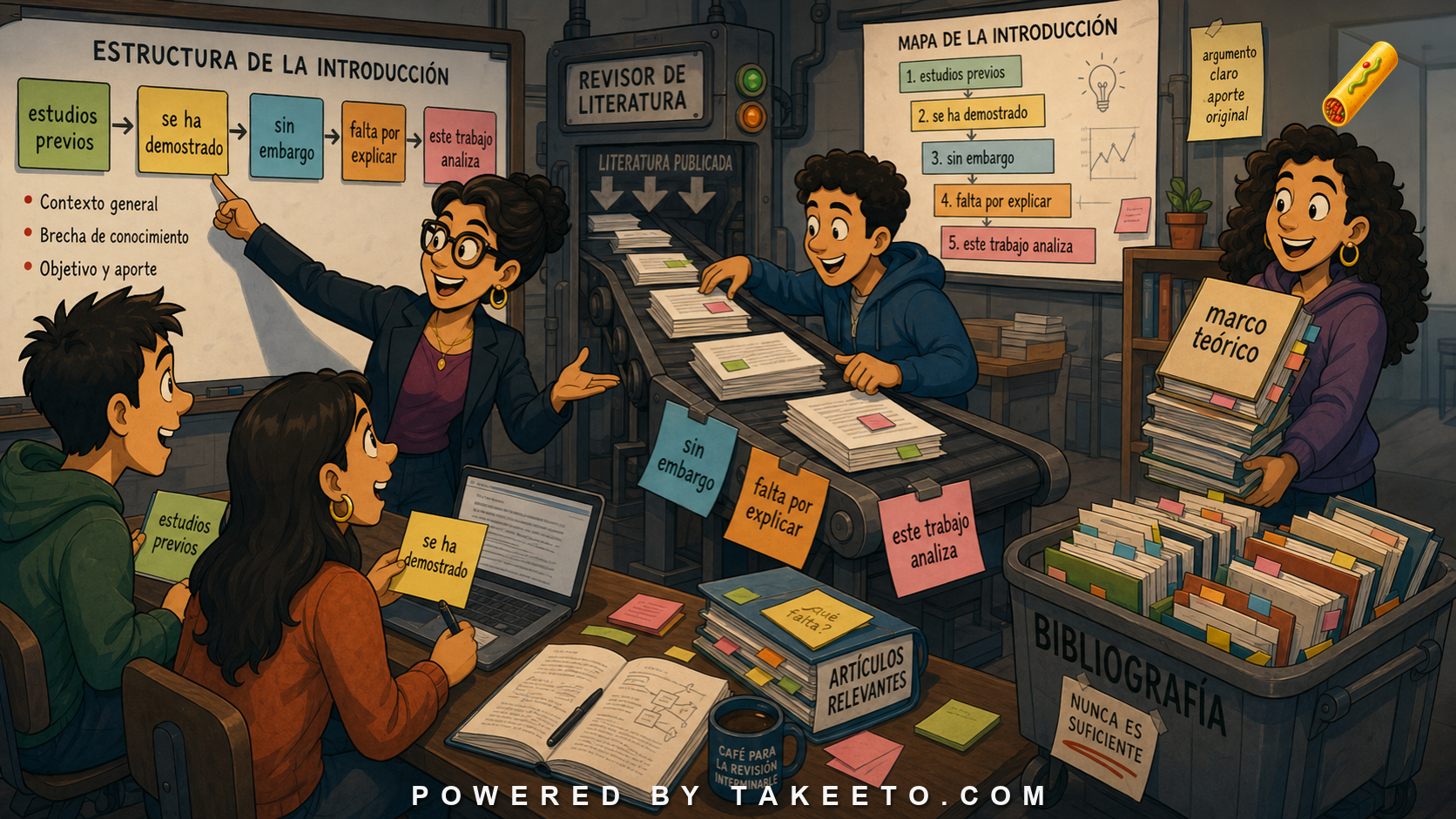
Introductions build a research problem
A Spanish research article introduction is not simply a polite beginning. It builds a scholarly situation. It tells the reader what problem matters, what others have said, what remains unresolved, and what the current article will do.
The key principle is:
Academic introductions create a space for the article by connecting prior work, gap, objective, and structure.
If you read only for topic vocabulary, you may miss the rhetorical architecture. A good introduction often performs these moves:
- Establish field or problem.
- Review prior research.
- Identify limitation, gap, debate, or unresolved question.
- State objective or hypothesis.
- Explain method/material.
- Preview article structure.
Establishing the field
Introductions often begin broadly.
Common frames:
En las últimas décadas, el estudio de... ha cobrado especial relevancia.
In recent decades, the study of... has become especially relevant.
La relación entre X e Y ha sido objeto de numerosos estudios.
The relationship between X and Y has been the subject of numerous studies.
El análisis de X permite comprender...
The analysis of X makes it possible to understand...
This kind of sentence is not a conclusion. It creates the field.
Learners should watch for broad nouns:
fenómeno — phenomenon
problemática — problem area
debate — debate
cuestión — issue/question
campo — field
enfoque — approach
Prior research: estudios previos
Literature reviews cite previous work and organize it.
Common phrases:
estudios previos
investigaciones anteriores
la bibliografía especializada
la literatura existente
diversos autores han señalado
se ha demostrado que
se ha observado que
Example:
Estudios previos han señalado la importancia de los marcadores discursivos en la organización de la interacción oral.
Previous studies have noted the importance of discourse markers in organizing spoken interaction.
Se ha demostrado is stronger than se ha sugerido. It implies a finding has been established. A careful reader tracks strength.
Claim-strength ladder:
se ha sugerido — it has been suggested
se ha observado — it has been observed
se ha señalado — it has been pointed out
se ha demostrado — it has been demonstrated
se ha confirmado — it has been confirmed
Citation verbs
Academic Spanish uses verbs to position sources.
afirmar — to state/assert
sostener — to maintain/argue
señalar — to point out
advertir — to warn/note
proponer — to propose
demostrar — to demonstrate
cuestionar — to question
destacar — to highlight
analizar — to analyze
Example:
García sostiene que la cortesía no puede analizarse sin atender al contexto institucional.
García maintains that politeness cannot be analyzed without attention to institutional context.
Sostener is not physical holding here; it is intellectual position.
A literature review is not just a list of names. Verbs show how each source enters the argument.
Tense choices
Spanish literature reviews use tense strategically.
Present:
García sostiene que...
García argues/maintains that...
Present perfect:
Diversos estudios han demostrado que...
Various studies have shown that...
Preterite:
En 2015, López analizó...
In 2015, López analyzed...
Imperfect may describe ongoing context or historical background:
En ese momento, la investigación se centraba en...
At that time, research focused on...
Learners should not treat tense as random. Present often frames a source’s claim as currently relevant; preterite locates a specific study as a past action; present perfect builds a research tradition up to now.
The gap: sin embargo, falta por explicar
The gap is the point where the introduction shifts from what is known to what remains open.
Common phrases:
sin embargo
no obstante
pese a estos avances
todavía falta por explicar
se ha prestado poca atención a
son escasos los estudios sobre
queda por determinar
no se ha analizado suficientemente
Example:
Sin embargo, se ha prestado poca atención al uso de estos marcadores en interacciones digitales.
However, little attention has been paid to the use of these markers in digital interactions.
This is a crucial sentence. It creates the need for the article.
A weak gap attacks prior research vaguely:
Nadie ha estudiado este tema.
A stronger gap is precise:
Aunque existen estudios sobre la cortesía en conversaciones presenciales, son escasos los trabajos que analizan la mitigación en comentarios de plataformas educativas.
Stating the article’s objective
Once the gap exists, the article states its work.
Common frames:
Este trabajo analiza...
El presente artículo examina...
En este estudio se propone...
Nuestro objetivo es...
A partir de X, se busca determinar...
Example:
Este trabajo analiza las estrategias de reformulación en textos administrativos dirigidos a ciudadanos.
This paper analyzes reformulation strategies in administrative texts addressed to citizens.
Este trabajo refers to the article/study, not the author’s job.
Marco teórico
Marco teórico means theoretical framework. It tells the reader what concepts, theories, or models guide the analysis.
Related terms:
marco conceptual — conceptual framework
enfoque teórico — theoretical approach
perspectiva — perspective
categoría de análisis — analytical category
modelo — model
Example:
El análisis se apoya en un marco teórico pragmático-discursivo.
The analysis is based on a pragmatic-discursive theoretical framework.
A learner should not skip this section as “abstract theory.” It often defines how the article will use key terms.
Article-structure previews
Introductions often end by previewing structure.
Examples:
El artículo se organiza de la siguiente manera.
The article is organized as follows.
En primer lugar, se presenta el marco teórico. A continuación, se describe la metodología. Finalmente, se analizan los resultados.
First, the theoretical framework is presented. Next, the methodology is described. Finally, the results are analyzed.
These previews are reading aids. Use them to build a map before entering the article.
Paragraph annotation model
Consider this invented academic paragraph:
La relación entre lenguaje administrativo y comprensión ciudadana ha sido objeto de creciente interés en los estudios de comunicación pública. Investigaciones previas han mostrado que la densidad nominal y el uso de estructuras impersonales dificultan la lectura de documentos oficiales. Sin embargo, se ha prestado menos atención a las estrategias de reformulación dentro de esos mismos textos. Este trabajo analiza el uso de marcadores como es decir, esto es y en otras palabras en un corpus de resoluciones administrativas.
Annotation:
- Field: language administration and citizen comprehension.
- Prior research: nominal density and impersonal structures create difficulty.
- Gap: less attention to reformulation strategies.
- Objective/data: analyze markers in a corpus of administrative decisions.
That is the introduction move-set in miniature.
Example bank walkthrough
estudios previos
Previous studies.
Learner action: identify what research tradition the article invokes.
se ha demostrado
It has been demonstrated/shown.
Learner action: treat as a strong claim; look for citation or evidence.
este trabajo analiza
This paper analyzes.
Learner action: find the object of analysis and method.
sin embargo
However.
Learner action: watch for the gap or contrast after it.
falta por explicar
Remains to be explained.
Learner action: identify the unresolved question.
marco teórico
Theoretical framework.
Learner action: read definitions carefully; they control the analysis.
Research-introduction reading workflow
When reading a Spanish research article introduction:
- Highlight the broad field.
- Mark prior-research phrases.
- List cited claims and their verbs.
- Find the gap sentence. Look for sin embargo, no obstante, falta, escaso.
- Find the objective sentence. Look for este trabajo, este artículo, se analiza.
- Identify data/corpus and method if stated.
- Read the theoretical framework for definitions.
- Use the structure preview as a map.
- Track claim strength: sugiere vs demuestra.
Remediation: identify the research move before translating the sentence
Spanish research introductions are built from rhetorical moves. If the learner translates line by line without identifying the move, the text can feel like a pile of cautious phrases. A stronger reader asks what the paragraph is doing.
Common introduction moves:
establecer el campo — define the broad area.
mostrar importancia — explain why the topic matters.
resumir estudios previos — place earlier research.
marcar un vacío — identify what remains unresolved.
formular objetivo — state what this article does.
anticipar estructura — tell how the article is organized.
Example:
En los últimos años, diversos estudios han analizado la adquisición del subjuntivo en aprendientes adultos. Sin embargo, se ha prestado menos atención a su uso en textos argumentativos producidos fuera del aula. Este artículo examina ese problema a partir de un corpus de ensayos universitarios.
Move labels:
prior research → gap → objective/corpus
Once labeled, the paragraph becomes simple. Without labels, diversos, sin embargo, se ha prestado menos atención, and este artículo examina may feel like generic academic fog.
Citation verbs and stance
Literature reviews do not merely list names. They position sources. Spanish citation verbs encode stance.
Neutral or descriptive:
analiza, examina, describe, estudia, presenta.
Evidence-oriented:
demuestra, muestra, documenta, identifica, confirma.
Cautious:
sugiere, plantea, propone, apunta, observa.
Critical or contrastive:
cuestiona, matiza, problematiza, discute, revisa.
Do not translate all of these as “says.” A literature review that says García demuestra gives García stronger evidential authority than García sugiere. A sentence that says López cuestiona places López in debate with prior claims. This matters when reconstructing the intellectual map.
Mini-workshop: find the gap
Read this paragraph:
La mayoría de los trabajos sobre retroalimentación correctiva se ha centrado en la interacción oral en el aula. Aunque estos estudios han permitido describir varios tipos de corrección, todavía falta explicar cómo los estudiantes interpretan los comentarios escritos cuando revisan sus textos de manera autónoma.
The gap is not “feedback exists.” It is:
how students interpret written comments during independent revision.
The paragraph narrows the field:
corrective feedback → oral classroom interaction → existing descriptions → missing explanation of written comments in autonomous revision.
This is the kind of narrowing learners must learn to see. In Spanish, gap phrases include:
falta por explicar, apenas se ha estudiado, son escasos los trabajos, no se ha prestado suficiente atención, queda por determinar, sigue siendo necesario.
These phrases are structural signals. When they appear, the article is preparing its contribution.
Tense choices in literature review
Spanish literature reviews often alternate between present perfect, preterite, and present.
Se ha demostrado que...
Pérez analizó...
Este enfoque permite...
The pretérito often refers to a completed study by a specific researcher. The pretérito perfecto compuesto or passive-like construction can summarize a line of research, especially in varieties where this tense is common. The present can state accepted knowledge, describe the content of a source, or make the current article’s move.
Do not force English tense habits onto Spanish. More important than tense label is rhetorical function: individual study, accumulated research, established concept, current argument.
Writing remediation: avoid “name dumping”
Weak literature review:
García habla del subjuntivo. López habla de la enseñanza. Martínez habla de estudiantes adultos.
Better:
García describe los errores más frecuentes en subordinadas sustantivas, mientras que López se centra en la intervención pedagógica. Sin embargo, ambos trabajos dejan fuera la producción escrita de estudiantes adultos en contextos profesionales.
The improved version groups sources by function and uses contrast to create a gap. A Takeeto tool could ask learners to drag citations into categories: background, method model, evidence, disagreement, gap, or theoretical frame. That would teach literature review as architecture instead of bibliography.
Suggested interactive module: literature-review move mapper
A strong tool for this article would annotate introduction moves.
Suggested functions:
- Move labels: field, prior work, gap, objective, method, structure.
- Citation-verb highlighter: señala, sostiene, demuestra, cuestiona.
- Gap detector: sin embargo, poco estudiado, falta por.
- Tense explanation: present, preterite, present perfect in citation context.
- Framework glossary: marco teórico terms and definitions.
- Reverse outline: generate article map from introduction.
Final rule
Spanish research introductions are engineered, not decorative.
Find prior work, citation verbs, gap language, objective statements, theoretical framework, and structure preview. When you can see those moves, a dense article becomes navigable. You no longer read academic Spanish as a wall of formal sentences; you read it as a sequence of scholarly actions.